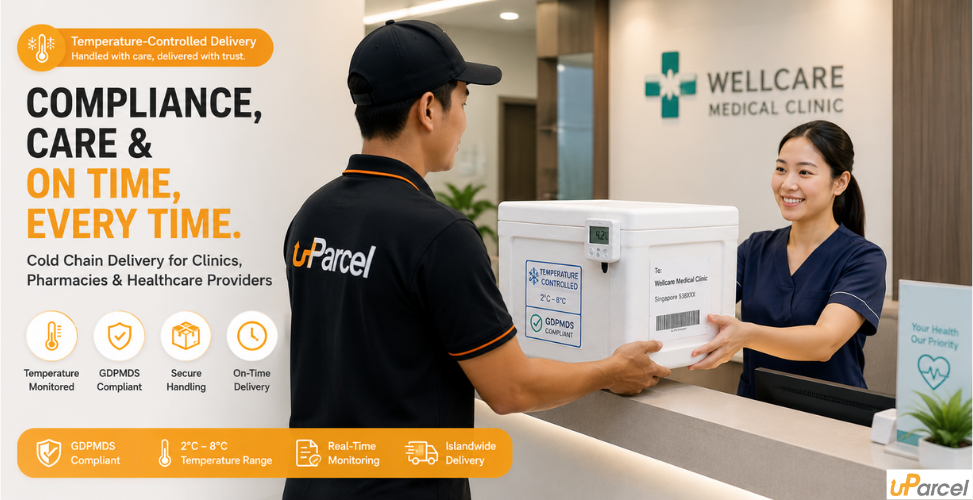
uParcel offers temperature-controlled medical logistics across Singapore

Er Cai Fang
Senior Product Manager
How uParcel delivers GDPMDS-certified, temperature-controlled medical logistics across Singapore from product qualification to proof of delivery.
A temperature-sensitive healthcare shipment can look perfectly normal at handoff and still become unusable by the time it reaches a clinic, pharmacy, laboratory, or patient. Cold chain delivery for healthcare is not simply refrigerated transport, it is a controlled operating system that protects products, records handling conditions, and gives teams enough visibility to intervene before a delay turns into waste, risk, or a missed treatment window.
For healthcare distributors and operations teams, the commercial stakes are clear: product loss raises replacement costs, delivery uncertainty creates service failures, and missing records make audits harder. This guide covers what a reliable cold chain actually has to control, the workflow that prevents avoidable excursions, and what to look for in a temperature-controlled medical logistics partner in Singapore.
What Cold Chain Delivery for Healthcare Must Control
Cold-chain performance begins before a driver is assigned. The required temperature range, allowable excursion time, packaging validation, route duration, recipient availability, and hand off procedure must all be defined for each product class. A chilled diagnostic kit, a biologic medicine, and a clinical sample may all need temperature control, but they do not necessarily require the same packaging, monitoring method, or urgency.
That distinction matters. Over engineering every shipment makes the service unnecessarily expensive; under engineering it leaves too much exposure to traffic, failed delivery attempts, building access restrictions, and ambient heat. The goal is applying the right level of control to the product and the delivery lane not treating every shipment identically.
A reliable healthcare cold chain manages four connected conditions:
-
Temperature — the stated range the product must remain within
-
Time — both the planned journey and the maximum exposure permitted outside controlled storage
-
Custody — who handled the item at every stage
-
Evidence — temperature records, dispatch data, delivery confirmation, and exception notes
When one condition is treated separately from the others, gaps appear. A vehicle may be temperature-capable, but a late recipient can extend the journey beyond the packaging design. A signed proof of delivery may confirm arrival without explaining whether a temperature alarm occurred en route. Healthcare logistics needs the full picture, not one metric standing in for the whole system.
The Delivery Workflow That Prevents Avoidable Excursions
The strongest cold-chain programs are built around process discipline, not a last-minute request for a refrigerated vehicle.
Qualify the Product and the Lane
Each SKU should carry clear handling instructions temperature range, sensitivity to delay, approved packaging, required monitoring, and any special delivery condition visible in the warehouse and order management workflow, not held in a separate spreadsheet staff may miss during a busy dispatch period.
Lane qualification matters just as much. A recurring same-day route from a warehouse to a hospital is different from an on-demand delivery to a residential address. Travel time by time of day, pickup and receiving windows, security procedures, elevator access, and whether the recipient can accept the shipment immediately all affect the outcome, a lane that works at 10 a.m. may be a poor fit during evening congestion. For recurring healthcare distribution, route history helps teams set realistic cutoffs and identify locations that frequently cause delays.
Pack for the Real Journey, Not the Ideal One
Packaging must protect the product through expected handling and credible exceptions waiting at pickup, loading, traffic, unloading, security checks, and a short delay at the receiving point. More insulation and refrigerant extends protection but adds weight, cost, and preparation time, and some products need protection from freezing, not just heat.
Packaging decisions should follow the product specification, not a generic "cold shipment" label. A pre-dispatch checklist, package condition, labels, documentation, seal requirements, monitoring device status prevents costly errors when multiple temperature bands leave the same facility.
Visibility and Evidence: Tracking a Shipment and Proving It Arrived Intact
Live delivery tracking is useful, but healthcare operations need milestone visibility: pickup completed, vehicle departed, delivery approaching, recipient notified, delivery completed, or exception raised. Active recipient notifications reduce failed handoffs by ensuring the receiving team is ready before the driver arrives.
For higher-risk shipments, temperature monitoring and exception alerts add a further control point and the response plan matters as much as the alert itself. Who assesses the event? Can the shipment continue, or does it need to return to controlled storage? Who informs the customer or quality team? These decisions need to be defined before the first exception occurs, not during it.
Delivery confirmation should capture more than a completed timestamp. Depending on the shipment, the record may include recipient name, signature or photo proof, location, time, temperature data, and hand off remarks accessible without a manual chase across email threads and driver chat groups. For distributors managing recurring deliveries across clinics, laboratories, pharmacies, and corporate sites, a traceable record supports internal quality reviews, customer inquiries, and audit preparation, per HSA's guidance documents for medical devices.
Where Healthcare Cold Chains Commonly Fail
The most expensive failures are often operationally ordinary: a driver arrives during a clinic's closed receiving window, the recipient isn't notified, a shipment waits too long at an uncontrolled staging area, or an address is technically accurate but missing a floor, department, or contact name.
Fragmented systems make these problems harder to catch. If inventory, order intake, fulfillment, and last-mile delivery sit in separate tools, staff may not see a stock issue, an urgent order note, or a failed delivery attempt until it's too late, a connected workflow reduces hand-offs and creates one source of truth from order release through delivery completion. Capacity planning is another frequent pressure point: healthcare demand can spike after a campaign launch, replenishment cycle, or supplier delay, and a provider that handles routine deliveries but can't scale quickly forces teams into expensive ad hoc arrangements.
Choosing a Healthcare Cold-Chain Partner in Singapore
The right partner should be evaluated on operating controls, not vehicle photos. Ask how temperature requirements are translated into order instructions, how drivers receive special handling details, how exceptions are escalated, what delivery evidence is retained, and whether that data integrates with existing order or inventory systems. It also helps to separate capability from fit, a provider may have cold-chain equipment but lack the fulfillment process to pick, pack, stage, and dispatch healthcare orders reliably.
uParcel runs its temperature-controlled medical logistics against exactly this set of controls. Deliveries move in cooler boxes purpose-built to hold products within 2°C–8°C throughout transit, with real-time tracking and temperature monitoring visible to both operations teams and recipients.
The service is GDPMDS-certified, aligning with Singapore's Good Distribution Practice standard for medical devices, and covers collection through to last-mile distribution as one connected operation rather than separate hand-offs between storage, fulfillment, and delivery, the same warehouse fulfillment infrastructure that supports uParcel's broader cold chain storage and fulfillment and pharmaceutical warehousing services. uParcel has delivered for private clinics and hospitals across Singapore for over five years, with programs tailored to healthcare providers, pharmaceutical companies, and research institutions.
In Singapore specifically, tight delivery windows, dense urban routes, and strict building access make route knowledge and recipient communication as important as refrigerated capacity itself. For distributors comparing options more broadly, choosing the right courier for medication delivery and understanding HSA import/export requirements for medical devices and medicine are useful next steps before finalizing a partner.
Making Quality Measurable at Every Hand off
Cold-chain delivery should be managed through service levels that reflect product risk: on-time delivery performance, first-attempt success, excursion incidents, exception response time, proof-of-delivery completion, and product loss reviewed by product type, customer location, and route rather than a single overall delivery score.
The result is a more useful operating conversation. Instead of asking whether a courier is generally reliable, teams can identify which lane, hand-off point, or order profile needs attention, creating room to improve cutoffs, packaging, notifications, staffing, or routing before the next shipment is at risk. Healthcare logistics earns trust in small, repeatable moments, the right product picked, the right package prepared, the right recipient notified, the right evidence captured and building the delivery operation around those moments is what turns temperature control into a measurable business capability rather than a costly last-mile gamble.
If you're evaluating a temperature-controlled logistics partner for pharmaceutical, clinical, or medical device distribution in Singapore, uParcel's team is happy to walk through how the process would work for your product range. Reach out via www.uparcel.sg to find out what works best for your operation.
Other Blog Posts
How Warehouse Location in Singapore Affects Delivery Speed and Last-Mile Cost
When most ecommerce sellers evaluate a Singapore warehouse, they compare storage price per pallet, square footage, and minimum commitment. Almost no one asks the more consequential question first: where in Singapore is the warehouse actually located? In a 728-square-kilometre island where peak-hour expressway congestion can turn a 15-kilometre trip into a 45-minute ordeal, the geographic position of a warehouse inside Singapore is not a minor detail. It determines how early your daily cut-off time must be, how much fuel each delivery run consumes, how many parcels a driver can complete per shift, and ultimately, what each delivery costs your business. This post breaks down the mechanics and explains why location is a logistics variable, not just a property decision. Why Warehouse Location Is a Logistics Variable, Not Just a Real Estate Choice The traditional way of thinking about warehouse location goes like this: find the most cost-effective industrial space, sign a lease, and move inventory in. Delivery cost is treated as separate, something the courier handles after collection. This framing breaks down in Singapore because the last-mile cost is directly downstream of warehouse placement. Here is what location actually controls: Dispatch-to-door drive time: how long a driver spends getting from your warehouse to the first delivery address in a zone Daily drop capacity: more cross-zone travel time means fewer completed deliveries per shift Same-day cut-off windows: a warehouse far from its primary delivery zones needs an earlier order cut-off to reliably fulfill a same-day promise Failed delivery re-attempt cost: if a driver cannot complete a delivery and must re-route, the per-parcel cost of that failed attempt rises with distance Every one of these variables traces back to where the warehouse sits relative to Singapore's population clusters. How Singapore's Road Network Creates Delivery Advantages and Gaps Singapore's expressway system, the PIE, TPE, KPE, CTE, AYE, and BKE forms the backbone of last-mile logistics on the island. Warehouses with direct access to multiple expressways can reach different residential regions efficiently. Those inside estates with limited arterial road connections face avoidable delays before a driver makes a single delivery. The residential density map is the real benchmark Singapore's highest-density residential zones are concentrated in three broad belts: 🏘️ Northeast belt: Sengkang, Punggol, Hougang, Serangoon, among Singapore's fastest-growing residential towns 🏘️ East belt: Tampines, Pasir Ris, Bedok, Changi, established HDB heartland with consistently high parcel volumes 🏘️ Central-north belt: Ang Mo Kio, Bishan, Toa Payoh, Novena, dense residential and mixed-use zones with strong ecommerce demand A warehouse positioned within efficient reach of these belts with direct expressway access to each can maintain higher delivery density per route, lower fuel consumption per drop, and more competitive same-day cut-off times. The Last-Mile Cost Formula Where Location Enters the Equation Last-mile delivery cost per parcel is not a flat rate. It is the output of a simple formula: Driver time + fuel + vehicle costs ÷ number of successful deliveries per shift When a warehouse is well-positioned relative to its primary delivery zones, a driver completes more drops per hour. When it is poorly positioned, a larger portion of each shift is spent travelling between zones rather than completing deliveries. How the numbers play out Consider two hypothetical warehouses serving northeastern Singapore: Warehouse A is in the western industrial belt. A driver serving Tampines or Sengkang spends 30–40 minutes travelling before making a single delivery, then the same again on the return leg. Warehouse B is in the northeastern belt. The same driver reaches Tampines in 15 minutes and Sengkang in under 20. On a fixed delivery window, Warehouse A's driver might complete 8–10 drops. Warehouse B's driver completes 14–16 on the same route. At scale across hundreds of daily orders, this difference compounds into a meaningful per-parcel cost gap that eats directly into seller margins. The lesson is not that any specific part of Singapore is better or worse. It is that the right warehouse location is defined by where your deliveries actually go and whether the warehouse sits in the right quadrant to serve those zones efficiently. uParcel's Defu Warehouse: Why This Location Works uParcel's warehouse is located at 6 Defu South Street 1, JTC Defu Industrial City, BLOCK 6, #05-24 Lobby Q, Singapore 533757 in the northeastern part of the island, within JTC's purpose-built Defu Industrial City development. The strategic value of this location comes from three factors. 1. Expressway access that reaches every region of Singapore From Defu Industrial City, delivery drivers access: TPE (Tampines Expressway) direct east and northeast corridor; Tampines, Pasir Ris, and Changi within 15–20 minutes PIE (Pan-Island Expressway) the island's main artery; central Singapore and the CBD reachable in 25–35 minutes off-peak KPE (Kallang-Paya Lebar Expressway) efficient north-south connector linking Defu to Kallang, Marina Bay, and the central business district Upper Serangoon Road and CTE access north Singapore, including Ang Mo Kio, Bishan, and Yishun, within a 20–30-minute window The result is a facility that can serve island-wide delivery volumes without routing drivers through avoidable bottlenecks or off-route industrial estate loops. 2. Proximity to Singapore's largest online shopping populations The northeastern and eastern residential belt, Sengkang, Punggol, Hougang, Tampines, Pasir Ris, and Serangoon, sits within 15–25 minutes of the Defu facility under normal traffic conditions. These towns are among Singapore's most populous, with some of the island's highest concentrations of online shopping households. For any ecommerce seller whose Shopee, Lazada, or TikTok Shop orders skew toward this region which for most Singapore-focused sellers, they do storing inventory at Defu means shorter average delivery distances, later realistic same-day cut-off times, and lower per-parcel fuel costs. 3. JTC industrial infrastructure built for logistics operations JTC Defu Industrial City is a modern, purpose-built industrial estate with proper loading bay access, adequate ceiling clearance for pallet movement, and the structural quality required for high-throughput fulfillment operations. This matters practically: faster inbound receipt of inventory, smoother pick-and-pack workflows, and reliable daily dispatch windows, all of which feed directly into delivery speed and order processing consistency. What This Means for Same-Day Delivery Capability Same-day delivery in Singapore is not just a logistics feature; it is a live performance metric that directly affects marketplace seller ratings. For Shopee sellers, Late Shipment Rate (LSR) triggers penalties when it exceeds 10%. For Lazada sellers, Non-Fulfilment Rate (NFR) measures the gap between orders received and orders dispatched on time. Maintaining these metrics requires more than a fast courier. It requires a warehouse that can dispatch reliably across a broad daily order window. How location extends the cut-off window When a warehouse is close to its primary delivery zones, the same-day cut-off can be pushed later without sacrificing delivery success rates. A warehouse far from its delivery clusters must enforce earlier cut-offs to buffer the extra travel time — which means sellers with late-morning or lunchtime order surges may miss the same-day window entirely. From uParcel's Defu facility, the combination of nearby residential clusters and direct expressway access supports later daily cut-off windows for northeast and east Singapore deliveries. For sellers using uParcel's ecommerce last-mile fulfillment service, this translates to better LSR and NFR scores, fewer late shipment penalties, and stronger seller ratings across all major Singapore marketplaces. Storage, Fulfillment, and Delivery - Why One Location Changes Everything The most efficient ecommerce operation keeps storage, pick-and-pack fulfillment, and last-mile delivery dispatch under one roof or as close to it as possible. When inventory is stored in one location and then transferred to a separate fulfillment center before dispatch, two things happen: time is added through the transfer leg, and cost is added through the additional handling. When all three functions operate from the same facility, orders move from shelf to driver without an intermediate step. At uParcel's Defu facility, inventory stored in the warehouse is picked, packed, and dispatched by uParcel's fulfillment team, then collected directly by uParcel's island-wide delivery network. There is no transfer leg between storage and dispatch. Orders that arrive before the daily cut-off go out the same day. For ecommerce sellers evaluating their logistics setup in Singapore, this integrated model anchored at the right location removes an entire layer of cost and delay that fragmented arrangements typically carry. If you want to understand what storage at a strategically located Singapore facility would cost your business, use uParcel's storage quotation tool for an instant, no-commitment estimate. Choosing a Warehouse Partner Is Choosing a Location When you choose a fulfillment partner in Singapore, you are not just selecting a service. You are selecting where your inventory sits in relation to your customers, and that decision shapes every delivery metric that follows. A facility with competitive storage rates but poor expressway access, or one located far from Singapore's highest-density residential zones, will add cost and friction to every order your business ships, regardless of how efficient the pick-and-pack operation inside the warehouse is. Warehouse location is a logistics variable. It belongs in your evaluation criteria alongside price, service quality, and technology integration. uParcel's Defu facility is positioned where Singapore's ecommerce volumes actually move, within efficient reach of the northeastern and eastern residential heartland, directly connected to the island's major expressways, and integrated with the same-day delivery network that serves businesses and customers island-wide. For sellers looking to improve delivery speed, reduce last-mile cost, and protect their marketplace performance metrics, the question is not just what a warehouse offers, it is where it is. Explore uParcel's same-day courier delivery services or learn how uParcel's ecommerce fulfillment works to see what a strategically located fulfillment partner can do for your business.
API-Connected Warehouse Fulfillment: How Singapore Sellers Automate Order Dispatch From Store to Ship
At 30 orders a day, manual fulfillment is inconvenient. At 300 orders a day, it is a structural problem. A seller downloading order CSVs from three platforms, copy-pasting addresses into a courier system, printing labels one by one, and manually marking each order as shipped is not running a scalable ecommerce operation, they are running a data entry operation with an ecommerce side business attached. API-connected warehouse fulfillment is how Singapore's growing ecommerce sellers eliminate that problem. It automates the entire chain from order received to courier scan connecting your sales platforms directly to your warehouse management system, so the moment a customer places an order, the pick instruction is generated, the label is printed, and the clock starts without any human touching a keyboard. This guide explains how the automation works, what connects to what, where human error is eliminated, and what the business impact looks like at different order volumes. The Manual Fulfillment Problem at Scale To understand why API integration matters, it helps to map what manual fulfillment actually involves step by step for a seller managing orders across Shopee, Lazada, and TikTok Shop simultaneously. Manual workflow per platform (repeated for each channel): Log into Shopee Seller Centre Download pending orders as CSV Open a spreadsheet, check each order for address issues Log into Lazada Seller Centre, repeat steps 2–3 Log into TikTok Shop, repeat steps 2–3 Consolidate all orders into a single working file Enter delivery addresses into the courier booking system manually Generate shipping labels Print labels Match printed labels to physical orders on the packing bench Dispatch parcels with courier Return to each platform and manually mark each order as shipped Enter tracking numbers for each order into each platform manually At 50 orders across three platforms, this sequence takes approximately 3–4 hours. Every step is a potential error point, a transposed address digit, a label on the wrong parcel, an order marked shipped on one platform but not another. At 200+ orders, a single person cannot complete the sequence before the platform's dispatch cut-off time. API integration removes steps 1–6 and 12–13 entirely. The remaining steps happen inside the warehouse, faster, with system-verified accuracy. What API-Connected Warehouse Fulfillment Is API (Application Programming Interface) is the technical protocol that allows two software systems to communicate directly, exchanging data automatically without human intermediaries. In ecommerce fulfillment, an API connection links your sales platform (Shopee, Lazada, TikTok Shop, Shopify, WooCommerce) to your warehouse partner's Warehouse Management System (WMS). Data flows in both directions: Platform → WMS: Order details (buyer address, SKU, quantity, special instructions) are pushed to the warehouse the moment an order is placed WMS → Platform: Tracking numbers and shipment status are pushed back to the platform automatically once the parcel is scanned by the courier The seller never handles this data transfer. It happens in the background, in near-real time, every time an order is placed. How the Automation Chain Works: Store to Ship Here is the full automated sequence from the moment a buyer clicks "Buy Now" to the moment their parcel is with the courier. Step 1 — Order Placed on Platform A buyer on Shopee completes checkout. The order is confirmed in Shopee's system. Step 2 — API Sync to WMS ( Shopee's API pushes the order data — buyer name, address, postal code, SKU, quantity, order reference number directly to the warehouse management system. No CSV download. No manual entry. The order appears in the WMS within minutes of being placed. Step 3 — Pick List Generated (Automatic) The WMS processes the incoming order and generates a pick instruction, a digital or printed list telling warehouse staff exactly which shelf location to go to and which SKU to retrieve. For multi-item orders, the pick list consolidates all items into a single instruction. Step 4 — Pick and Pack A warehouse operative follows the pick instruction, retrieves the correct items, and brings them to the packing station. The packing process follows the agreed specification standard mailer, branded box, inserts, or a custom configuration depending on the seller's requirements. Step 5 — Label Printed and Applied (System-Generated) The shipping label is generated by the WMS directly from the order data. The address, zip code, and courier barcode are pulled from the original order record not retyped. This is one of the most significant error-elimination points in the chain. Manually re-entered addresses generate transposition errors. System-generated labels from verified order data do not. Step 6 — Quality Check and Scan Before the parcel is sealed, a scan confirms the correct SKU is in the correct box for the correct order. This scan creates the first record in the parcel's tracking chain. Step 7 — Courier Handover and Scan The parcel is handed to the courier at pickup. The courier scans the label, this is the trigger event that starts the tracking record visible to the buyer. Step 8 — Tracking Number Pushed Back to Platform (Automatic) The WMS pushes the courier's tracking number back to Shopee's API automatically. The buyer receives their tracking update, and the order is marked as shipped in the seller's Shopee dashboard with no action required from the seller. Platform Integrations: What Connects to What Singapore's major ecommerce platforms all support API integration with third-party WMS and fulfillment systems. Here is what the integration landscape looks like for each: Platform API Availability What It Enables Shopee Full seller API Order sync, tracking push, inventory sync, fulfillment status update Lazada Full seller API Order sync, tracking push, and inventory level updates TikTok Shop Seller API available Order sync, tracking push, shop management Shopify Full API + webhook support Real-time order push, inventory sync, multi-location support WooCommerce API + plugin ecosystem Order sync via API or plugin integration Qoo10 API available Order sync, fulfillment status update A fully integrated 3PL connects to all relevant platforms simultaneously. This means a seller's Shopee, Lazada, and Shopify orders all land in the same WMS, are processed through the same warehouse operation, and dispatch from the same inventory pool with tracking numbers returned to each platform independently without any cross-platform data management from the seller. uParcel's API integration solution supports direct connection to Shopee, Lazada, TikTok Shop, and major ecommerce platforms with technical setup handled by uParcel's integration team rather than left to the seller to configure independently. What Automation Eliminates: Error Points and Metric Risk The business case for API-connected fulfillment is not just efficiency, it is error reduction and metric protection. 01. Human Data Entry Errors Manual address entry generates errors at a consistent rate across any team. A transposed zip code means a returned parcel, a frustrated customer, a refund, and a negative review. System-generated labels from order data have no transposition risk. 02. Platform Metric Exposure On Shopee and Lazada, your Late Shipment Rate (LSR) measures whether parcels are handed to a courier within your declared handling time. Manual processing creates variable dispatch times some orders get processed quickly, others get delayed in the queue. API-connected warehouses process orders on a first-in-first-out basis immediately upon receipt, providing consistent dispatch timing regardless of total order volume. 03. Inventory Discrepancies When orders are processed manually, inventory records lag actual stock movements. Overselling happens when a platform listing shows stock that has already been sold on a different channel. API integration updates inventory levels across all platforms in real time as each pick is completed preventing oversells before they become NFR events. When API Integration Makes Sense vs. When It Doesn't API-connected fulfillment is not the right fit for every seller at every stage. API integration is worth setting up when: ✅ You are processing 50+ orders per day across one or more platforms ✅ You sell on two or more platforms simultaneously and consolidation matters ✅ Your team is spending more than 2 hours per day on order processing admin ✅ You have experienced late shipment flags, incorrect addresses, or inventory discrepancies from manual processing ✅ You are planning a peak season (11.11, 12.12) where manual processing will not scale to volume Manual or semi-manual fulfillment is still workable when: You are processing fewer than 30 orders per day from a single platform You are in a very early stage where setting up API integration would take longer than the efficiency gain justifies Your products require highly custom handling that is not yet documented in an SOP For most Singapore ecommerce sellers who have outgrown manual processing, the integration setup is a one-time investment that pays back in reduced errors and recovered time within the first month of operation. What to Look for in an API-Capable Fulfillment Partner Not all 3PLs in Singapore have the technical infrastructure to support full API integration. When evaluating a fulfillment partner for API-connected operations, ask these questions directly: Question Why It Matters Which platforms do you have native API integrations with? Confirms Shopee, Lazada, TikTok Shop, Shopify are covered Who handles the integration setup - your team or mine? Sets expectation on technical resources required from the seller How long does integration setup typically take? Most setups should be completed within 1–2 weeks Is inventory synced in real time or on a schedule? Real-time sync prevents overselling; scheduled sync introduces lag What happens to orders if the API connection drops? Contingency handling is a critical reliability question Can I view live order and inventory status through a portal? Seller-facing visibility is important for exception management How do you handle order exceptions (failed address, out of stock)? Exception workflow defines how problems are surfaced and resolved The Net Outcome: What Changes After Integration Sellers who move from manual to API-connected fulfillment consistently report the same set of operational changes within the first 30 days: Dispatch time drops — orders that previously took 3–4 hours to process are dispatched within 30–60 minutes of placement Late Shipment Rate improves — consistent, fast dispatch eliminates the variability that generates LSR flags Error rate decreases — address errors, wrong-item dispatch, and missed orders fall sharply when system-generated processes replace manual data entry Seller time reclaimed — hours previously spent on order administration shift to business-building activities: sourcing, marketing, and customer engagement Peak season confidence — a 5x volume spike during 11.11 requires no additional staffing or process changes; the API and WMS handle the volume increase automatically Conclusion API-connected warehouse fulfillment is not a technology upgrade for its own sake, it is the operational infrastructure that allows a Singapore ecommerce seller to grow order volume without growing the administrative burden proportionally. The moment a customer places an order and the parcel appears at a courier's scanner without a human touching a spreadsheet in between is when the system is working as it should. For sellers at the point where manual processing is the bottleneck not product quality, not marketing, not pricing API integration with a fulfillment partner is the most direct solution available. Ready to connect your Shopee, Lazada, or TikTok Shop store directly to a Singapore fulfillment warehouse? uParcel's API integration and ecommerce fulfillment service handles the technical setup and runs the warehouse operation — so the first automated dispatch happens within weeks, not months. Talk to the team to get started.
International Shipping from Singapore Warehouse
International Shipping from Singapore: The Complete Guide for SME Business Owners Singapore's location at the crossroads of global trade makes it one of the best places in Asia to run a business with international ambitions. But for many SME owners, the leap from local to global isn't always smooth. Questions about customs, shipping costs, delivery timelines, and logistics partners can quickly pile up. This guide cuts through the complexity. Whether you're shipping your first parcel overseas or looking to scale your cross-border operations, here's everything you need to know about international shipping from Singapore — and how to do it smartly. Why More Singapore SMEs Are Shipping Internationally The numbers speak for themselves. Singapore's e-commerce market continues to grow, and consumer appetite for cross-border shopping across Southeast Asia, Australia, Europe, and the Middle East is surging. For SME owners, this represents a genuine opportunity to reach customers far beyond the island's 5.5 million population. The good news? Singapore's world-class port infrastructure, established trade networks, and streamlined customs processes give local businesses a real head start when going global. If you've been wondering whether international shipping from Singapore is worth the effort, the answer for most growing businesses is a clear yes. The Main Challenges of International Shipping — and How to Solve Them Cross-border shipping comes with its own set of hurdles. Understanding these in advance saves time, money, and headaches down the line. 1. Customs Documentation Every country has its own import regulations. Inaccurate or incomplete customs documentation, especially commercial invoices, packing lists, certificates of origin — can delay shipments or result in packages being held at customs or returned to sender. So what is the fix? Work with a logistics partner who handles customs paperwork for you and provides accurate duty and tax estimates upfront, so there are no nasty surprises for your customers. 2. Shipping Costs International shipping is more expensive than local delivery, but the gap has narrowed significantly with the rise of aggregated shipping networks. Businesses that consolidate their fulfilment through a single provider often unlock better rates than booking ad-hoc shipments through multiple couriers. Volume and consistency are your friends here. 3. Delivery Speed and Reliability Customers anywhere in the world now expect fast, trackable deliveries. Selecting a logistics partner with a proven global network not just local reach is critical. Look for real-time tracking, realistic delivery windows, and a clear track record of on-time performance to the destinations you care about. Why a Warehouse Fulfilment Base in Singapore Changes Everything Rather than shipping individual parcels from your office or home each time an order comes in, a smarter approach is to store your inventory at a professional fulfilment centre in Singapore. This is the model used by fast-growing e-commerce brands worldwide and it's now accessible to SMEs too. With a Singapore warehouse fulfilment service, the process looks like this: You send your stock to the fulfilment warehouse once, in bulk. When an order comes in — from any channel (Shopify, Shopee, Lazada, or direct) — the warehouse picks, packs, and dispatches it automatically. Local Singapore orders go out the same or next day. International orders are handed off to your cross-border carrier. This model dramatically reduces the time and effort involved in fulfilment, and makes scaling internationally far more manageable. You're no longer bottlenecked by your own capacity. What Does a 3PL Warehouse Actually Do? A third-party logistics (3PL) provider takes over the physical side of your operations - - storage, picking, packing, and shipping. Rather than leasing your own warehouse space (expensive and inflexible), you pay for what you actually use. uParcel's 3PL service in Singapore is built specifically with SMEs in mind: no long-term contracts, a real-time inventory management system, and competitive per-order pricing starting from as low as S$4.50 per order. For businesses just starting to scale internationally, this kind of flexibility is invaluable. How uParcel Handles International Shipping from Singapore uParcel is one of Singapore's most trusted logistics platforms, built to serve businesses of all sizes. Beyond same-day local delivery, uParcel enables international shipping through its partnership with Aramex, a global logistics network with coverage across Southeast Asia, South Asia, the Middle East, Europe, North America, and beyond. Here's what that means in practice: Broad global reach: Ship to over 220 destinations worldwide, from Malaysia and Indonesia to the UK and the UAE. Transparent shipping pricing: Upfront estimates of shipping fees. Seamless platform integration: If your store runs on Shopify, you can connect directly to uParcel for automated order fulfilment — orders flow into the system without any manual entry. Real-time tracking: Your customers get tracking updates from dispatch through to their door, wherever in the world they are. Local + international in one platform: Combine same-day delivery for Singapore customers with cross-border shipping for overseas orders — managed from a single dashboard. Popular Destinations for International Shipping from Singapore Singapore-based businesses most commonly ship to these regions: Southeast Asia: Malaysia, Indonesia, Thailand, Philippines, Vietnam East Asia: China, Japan, South Korea, Hong Kong South Asia: India, Bangladesh, Sri Lanka Oceania: Australia, New Zealand Middle East: UAE, Saudi Arabia, Qatar Europe: United Kingdom, Germany, France, Netherlands North America: United States, Canada With uParcel's Aramex partnership, most of these destinations are covered under a single shipping account — simplifying the operational complexity of managing multiple carriers. Choosing the Right International Shipping Model for Your Business Not every business ships the same way. Here are the most common models, and when each makes sense: Direct Shipping (Parcel by Parcel) Suitable for low-volume businesses. You book individual international shipments as orders arrive. Simple to start with, but not scalable — as orders grow, the manual admin becomes a bottleneck. Fulfilment Centre + International Shipping You store stock at uParcel's Singapore warehouse. Local and international orders are fulfilled automatically. You benefit from better per-shipment rates, less admin overhead, and faster dispatch times. This is the model most growing SMEs migrate to once monthly order volumes start climbing. Fully Outsourced Logistics Hand off the entire supply chain — from receiving inbound supplier shipments to last-mile delivery — to a single logistics provider. uParcel's outsourced logistics service covers end-to-end operations, letting you focus entirely on sales and product. What to Look for in an International Shipping Partner Before committing to any logistics provider, ask these questions: Do they have real experience with the countries you are targeting? Are duties and taxes calculated upfront, or passed to the customer as a post-purchase surprise? How does their tracking work — is it real-time, end-to-end? Can they handle returns from international customers? Do they integrate with your existing e-commerce platforms (Shopify, Shopee, Lazada)? Are there long-term contracts or punishing minimum volume commitments? Go Global Without the Guesswork International shipping from Singapore doesn't have to be complicated. With the right fulfilment partner, you can store inventory locally, automate order dispatch, and reach customers across Southeast Asia and beyond — without the operational headaches. uParcel combines local delivery speed with global reach, backed by warehouse fulfilment infrastructure designed for businesses that are serious about growth. Whether you’re shipping ten parcels a month or ten thousand, the right setup starts with the right partner. Ready to take your Singapore business global? Contact the uParcel team to discuss a fulfilment and international shipping plan tailored to your needs. Common Questions about International Shipping 1. How much does it cost to ship internationally from Singapore? It depends on the destination, parcel weight, and dimensions. As a rough guide, a 0.5kg parcel to Malaysia might cost S$8–12, while the same parcel to the UK could be S$25–40. Rates drop significantly when you ship in volume through a fulfilment provider. There are also some remote surcharges if your recipient's address is classified as remote by the shipping company such as Aramex or DHL. 2. Who pays for the custom duties and taxes, is it me or my customer? By default, the recipient (your customer) pays import duties and taxes upon delivery in their country. However, you can offer DDP (Delivered Duty Paid) shipping, where you pre-pay these charges — this leads to a smoother customer experience and fewer abandoned deliveries. uParcel provides upfront duty and tax estimates so there are no surprises. 3. Are there hidden fees I should know about? Common extra charges include fuel surcharges, remote area delivery fees, oversized parcel fees, and re-delivery fees if the recipient isn't home. Always ask your logistics provider for a full fee schedule before committing. 4. How do I offer free international shipping without losing money? Build the shipping cost into your product price, set a minimum order value to qualify for free shipping, or absorb it selectively for high-margin products. Many sellers offer free shipping to nearby markets (e.g. Malaysia, Indonesia) and charge for longer-haul destinations. 5. What documents do I need to ship overseas? At minimum: a commercial invoice (itemised list of goods, values, and declared country of origin), a packing list, and an airway bill or tracking document. Some countries also require a certificate of origin, especially for preferential tariff rates under FTAs Singapore has signed. 6. What items are prohibited or restricted from export? Common restrictions include lithium batteries (can only ship by sea or with special airline approval), flammable liquids, counterfeit goods, certain food products, and controlled substances. Singapore Customs publishes a full list of controlled goods. Always check the destination country's import restrictions too. 7. How do I fill in a commercial invoice correctly? Include: sender and recipient full names and addresses, a clear description of each item (not vague terms like "gift"), quantity, unit value, total value in the declared currency, HS code, and country of origin. Undervaluing goods to avoid duties is illegal and risks seizure or fines. 8. What is an HS code and do I need one? An HS (Harmonized System) code is a standardised international product classification number. Customs authorities use it to determine applicable duties. You technically need one for every commercial shipment — your logistics provider can help identify the correct code for your product category. 9. What happens if my parcel gets held at customs? Customs may hold a parcel due to missing documentation, incorrect values, prohibited items, or random inspection. Your carrier will usually notify the recipient to provide additional information or pay duties. In some cases the parcel is returned or destroyed. The best prevention is accurate, complete paperwork upfront. 10. How long does international shipping from Singapore take? Typically: Malaysia 1–3 days, Southeast Asia 3–7 days, Australia 5–10 days, Middle East and Europe 7–14 days, USA 7–14 days. Economy services take longer; express services compress these by 30–50%. 11. Can my customers track their parcels in real time? Yes, most modern international carriers provide end-to-end tracking with SMS or email updates. When shipping through uParcel, customers can track their parcel from dispatch through to doorstep delivery. 12. How do I handle international returns? International returns are expensive and slow. Options include: a local returns address in the destination country (through a local partner), a "keep it" policy for low-value items combined with a refund, or directing customers to a regional returns hub. Clearly communicate your returns policy on your website before purchase. 13. Which countries can I ship to from Singapore? Through uParcel's Aramex partnership, you can ship to 220+ countries worldwide. Southeast Asia, Australia, the Middle East, Europe, and North America are well-covered with reliable transit times. 14. Do EU and US customs rules affect me as a Singapore seller? Yes. From July 2026, the EU removed its de minimis (duty-free) threshold for low-value imports — all goods entering the EU are now subject to VAT regardless of value. The US still has a US$800 de minimis threshold. These rules affect your pricing and landed cost calculations for overseas customers. 15. What are the weight and size limits for international parcels? Standard courier services typically accept parcels up to 30–70kg and with maximum dimensions around 150cm on the longest side. Anything beyond this usually needs to be sent as freight. Dimensional weight (volumetric weight) may apply — large, light packages are charged based on size, not just actual weight. 16. What happens if a parcel is lost or damaged overseas? You should file a claim with your carrier. Most carriers offer basic liability coverage (often capped at S$50–100), but you can purchase additional insurance for higher-value items. Always photograph your packaged goods before dispatch as evidence. Reach out to our sales team at sales@uparcel.sg or calculate your warehouse storage fees with our instant calculator.