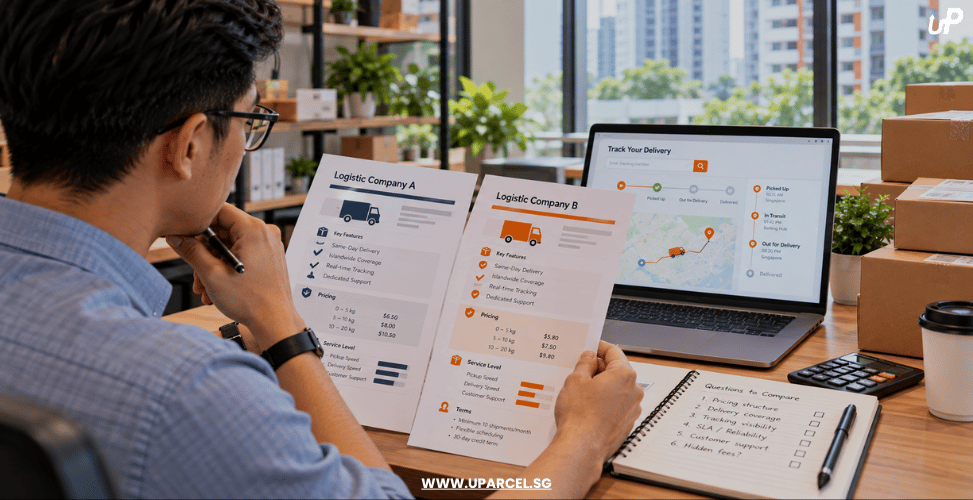
Questions to Ask Before Choosing a Courier Service for Your Business

Er Cai Fang
Senior Product Manager
hoosing the wrong courier costs more than the delivery fee. Here are the key questions Singapore businesses should ask before committing to a courier service partner.
Choosing a courier is not a procurement checkbox. It is one of the most consequential operational decisions a business makes.
Your courier is the last touchpoint before a product reaches your customer. If they fail, late delivery, lost parcel, no tracking update, unprofessional agent, that failure lands on your business, not theirs. The customer does not know who the courier is. They know who they bought from.
The questions below help Singapore businesses evaluate courier partners properly, before committing, not after something has already gone wrong.
1. Will They Collect Regularly From Your Location?
This is the first practical test of a courier's fit for your business.
A courier that requires you to drop off parcels at a collection point every day adds time and overhead that compounds at scale. For businesses, regularly dispatching, scheduled collection from your premises, your office, warehouse, or home is the operational baseline you need.
Ask specifically:
-
Do they offer scheduled daily or on-demand collection?
-
Is your address within their standard collection zone, or does it attract a surcharge?
-
What is the cut-off time for same-day collection and dispatch?
A courier that cannot give you a clear answer on collection reliability is telling you something about how they will operate once the contract is signed.
2. Do They Cover All of Singapore?
Not every courier network covers every part of Singapore with equal reliability.
Some providers have strong coverage in the central and commercial districts but weaker service in the north, northeast, or western industrial estates. If your customers are island-wide, and for most ecommerce businesses, they are gaps in coverage mean you will need a second provider, or your customers in those areas will receive slower or less reliable service.
Ask specifically:
-
Is there full island-wide coverage with no zone surcharges?
-
Are areas like Jurong, Woodlands, Changi, and the HDB heartlands covered on the same terms as CBD addresses?
-
Are there any postcodes or building types (industrial, restricted access) they do not serve?
The answer should be a clear yes, not a list of exceptions.
3. Is the Pricing Competitive for Your Volume?
Pricing is not just about the per-delivery rate. It is about whether the rate structure makes sense for the way your business actually sends.
A business sending five parcels a week needs different pricing than one sending 200. Ask whether the provider offers volume pricing or corporate account rates that reflect your actual usage, not just a consumer rate applied to a business account.
Ask specifically:
-
What is the standard rate per delivery for your typical parcel size?
-
Do rates decrease at higher monthly volumes?
-
Are there setup fees, account fees, or minimum monthly commitments?
For reference, uParcel's delivery rates are published transparently, a useful benchmark when comparing providers.

4. How Is Pricing Structured Across Sizes, Weights, and Distances?
The headline rate and the actual charge on your invoice can look very different if you have not understood the pricing structure upfront.
Many couriers charge based on a combination of weight, dimensions (volumetric weight), delivery distance or zone, and parcel type. A flat rate that looks competitive for small parcels may become uncompetitive for heavier items or longer distances.
Ask specifically:
-
Is pricing based on actual weight, volumetric weight, or a flat rate?
-
Are there additional charges for oversized or irregular items?
-
Do rates vary by delivery zone or distance, or is it flat across Singapore?
Get the full rate card in writing before committing. Verbal assurances about pricing are not useful when an unexpected surcharge appears on month two.
5. What Service Guarantees Do They Offer?
A courier who cannot articulate what they will do if a delivery is late is effectively offering no guarantee at all.
Reputable courier services offer defined delivery windows, same-day, 3-hour, 1-hour and stand behind those commitments. For businesses where delivery timing affects customer satisfaction, marketplace SLA compliance, or professional reputation, a vague "we try our best" is not an acceptable standard.
Ask specifically:
-
What are the defined delivery windows for each service tier?
-
What happens operationally when a delivery is running late?
-
Do they have a track record for on-time performance they can share?
For ecommerce sellers on Shopee and Lazada, your courier's reliability directly determines your seller metrics. Their guarantee needs to be specific enough to hold them accountable.
6. Are Shipments Insured? What Happens If a Parcel Goes Missing?
Every courier drops a parcel eventually. The question is what happens next.
A courier without a clear compensation policy puts the full financial risk of lost or damaged shipments on your business. For businesses sending high-value items, this is not a hypothetical risk; it is an exposure that needs to be understood before you commit.
Ask specifically:
-
Is basic insurance included, or is it an add-on cost?
-
What is the maximum compensation per shipment?
-
What is the claims process, and how long does resolution typically take?
Read the terms carefully. Some providers include basic coverage but cap it at a level that does not reflect the actual value of items your business sends.
7. What Does Order Tracking Look Like for Your Customers?
Tracking is not just for you; it is for your customers.
When a customer buys from your business and receives no tracking update until a "delivered" notification appears, the anxiety that builds in between creates unnecessary service contacts and erodes confidence in your brand. A courier with real-time, customer-facing tracking removes that friction entirely.
Ask specifically:
-
Do customers receive automated tracking notifications via SMS or email?
-
Is there a live tracking link the customer can access at any point?
-
Can tracking be integrated with your ecommerce platform or internal systems?
For businesses processing significant order volumes, API-connected tracking through uParcel's API integration allows tracking data to flow automatically into your platform, no manual updates required.
8. What Proof of Delivery Do They Provide?
Proof of delivery is your evidence that an order was fulfilled and your defense when a customer disputes receipt.
A photo of a parcel left outside a door satisfies some use cases. For corporate documents, legal correspondence, high-value goods, or any delivery where a named recipient needs to confirm receipt, a more detailed proof of delivery record is required.
Ask specifically:
-
Is proof of delivery provided for every shipment as standard?
-
Does it include a timestamp, recipient name, and photo?
-
How is the proof of delivery stored and accessed?
For businesses dealing with marketplace disputes on Shopee or Lazada, having timestamped proof of delivery for every order is essential, not optional.

9. How Flexible Is the Service When Your Needs Change?
Your delivery needs today will not be identical to your delivery needs in six months.
A courier partner needs to flex with you, handling higher volumes during peak periods without degrading service, accommodating different delivery speed requirements as your customer base evolves, and supporting new service types (bulky items, temperature-sensitive goods, B2B drops) if your product range expands.
Ask specifically:
-
Can they handle volume spikes during campaigns, 11.11, or peak seasons without advance notice?
-
Do they offer multiple delivery speed tiers under one account?
-
Is there a dedicated account manager for business customers, or does everything go through a general support queue?
Flexibility is hard to evaluate from a rate card. Ask for examples of how they have supported business customers through demand changes or speak to an existing business customer if possible.
10. How Easy Is It to Book, Manage, and Scale Deliveries?
This is the question most businesses forget to ask and then regret once they are operating at volume.
Manually booking each delivery through a consumer app works when you are sending a handful of parcels per week. At 50, 100, or 500 orders a month, it becomes a significant time drain that limits how efficiently the business can operate.
Ask specifically:
-
Is there a web portal or app built for business booking with bulk upload, saved addresses, and booking history?
-
Can deliveries be dispatched automatically via API when orders are placed?
-
Is there a corporate account structure that consolidates billing and simplifies cost reporting?
uParcel's same-day courier service includes corporate account management, bulk booking, and API integration for businesses that need more than a one-parcel-at-a-time interface.
Ask Before You Commit, Not After
Switching courier partners mid-operation is disruptive. It means migrating booking systems, briefing a new team, and managing a transition period where delivery reliability may temporarily dip.
The questions above are worth the time it takes to ask them, because the answers reveal how a provider will actually perform over months and years, not just how they pitch in a sales conversation.
A courier that answers every question clearly, with specifics rather than generalities, is signaling the kind of operational transparency that holds up when things get busy.
To discuss your business delivery requirements with the uParcel team or explore corporate account options, visit the uparcel.sg and get in touch.
Other Blog Posts
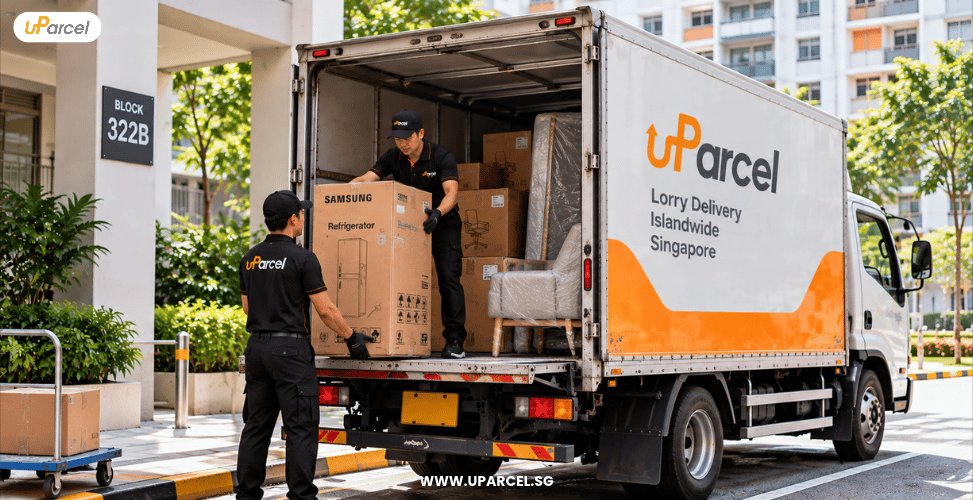
Lorry Delivery Price in Singapore: What Affects the Cost
Getting a lorry delivery quote in Singapore often feels like a moving target. The base rate looks straightforward, but by the time you factor in your actual load, your building’s lift access, and whether you need help carrying things upstairs, the final number can look quite different. This post covers uParcel’s actual lorry and van delivery rates, the factors that push the price up, and the add-ons that most real deliveries end up needing. If you are trying to budget accurately before booking, this is what you need to know. uParcel Lorry and Van Delivery Rates in Singapore uParcel operates a range of vehicles from a half-van up to a 24-foot lorry, all on a flat-rate islandwide basis — no surge pricing regardless of where in Singapore you are sending to. Vehicle Load Space Max Weight Base Rate 1.7m Van (Half) 1.6m × 1.2m × 1m 50 kg From $35 1.7m Van (Full) 1.6m × 1.2m × 1m 350 kg From $52 2.4m Van 2.3m × 1.2m × 1.2m 500 kg From $62 10 ft Lorry 2.9m × 1.4m × 1.7m 700 kg From $102 14 ft Lorry 4.2m × 1.7m × 1.9m 900 kg From $162 24 ft Lorry 7.0m × 2.0m × 2.0m 5,000 kg From $232 Lorries are available in open or covered configuration, and with or without a tailgate — the right combination depends on what you are transporting and how it needs to be loaded. These are the published starting rates. What changes that number is covered below. What Actually Drives the Final Price The base rate gets you the vehicle and the driver. These are the factors that determine whether you pay the minimum or significantly more. Vehicle size vs your actual load The single biggest cost driver is choosing the right vehicle. Underestimating your load means the agent may not be able to proceed, or you will need to rebook a larger vehicle. Measure your items before selecting: A single bicycle, a TV set, or two flat-pack boxes → 1.7m van (half) A full sofa set or 20–25 cartons → 2.4m van Four pallets of goods or large appliances → 10 ft lorry Six pallets or a full retail restocking run → 14 ft lorry Retail moving, 18+ pallets, or full warehouse transfers → 24 ft lorry Weight limits Each vehicle has a maximum weight, and it matters independently of space. A load that fits physically in a 10 ft lorry but weighs more than 700 kg needs the 14 ft lorry instead. If you are shipping dense or heavy goods, tiles, machinery parts, stacked inventory, calculate weight alongside dimensions. Open vs covered lorry An open lorry is cheaper to configure but exposes your items to weather. A covered lorry costs slightly more but is the right choice for electronics, furniture, paper goods, or anything that cannot get wet. If your delivery window includes a risk of rain or your goods are sensitive, covered is the safer option. Tailgate access A tailgate attachment lets the agent lower heavy items from the lorry bed to ground level hydraulically, without manual lifting. If you are moving appliances, machinery, or anything that cannot be hand-carried safely off a lorry, you will need a tailgate-equipped vehicle. Booking one without a tailgate for a job that requires one will delay the delivery on the day. Location surcharges uParcel’s rates are flat-rate islandwide, locations like Jurong Island, Tuas, or Changi are served but carry a long-distance surcharge. If your pickup or dropoff is in a restricted or industrial zone, check for this when booking. Fuel surcharge A temporary fuel surcharge of $1 applies on top of published rates across all vehicle types, with an additional $1 increase to the long-distance surcharge. This is reflected in the final booking cost. The Add-Ons That Most Bookings Actually Need This is where lorry delivery quotes most often surprise people. The vehicle gets your goods to the building, but it does not automatically get them inside, up the stairs, or assembled. uParcel offers a full set of add-ons that can be selected at booking: Add-On What It Covers Cost Extra Manpower An additional agent to help carry, load, or unload +$40 per man per trip Dismantle / Assemble Furniture disassembly before transport and reassembly on delivery +$30 per piece Pallet Jack Agent brings and operates a pallet jack for stacked pallets +$20 per jack No Lift Access (Stairs) Agent carries your load up each floor level with no lift +$10 per level Wrapping Service Agent wraps items in protective materials before loading +$5 per piece Return Trip (Document) Agent brings a signed document back from the dropoff location +$15 A realistic example: A family moving a sofa set and wardrobe to a 4th-floor HDB flat with no cargo lift would add: 1 extra man ($40) + stairs surcharge for 3 floors ($30) + wrapping for the wardrobe ($5). That is an additional $75 on top of the vehicle rate, a number worth planning for rather than discovering on the day. The Half-Van Option: Useful More Often Than You Think Most lorry delivery providers quote by the full vehicle. uParcel’s half-van option is worth knowing about because it directly lowers the cost for loads that do not fill an entire van. The 1.7m van half-load carries up to 50 kg within the same 1.6m × 1.2m × 1m space at $35 versus $52 for the full van. For a single piece of furniture, a bicycle, a rolled carpet, or a handful of bulky boxes, this is the more accurate way to match your cost to your actual load. If you are unsure whether your items fill a full van or half, err on the side of booking a half and contacting uParcel support to confirm before the booking is locked. What to Factor Into Your Budget Before Booking A useful way to estimate your real cost before you reach the checkout: Start with the right vehicle - measure dimensions and calculate total weight before choosing Check your delivery location - long-distance zones carry a surcharge; lifts affect access costs Count your items needing assembly - if anything needs dismantling to move safely, add $30 per piece Assess whether a second agent is needed - for anything heavy or bulky going above ground floor, add manpower Check if it’s an open lorry job or covered - weather-sensitive goods always need covered Add the $1 fuel surcharge - this is applied on top of the published base rate For most single-item or small-load deliveries (a sofa, a gym equipment set, a few pallets of stock), the final cost lands somewhere between the base rate and the base rate plus one or two add-ons. Plan for that range and you will not be caught short. Booking a Van or Lorry in Singapore uParcel’s van and lorry service is booked on-demand, same-day booking is available, and rates are flat across Singapore with no surge pricing. For full vehicle specs, current base rates, and to book directly, visit the uParcel van and lorry delivery. If your load is somewhere between sizes or you are not sure which vehicle fits, the booking interface lets you specify dimensions and weight or you can reach the team for a quick recommendation before you confirm.
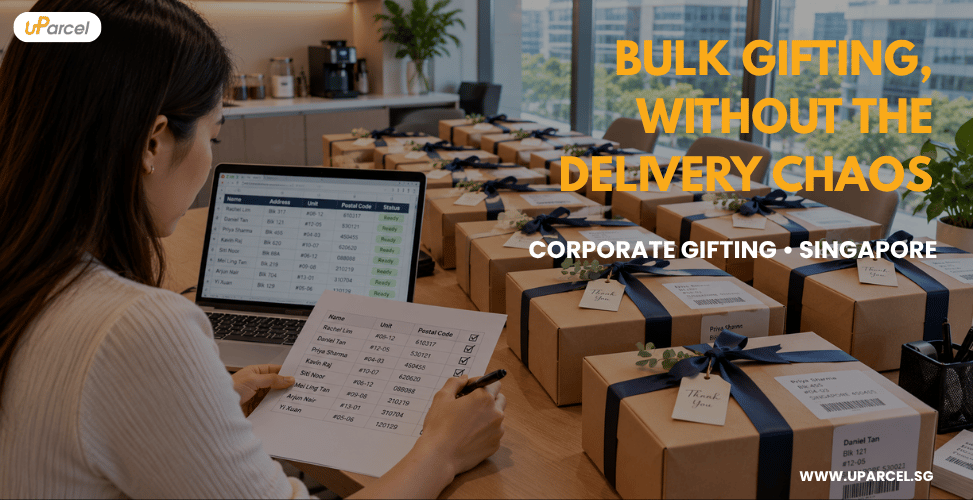
Corporate Gift Delivery in Singapore: Year-End Bulk Guide
Every December, admin and marketing teams across Singapore face the same job. Sixty hampers for clients, two hundred gift boxes for staff working from home, a batch of wine sets for partners across three business parks. The gifts are chosen, but getting each one to the right door before people leave for the holidays is a different problem. Corporate gift delivery in Singapore goes wrong in predictable ways: a missing unit number, an office reception that closed early, a condo guardhouse that refused a parcel, or a gift that arrived after the recipient flew off on leave. Most of these failures start before the courier is even booked. This guide walks through the full process: preparing the address list, packing and labelling, booking many deliveries at once, choosing between same-day and scheduled delivery, handling office, condo and HDB addresses, and keeping proof that every gift arrived. It applies whether you are an HR team sending staff gifts or a gift seller fulfilling a corporate order. Start With a Clean Address List A clean address list prevents most failed deliveries. Build it as a spreadsheet from the start, one row per gift, because that same file can become your bulk booking upload later. Each row should carry: Recipient name and mobile number: the rider calls this number if the recipient cannot be found, so a general office line is less useful than a direct mobile. Six-digit postal code: Singapore's six-digit postal code identifies a single building, not a single unit. Block, street, unit number and building name: for an HDB block or condo tower, the postal code alone only gets the rider to the building. Without "#08-123", the gift goes nowhere. Address type: mark each row as office, condo, HDB or landed. This decides delivery timing later. Gift variant and any note: "Hamper B, contains alcohol" or "Fragile, glassware" helps whoever packs and whoever delivers. Before you finalise the list, run three checks: Postal code against building name. Look up anything unfamiliar on OneMap, the Singapore Land Authority's national map, and fix mismatches. A typo in one digit can send a rider to the wrong estate. Duplicates. The same client often appears twice under different contacts. Decide whether they get one gift or two before you pack. Home addresses for staff. If you collect personal addresses for gifting, tell staff what the address is for and keep the file restricted. The PDPC's advisory guidelines on key concepts in the PDPA treat a residential address as personal data, so consent, purpose and reasonable protection all apply. Collect addresses through a short form rather than email replies. A form with fixed fields for postal code and unit number removes most of the formatting cleanup. Pack and Label Every Gift the Same Way Consistent packing and labelling let a rider identify each gift in seconds, which matters when one vehicle carries dozens of near-identical boxes. Treat the gifts like a production run, not a stack of individual presents. Use an outer carton or mailer over decorative wrapping. Ribbon and gift paper tear in transit. Wrap the gift, then put it inside a plain outer box, or use a branded mailer box that already looks presentable. Print labels from the spreadsheet. Handwritten labels slow the rider down and invite errors. Print name, full address with unit number, mobile number and the booking reference if you have one. Place the label on the top face. Riders photograph the label at drop-off, so a label on the side or bottom makes proof of delivery harder. Cushion fragile items. Wine bottles, ceramic mugs and glass jars need dividers or padding so they do not move when the box is shaken. Keep perishables separate. Cakes, fresh fruit and chilled items should go out on their own same-day run, not sit in a batch that will be delivered over two days. Add a card inside, not on the outside. A personal note belongs inside the box. Anything written on the outside can get smudged or torn. Number the boxes to match the row numbers in your spreadsheet. If a box is returned or a recipient calls, you can find the right row in seconds. Book Many Deliveries at Once With Bulk Upload Booking fifty gifts one by one in an app is slow and error-prone, so most businesses book in bulk. The aim is to turn the spreadsheet you already built into delivery orders in one step. uParcel's bulk upload works this way: 1. Sign in to the uParcel web portal and open the Bulk Delivery module. 2. Download the sample Excel file. This is the template the system reads, so use it rather than your own layout. 3. Copy your address list into the template. Map your columns (name, mobile, address, unit number, notes) to the template's columns. 4. Upload the file. Each row becomes a delivery booking in one go, instead of fifty separate entries. 5. Review the bookings before confirming. Spot-check a few rows against your packed boxes, especially unit numbers. The full walkthrough is in the guide on how to use uParcel's bulk upload function. The benefit is less about speed than accuracy: the address you checked in the spreadsheet is the address the rider sees, with no retyping in between. For gift sellers who receive corporate orders every season, a regular volume of bookings can also be pushed through uParcel's API integration, so orders flow from your store system into delivery bookings without manual uploads. Choose Between Same-Day and Scheduled Delivery The right delivery speed depends on what is in the box and who is receiving it. Faster is not always better for corporate gifts, because an office gift that lands after the recipient has left for the day is effectively a failed delivery. Option Best for Watch out for 1-hour or 3-hour express A single urgent gift, such as a forgotten client hamper or a last-minute replacement Not economical for large batches Same-day delivery Perishables, cakes and fresh hampers; batches that must arrive on a specific day Book early in the day so office deliveries arrive within working hours Next-day delivery Non-perishable gift boxes sent in larger batches where a fixed day is less critical Count working days carefully around public holidays A practical pattern is to split the list. Send office-bound gifts on a mid-week same-day run so they arrive while people are at their desks, and send home-bound gifts by next-day delivery, timed for when recipients are likely to be in. uParcel offers same-day delivery island-wide, plus 1-hour and 3-hour express and next-day options, all bookable from the same account. You can compare the options on the same-day delivery service page. For a batch with heavy hampers or many cartons to one office, a van booking is usually more practical than sending each box separately. Handle Office, Condo and HDB Addresses Differently Each address type in Singapore has its own access rules, and planning for them is the biggest lever for a smooth gift run. This is why the spreadsheet has an "address type" column. Office buildings: Many commercial towers route all parcels through a central reception or loading bay, and some do not let riders go up to individual floors. Confirm with each client whether gifts should go to their own office reception or the building's mailroom. Many offices also wind down in the last week of December, so office gifts should land before the final working days of the year. Condominiums: Guardhouses often need the resident's name and unit number before letting a rider in, and some will hold parcels while others will not accept them at all. Add a note such as "Guardhouse may receive" or "Call resident on arrival" to the booking. If the recipient has told you the guardhouse will hold parcels, say so in the notes. HDB flats: Riders can usually go straight to the unit, so the unit number and a reachable mobile number matter most. If nobody is home, the gift may be left at the door only if your instructions allow it, so decide in advance whether high-value gifts need to be handed over in person. Landed homes: Gates and dogs are the common issues. A mobile number the rider can call on arrival solves most of them. Keep Billing and Records in One Place With a Corporate Account When several departments send gifts, billing and records get scattered across personal cards and expense claims. A corporate account keeps every booking under the company. With a uParcel corporate account: Bookings are billed on a monthly invoice instead of being paid card by card at checkout, which suits finance teams closing the year. Sub-accounts can be added for different departments, so HR's staff gifts and Sales' client hampers are booked separately but billed to the same company. Booking history sits in one place, which helps when you reconcile gift budgets or plan the next gifting round. You request a corporate account from the left-hand panel after logging in, and it is subject to approval, so apply a few weeks before the December rush. The guide on how corporate courier services make corporate delivery simple covers the wider set of business delivery needs a corporate account handles. Track Every Gift and Keep Proof of Delivery Tracking and proof of delivery turn "I think it arrived" into a record you can show a client or a manager. With a hundred gifts in transit, you need both. Live tracking: each booking can be tracked from pick-up to drop-off, so you can answer a "has it been sent?" message without calling the courier. Photo proof of delivery: uParcel riders photograph the parcel at the drop-off point, with the label and unit number visible. For a gift left at a reception desk or guardhouse, the photo shows exactly where it was placed. A simple status column: add "Delivered", "Failed" and "Re-booked" columns to your spreadsheet and update them from the tracking screen at the end of each day. Do not send thank-you or "your gift is on the way" emails before the gifts are actually picked up. If one batch slips by a day, the message becomes awkward. Plan for Failed Deliveries and Re-Delivery Even a well-prepared gift run will have a handful of failed deliveries. Planning for them in advance keeps them from turning into lost gifts. Common causes and fixes: Recipient not reachable: confirm mobile numbers before booking, and send a short heads-up message the day before so recipients expect a call. Office closed or reception refused: check building rules for any address where you have not delivered before, and avoid booking office drops on the last working day before a public holiday. Wrong or incomplete address: this goes back to the address list. Fix the row, then re-book. Condo guardhouse refusal: contact the recipient for an alternative, such as their office or a family member's address. Keep returned gifts in a labelled holding area, matched to their spreadsheet row. Re-book them as one small batch once you have corrected details, rather than one by one as they come back. Work Backwards From the December Peak December is one of the busiest delivery periods in Singapore, and corporate gifting competes with year-end online shopping for courier capacity. Christmas Day on 25 December and New Year's Day on 1 January are both public holidays, and many offices run on reduced staff in between. A simple timeline, counted backwards from your target delivery week: Six to eight weeks before: confirm the gift list and budget, apply for a corporate account if you do not have one, and order gift stock. Four weeks before: collect and clean addresses through a form. Chase anyone who has not replied. Two to three weeks before: pack, label and number all boxes. Fill in the bulk upload template. One to two weeks before: send office-bound gifts first, while offices are fully staffed. Final week before Christmas: send home-bound gifts and any perishables by same-day delivery, and use express delivery only for late additions and re-deliveries. Make the Gift Run as Personal as the Gift Corporate gift delivery in Singapore works best when it is treated as a small logistics project: one clean spreadsheet, consistent labels, deliveries timed to how each address type works, and a proof-of-delivery record for every box. The gift is what recipients remember, but a gift that arrives on time, at the right door, is what makes it land. uParcel's 4.9 Google rating from 9,500+ reviews comes largely from this kind of everyday delivery work. If you are planning a year-end gift run, the uParcel team can help you set up bulk bookings and choose the right mix of same-day, express and next-day delivery for your list.
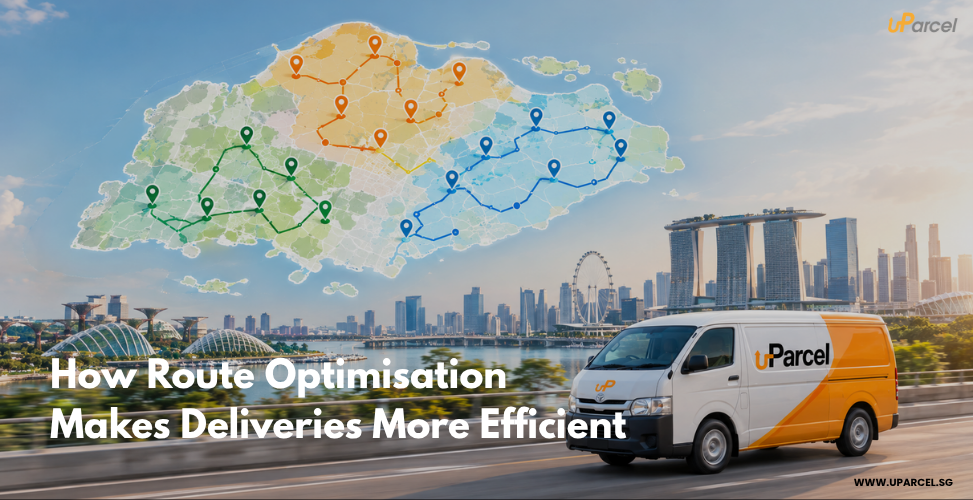
How Route Optimization Cuts Delivery Costs for Businesses with Multiple Daily Drops
If your business is making 20, 50, or 100+ deliveries a day across Singapore, the sequence of those deliveries is either money saved or money wasted. Two businesses with identical order volumes and identical delivery destinations can pay vastly different amounts per drop based entirely on how those deliveries are sequenced, grouped, and dispatched. The difference is route optimization: the practice of organizing delivery stops in a sequence that minimizes total distance, time, and cost while meeting customer delivery expectations. For businesses running their own delivery fleet, route optimization is a deliberate operational decision that requires planning tools and discipline. For businesses using a third-party courier, it is often built into the network but only if the courier's infrastructure is designed for multi-drop efficiency at scale. This article explains how route optimization works, what it costs to get it wrong, and what to look for when choosing a delivery partner for a business with multiple daily drops in Singapore. What Is Route Optimization? Route optimization is the process of determining the most efficient sequence and path for a set of delivery stops minimizing total distance traveled, time spent, and cost incurred, while respecting delivery time windows and vehicle capacity. It is distinct from simple navigation. A navigation app like Google Maps finds the fastest path between two points. Route optimization solves a more complex problem: given 40 delivery stops, a two-hour delivery window for some of them, and a vehicle that can carry a maximum load, what is the sequence that minimizes total cost? The variables that route optimization has to balance simultaneously include: Geographic clustering: grouping nearby stops to reduce backtracking Time windows: ensuring time-sensitive deliveries reach recipients within the promised window Vehicle capacity: matching load size to vehicle type for each run Traffic patterns: routing around known congestion periods on Singapore's road network Drop density: areas with more stops per square kilometer cost less per delivery than dispersed single drops When these variables are handled well, cost per drop falls. When they are not — when drivers are crisscrossing the island, backtracking to areas they already passed, or running half-full vehicles, every inefficiency multiplies across the entire day's deliveries. The Real Cost of an Unoptimised Delivery Route Businesses that have not thought systematically about route optimisation often underestimate how much inefficiency is embedded in their current operations. The costs appear in several places: Unnecessary Distance and Fuel An unoptimised route covering the same stops as an optimised one can add 20–35% more distance in a single run. Over a fleet of vehicles operating five days a week, that additional distance translates directly into fuel spend, vehicle wear, and driver hours, none of which appear on a per-delivery invoice but all of which appear on a monthly cost sheet. Failed Deliveries and Redelivery Costs A failed delivery, where a recipient is unavailable, the address is inaccessible, or the time window is missed, is one of the most expensive events in last-mile logistics. The original delivery attempt costs the same as a successful one. The redelivery costs the same again. And in Singapore's ecommerce marketplace environment, a failed delivery frequently triggers a negative seller rating or a dispute. Failed deliveries are often a sequencing problem. When delivery windows are not respected because routes are planned without accounting for them, recipients who expected a morning delivery get a driver showing up at 6pm and nobody is home. Driver Time as a Hidden Cost For businesses running their own delivery staff, driver time is a fixed cost that does not disappear when routes run long. A driver spending two hours completing a run that should take 90 minutes is not a route that cost 33% more fuel, it is a driver who is unavailable for the next run during those 30 minutes. Across a team of drivers, unoptimised routes consistently compress the number of deliveries possible in a working day. The Key Variables That Determine Cost Per Drop in Singapore Understanding what drives cost per drop gives businesses the framework to evaluate both their own operations and the partners they work with. Drop density The most significant driver of cost per drop is how many stops a vehicle can service within a defined geographic area. A driver covering 10 drops in Tampines in one run has a far lower cost per drop than a driver covering 10 drops spread across Tampines, Jurong, and Woodlands. In Singapore's compact urban geography, tight geographic clustering is one of the highest-leverage optimisations available. Vehicle-to-drop matching Using a van for three small parcel drops, or a motorcycle for a large, heavy delivery, both represent a mismatch between vehicle cost and delivery requirement. Optimised operations match vehicle type, motorcycle, car, van, lorry to the load size and delivery characteristics of each run. uParcel's network includes motorcycles, cars, vans, and lorries, allowing each delivery to be matched to the appropriate vehicle type rather than defaulting to a single mode regardless of parcel size. Time-window compliance Deliveries that carry a specified time window (e.g., same-day before 6pm, or a specific two-hour slot) must be sequenced so that the driver reaches those stops within the window. When time-constrained stops are sequenced poorly, placed too late in a route, or too far from the previous stop, drivers either miss the window or rush to meet it inefficiently. Batching and dispatch timing For businesses processing orders continuously throughout the day, the timing of dispatch runs matters. Batching all morning orders into a single optimised run is more efficient than dispatching three separate runs as orders trickle in. The trade-off is delivery speed, earlier batching means longer wait times for the first orders in the batch. The right balance depends on what your customers have been promised. Own Fleet vs Outsourced Courier: The Route Optimisation Trade-Off Businesses with multiple daily drops face a foundational choice: run their own fleet and manage routing internally, or use a third-party courier whose network handles the routing problem. Running your own fleet gives maximum control over delivery scheduling and sequencing but places the full burden of route optimisation on your own operations team. This requires either dedicated routing software (with the associated cost and learning curve) or significant manual planning time daily. It also means your delivery cost structure is fixed: vehicles, drivers, insurance, and maintenance are sunk costs whether the routes are optimised or not. Using a third-party courier transfers the routing problem to a network that is already optimised, but only if the courier's infrastructure is genuinely built for multi-drop efficiency at scale. A courier that dispatches individual drivers for single drops is not providing a routing advantage; it is just shifting your fixed costs to variable ones. For businesses with consistent multi-drop volumes in Singapore, the decision hinges on whether the volume justifies the overhead of maintaining and optimising a dedicated fleet. For most SMEs and mid-size businesses, the variable cost of a purpose-built courier network is more efficient than the fixed cost of an internal fleet that requires ongoing route optimisation investment to match the same efficiency. How uParcel's Network Is Built for Multi-Drop Efficiency uParcel's delivery network is designed for businesses with consistent, volume-based delivery needs across Singapore not just one-off single drops. Key features relevant to multi-drop businesses: Island-wide coverage with no area surcharges uParcel covers all parts of Singapore on the same delivery network, Jurong, Woodlands, Changi, and everywhere in between. Businesses do not pay a premium for drops in specific zones or face coverage gaps that require a second provider. Multiple vehicle types matched to load From motorcycles for small parcels to vans and lorries for bulky or high-volume runs, uParcel matches vehicle type to delivery requirement, eliminating the vehicle-mismatch inefficiency that inflates cost per drop for businesses using a one-size-fits-all fleet. Same-day delivery across all drops For businesses whose customers expect same-day delivery, uParcel's same-day network covers Singapore-wide drops dispatched within the service window. This removes the trade-off between delivery speed and route efficiency that businesses managing their own fleet often face. Transparent per-drop pricing Rather than absorbing the hidden cost variability of an internal fleet, businesses using uParcel pay per delivery on a transparent rate structure. For businesses with consistent multi-drop volumes, this makes total delivery cost predictable and comparable across months. View uParcel's delivery rates to estimate cost per drop based on your delivery profile. What to Look for in a Delivery Partner for Multi-Drop Businesses For businesses evaluating a courier partner or reconsidering their current one, route optimisation capability is one of several criteria that determine whether the partnership will be cost-efficient at scale. 01. Coverage without gaps A courier that cannot reliably serve all of Singapore forces you to maintain backup arrangements for uncovered zones. Every exception in coverage adds operational complexity and cost. 02. Scalability on volume The partner needs to be able to absorb volume spikes, peak sale periods, campaign launches, seasonal demand without degrading delivery performance or requiring significant advance notice. A courier network that works well at 50 drops per day but struggles at 200 is not a long-term fit for a growing business. 03. API integration for automated dispatch For businesses processing high volumes, manual order submission to a courier is itself an inefficiency. API integration allows orders to be dispatched automatically as they are placed removing a daily administrative step and reducing the risk of missed or delayed bookings. uParcel's same-day courier service includes API integration for businesses that need automated, high-volume dispatch. 04. Tracking and proof of delivery Multi-drop operations generate a high volume of recipient queries. A courier that provides real-time tracking and digital proof of delivery reduces the time your team spends responding to "where is my order" contacts, a hidden administrative cost that scales with delivery volume. The Route Is Part of the Cost Route optimisation is not a logistics detail, it is a direct cost lever for any business making multiple deliveries every day. Unoptimised routes add distance, driver time, vehicle cost, and failed delivery risk to every run. Optimised routes compress all of those costs without compromising delivery speed or coverage. For businesses managing their own fleet, the investment in route planning whether through software or disciplined manual scheduling pays back in reduced operating cost per drop. For businesses using a courier, the equivalent question is whether the network they are using is genuinely built to deliver multi-drop efficiency or whether it is simply processing individual orders one at a time. The right answer depends on your volume, your delivery commitments to customers, and the total cost of each option at your current and projected scale. For businesses with regular multi-drop delivery needs in Singapore, view uParcel's delivery rates or reach out to the team through the same-day courier service page to discuss a delivery arrangement that fits your volume and schedule.