
How uParcel Helps You Launch a Marketplace Store in Singapore

Er Cai Fang
Senior Product Manager
Discover how uParcel Marketplace Manager helps sellers set up, integrate delivery, sync inventory, and scale across Shopee, Lazada, TikTok Shop, uShop Market & more.
Introduction: Why Marketplaces Are the Fastest Way to Grow Your Online Sales
Expanding into online marketplaces is no longer optional for sellers in Singapore, it’s essential. Whether you’re a small bakery looking to sell your pastries on Shopee, a boutique fashion brand entering Lazada, or a home-based seller testing the waters on TikTok Shop, marketplaces give you instant access to millions of ready-to-buy customers.
But success doesn’t just come from listing your products. Sellers need to manage SEO-optimized product listings, reliable delivery, order fulfillment, and returns to stand out in these competitive platforms. This is where uParcel Marketplace Manager becomes your growth partner.
The Marketplace Landscape in Singapore
Here’s a quick look at the most popular platforms:
-
Shopee – Loved for its discount-driven shopping and massive user base. Ideal for price-competitive categories like gadgets and household items.
-
Lazada – Backed by Alibaba, strong in electronics, fashion, and lifestyle products with professional branding options for sellers.
-
TikTok Shop – A fast-growing channel where video-driven shopping creates viral product demand.
-
uShop Market – A community-driven marketplace focused on local businesses in Singapore. Perfect for SMEs looking to get noticed.
💡 Example: A home decor brand in Singapore selling on Lazada may also list the same products on TikTok Shop to ride on social media demand maximizing reach without building separate infrastructure.
Challenges Sellers Face When Expanding to Marketplaces
-
Setting Up Storefronts – Creating professional product listings with SEO-optimized content.
-
Inventory Sync Issues – Selling on multiple platforms often leads to overselling or understocking.
-
Delivery Expectations – Marketplaces often require same-day or next-day delivery to keep your seller ratings high.
-
Returns & Customer Experience – Poor returns handling can hurt your credibility.
Without proper systems, sellers can get overwhelmed and lose out on opportunities.
How uParcel Marketplace Manager Helps Your Business Grow
This is where uParcel Marketplace Manager comes in a complete solution to help you start and scale across multiple platforms without the stress.
1. Store Setup & Product Listing

-
We create product listings professionally with SEO-optimized product titles, well-structured descriptions, and high-quality images.
-
Products are categorized correctly to improve discover-ability and search rankings.
2. Delivery Integration

-
Seamless integration with uParcel and other last-mile partners to ensure every incoming order is fulfilled on time.
-
Supports same-day and next-day delivery, keeping you competitive on platforms like Lazada and TikTok Shop.
3. Centralized Inventory & Order Management

-
Syncs inventory across Shopee, Lazada, TikTok Shop, uShop Market, Shopify, and WooCommerce.
-
Prevents overselling or out-of-stock frustrations.
4. Hassle-Free Fulfillment & Returns

-
Orders are stored, picked, packed, and shipped directly from uParcel’s warehouse.
-
Smooth reverse logistics process to handle customer returns without hurting seller ratings.
5. Insights & Growth Support
-
Access to sales and performance analytics.
-
Personalized recommendations to improve conversions and visibility.
Why Sellers in Singapore Trust uParcel
Unlike general logistics providers, uParcel understands the marketplace ecosystem. Whether you’re selling on one platform or five, we help you maintain:
-
Professional listings that attract buyers
-
Fast delivery to keep ratings high
-
Centralized inventory to prevent mistakes
-
Growth insights for scaling
Conclusion
Expanding your business into marketplaces is one of the smartest growth moves you can make in Singapore. But to succeed, you need the right support system that covers store setup, delivery, fulfillment, and growth insights.
With uParcel Marketplace Manager, sellers don’t just expand, they scale efficiently. Whether you’re a small business just starting or an established seller looking to streamline operations, uParcel is your partner for long-term success.
FREQUENTLY ASKED QUESTIONS
1. How does uParcel help new sellers get started?
We handle store setup, product listing, SEO-friendly descriptions, proper categorization, and delivery integration so sellers can start selling faster without technical hassle.
2. Can uParcel integrate delivery with marketplaces?
Yes. uParcel connects your store with our delivery network in Singapore, offering same-day, next-day, and scheduled delivery options seamlessly.
3. Does uParcel support inventory and order syncing?
Yes. With inventory sync, your stock updates automatically across multiple marketplaces, preventing overselling and improving order accuracy.
4. Is uParcel Marketplace Manager suitable for SMEs?
Absolutely. It’s designed for SMEs and growing brands who want to expand into marketplaces without managing operations manually.
5. How does uParcel help sellers scale their marketplace sales
Beyond setup and fulfillment, uParcel ensures smooth delivery, optimized product listings, and operational efficiency—helping you boost visibility, sales, and customer satisfaction.
Other Blog Posts
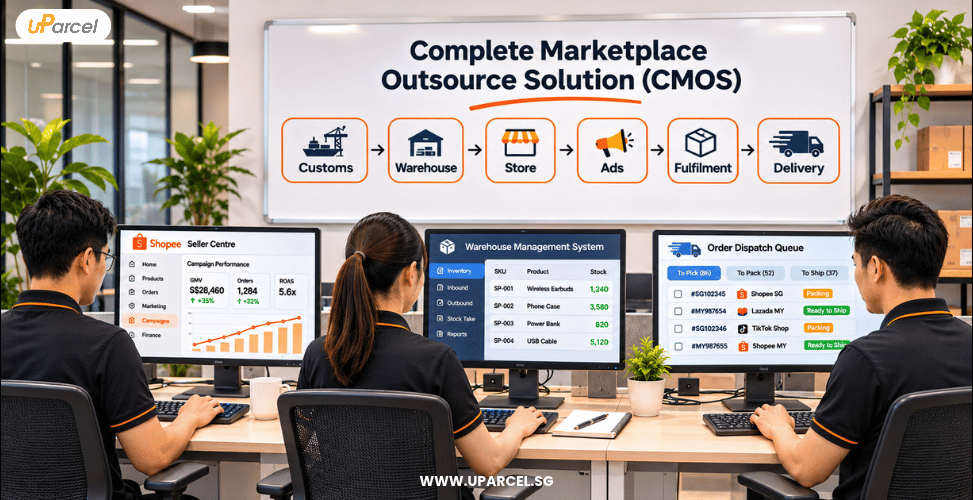
What Is CMOS? The Complete Marketplace Outsource Solution Explained
Selling on Shopee, Lazada and TikTok Shop looks straightforward from the outside. In practice, running a marketplace operation involves daily listing management, paid campaign optimisation, inventory tracking, order fulfilment, customer service, and logistics and each of those functions has to work together for the operation to perform. Most brands try to manage this across separate vendors: a marketing agency for the store, a 3PL for fulfilment, an in-house team for customer service. The result is fragmented accountability, when an order goes wrong, no single party owns the problem. CMOS, Complete Marketplace Outsource Solution is the model designed to eliminate that fragmentation. One partner takes on the full marketplace operation on the brand’s behalf, from the moment stock arrives to the moment the customer receives their order. This post explains what CMOS covers, who it is designed for, and how it applies to brands operating in Singapore, Malaysia or both. What CMOS Stands For CMOS stands for Complete Marketplace Outsource Solution. It describes a managed service model in which a single operations partner handles every layer of a brand’s marketplace presence, storefront management, traffic and ads, warehousing, order fulfilment, customer service and last-mile delivery rather than one or two of those functions in isolation. The defining characteristic of CMOS is accountability across the full chain. Under this model, the partner is not advising the brand on what to do; they are doing it, and they are responsible for the outcome at each stage. What CMOS Covers: The Full Scope CMOS covers six operational layers. Each one supports the others which is why outsourcing them to separate vendors creates coordination gaps that a single-partner model avoids. Store Setup and Marketplace Management The brand’s storefronts on Shopee, Lazada and TikTok Shop are set up, listed and managed on an ongoing basis. Product listings created with optimised titles, descriptions, specifications and images Store branding, banners and category structure configured for each platform Daily store health monitoring, seller ratings, fulfilment rates, response times Promotion planning and campaign nomination across platform-wide sale events Traffic Optimisation and Ads Management Paid campaigns within each marketplace are structured, run and reviewed against each product’s actual margin, not a blanket target across the whole store. Campaign architecture: products grouped into hero, supporting and test tiers Keyword strategy and bid management under manual and auto-bidding modes Break-even ROAS calculated per product before spend goes live Budget pacing through peak hours and campaign-day monitoring during mega sales Post-campaign review covering true ROAS after cancellations and returns Social Commerce and Live Social and live commerce channels are managed as part of the same traffic strategy as the marketplace ads — not as a separate workstream. TikTok Shop LIVE sessions planned and executed in peak traffic slots Short-form video content aligned with product launches and sale events Social content coordinated with listing updates and promotional mechanics Warehousing and Inventory Management Stock is stored in a managed fulfilment warehouse and tracked in real time. Inbound stock received, verified and shelved against the product catalogue Inventory levels monitored and low-stock alerts triggered before listings are affected Storage conditions matched to product type Order Fulfilment and Last-Mile Delivery Every order placed across connected marketplaces is fulfilled from the same warehouse. Pick, pack and dispatch for every order, with same-day processing during peak volumes Same-day delivery available across Singapore; fulfilment coverage in Malaysia Returns processed and restocked without the brand managing the logistics Customer Service and Returns Marketplace inbox management, review handling and return coordination are covered by the same team running the store — so responses reflect actual stock and fulfilment status. Buyer enquiries and escalations managed within platform response-time requirements Review monitoring and response coordination Return instructions issued and stock reconciled on receipt How uParcel Helps Overseas Sellers Enter Singapore For brands based outside Singapore, the first challenge is not the marketplace, it is the legal and logistical groundwork needed before a single product can be listed and sold. Without a local Singapore entity, an overseas brand cannot legally receive goods into the country or appear as the importer of record for customs purposes. Setting up a Singapore-registered company to solve this costs approximately S$4,000 per year in corporate secretarial and maintenance fees, a significant commitment for a brand that is still testing whether the Singapore market is viable. uParcel’s inbound and customs clearance service removes that barrier. It acts as the local entity on the brand’s behalf, allowing overseas brands to start selling in Singapore without incorporating locally. Specifically, uParcel: Acts as the local receiving entity: goods can be shipped to Singapore and received by uParcel even if the brand has not set up a Singapore business entity Submits customs declarations on TradeNet: all required declarations are filed with Singapore Customs on the brand’s behalf, covering the full inbound clearance process Holds a tax account for duties: import duties are paid through uParcel’s account, with the cost passed to the client; the brand does not need its own Singapore tax or GST registration to start Maintains audit-ready records: all import, export and sales records are kept for five years, meeting Singapore’s regulatory requirements without the brand managing compliance directly This service is designed for brands that are entering Singapore for the first time and want to test the market without the financial and administrative commitment of full incorporation. Clients include brands from Hong Kong, Taiwan, Australia and Malaysia who use uParcel as their Singapore operational base. The inbound and customs service is modular brands can start with inbound clearance and warehouse storage, then add store management and ads as the operation grows. Who CMOS Is Designed For CMOS suits brands at a specific operational stage, one where the gap between what internal teams can manage and what the marketplace operation actually requires has become too wide to close with another tool or another hire. Local Singapore or Malaysia brands scaling past internal capacity - the store is running, sales are growing, but managing listings, ads, stock and customer service internally is consuming more resource than it returns Overseas brands entering Singapore for the first time - no local entity, no warehouse, no fulfilment partner; the brand needs the entire operation set up from scratch without incorporating locally Brands selling in both Singapore and Malaysia - operating two separate marketplace operations through different vendors in each country; consolidating under one partner simplifies reporting and accountability Product companies that want to focus on product - brands with strong sourcing or manufacturing capability that want to hand the entire commercial operation to a partner and focus on what they do well CMOS is not suited to brands in the very early stages of marketplace testing with minimal order volume, where the overhead of a fully managed operation would outweigh the benefit. How CMOS Differs from Partial Outsourcing Most marketplace outsourcing arrangements cover one or two functions. CMOS is distinguished by covering all of them under a single accountable partner. Area Agency only 3PL only Self-managed CMOS Store and listing management ✓ ✗ ✓ ✓ Ads and traffic ✓ ✗ ✓ ✓ Warehousing and stock ✗ ✓ ✓ ✓ Order fulfilment ✗ ✓ ✓ ✓ Inbound and customs (overseas) ✗ ✗ ✗ ✓ Customer service ✗ ✗ ✓ ✓ Single point of accountability ✗ ✗ ✗ ✓ The table shows why fragmentation creates risk. When an agency runs the store and a 3PL runs fulfilment, campaign budgets can be set without visibility into stock levels, resulting in ads driving traffic to products that are already out of stock. Under CMOS, the team managing the campaigns is the same team receiving the stock, so those decisions are made with real information. CMOS Across Singapore and Malaysia uParcel operates CMOS in both Singapore and Malaysia, with scope adapted to each market. In Singapore: Full CMOS including inbound customs clearance and acting as local receiving entity for overseas brands Marketplace operations across Shopee SG, Lazada SG and TikTok Shop SG Fulfilment and same-day delivery across Singapore from uParcel’s Singapore warehouse Suitable for overseas brands from Malaysia, Hong Kong, Taiwan and Australia entering the Singapore market In Malaysia: Warehousing and fulfilment based in Selangor, covering Shopee MY, Lazada MY and TikTok Shop MY Full store management, ads, social commerce and customer service for Malaysia marketplaces Suitable for local Malaysian brands scaling their marketplace operations and for overseas brands wanting a managed presence in Malaysia For brands in both markets: running a single managed partner across Singapore and Malaysia simplifies operational reporting and removes the coordination layer between two separate vendor relationships. Product assortment, pricing and campaign strategies can be aligned across both markets rather than managed independently. What Handing Over the Full Operation Looks Like The transition to CMOS typically follows a structured onboarding sequence rather than a simultaneous handover of all functions. Scope and product audit: the partner reviews current listings, stock, platform health scores and ad history to establish a baseline Modular start: most brands begin with the services they need most urgently (often inbound + store management, or warehouse + fulfilment), then add layers as the operation stabilises Platform access setup: sub-account permissions on Seller Centre are configured so the partner operates within the brand’s own accounts, not a shared one Inventory inbounding: existing stock is transferred to the partner’s warehouse, received against the product catalogue, and listed for fulfilment First live order: campaigns go live once listings are complete, stock is in the warehouse, and fulfilment capacity is confirmed for the expected order volume From this point, the brand’s ongoing involvement is reviewing performance reports, approving major campaign changes and making product decisions. The day-to-day operational work sits with the partner. When One Partner for the Whole Operation Makes Sense CMOS is not the right model for every brand at every stage. It makes most sense when the operational complexity of running a marketplace business has grown past what internal coordination can handle efficiently, when managing multiple vendors is itself a significant job. For brands at that point, or for overseas brands entering Singapore or Malaysia for the first time with no local infrastructure, the ecommerce enabler service covers the complete CMOS scope. The uParcel team can walk through which modules apply to the current stage of the business and what the onboarding process looks like in practice. FREQUENTLY ASKED QUESTIONS 01. Does CMOS include fulfilment or only store management? CMOS covers the full operational chain store management, ads, warehousing, order fulfilment, customer service and last-mile delivery. It is not limited to the digital storefront; the physical fulfilment and delivery are part of the same engagement. 02. Can overseas brands use CMOS to enter Singapore without setting up a local company? Yes. uParcel acts as the local receiving entity for overseas brands, handles customs declarations on TradeNet, and manages inbound clearance, so brands can start selling in Singapore without incorporating locally. This removes the need to commit to Singapore entity maintenance costs before knowing whether the market is viable. 03. Is CMOS different from hiring a marketplace agency? A marketplace agency typically manages the store and ads but does not cover warehousing, fulfilment or inbound logistics. CMOS covers all of these under one partner. The key difference is accountability under CMOS, a single partner is responsible for the full chain from stock receipt to customer delivery. 04. What platforms does CMOS cover? In Singapore: Shopee SG, Lazada SG and TikTok Shop SG. In Malaysia: Shopee MY, Lazada MY and TikTok Shop MY. For brands selling on both, the same partner manages both market operations. { "@context": "https://schema.org", "@type": "FAQPage", "mainEntity": [ { "@type": "Question", "name": "Does CMOS include fulfilment or only store management?", "acceptedAnswer": { "@type": "Answer", "text": "CMOS covers the full operational chain store management, ads, warehousing, order fulfilment, customer service and last-mile delivery. It is not limited to the digital storefront; the physical fulfilment and delivery are part of the same engagement." } }, { "@type": "Question", "name": "Can overseas brands use CMOS to enter Singapore without setting up a local company?", "acceptedAnswer": { "@type": "Answer", "text": "Yes. uParcel acts as the local receiving entity for overseas brands, handles customs declarations on TradeNet, and manages inbound clearance, so brands can start selling in Singapore without incorporating locally. This removes the need to commit to Singapore entity maintenance costs before knowing whether the market is viable." } }, { "@type": "Question", "name": "Is CMOS different from hiring a marketplace agency?", "acceptedAnswer": { "@type": "Answer", "text": "A marketplace agency typically manages the store and ads but does not cover warehousing, fulfilment or inbound logistics. CMOS covers all of these under one partner. The key difference is accountability under CMOS, a single partner is responsible for the full chain from stock receipt to customer delivery." } }, { "@type": "Question", "name": "What platforms does CMOS cover?", "acceptedAnswer": { "@type": "Answer", "text": "In Singapore: Shopee SG, Lazada SG and TikTok Shop SG. In Malaysia: Shopee MY, Lazada MY and TikTok Shop MY. For brands selling on both, the same partner manages both market operations." } } ] }
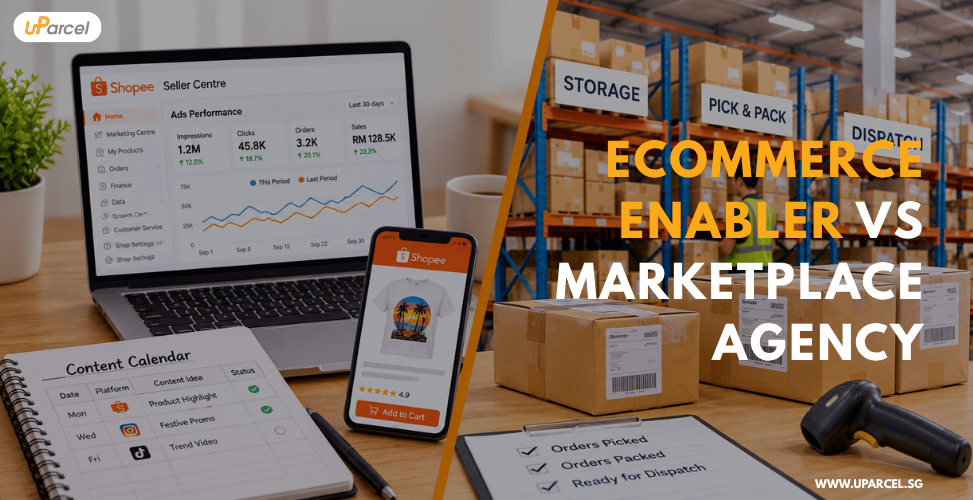
Ecommerce Enabler vs Marketplace Agency: What’s the Difference?
Both an ecommerce enabler and a marketplace agency help you sell on Shopee, Lazada, and TikTok Shop in Singapore. Both manage listings, run promotions, and report on performance. From the outside, they look like the same kind of service. But the difference matters, especially when you are deciding who to hand your Singapore operation to. One partner stops at the digital storefront. The other takes responsibility for everything: from inbound stock through to the package at your customer’s door. This post breaks down what each covers, where they genuinely overlap, and how to decide which one fits your current business stage. What a Marketplace Agency Does A marketplace agency is a digital and marketing specialist. Its focus is on building visibility, traffic, and conversion within platforms like Shopee, Lazada, and TikTok Shop. A typical marketplace agency covers: Store setup and branding: storefront banners, listing templates, product page design Listing and content optimisation: titles, descriptions, keyword mapping, A/B testing variants Paid advertising management: Shopee Ads, Lazada Sponsored Listings, TikTok Shop promotion campaigns Campaign and promotion planning: 9.9, 11.11, category-specific sale events Performance reporting: ROAS, conversion rate, ranking positions, click-through data Customer service management: inbox handling, review responses, escalation scripts What a marketplace agency typically does not cover: Warehousing and inventory storage Pick, pack, and dispatch operations Inbound logistics and Singapore customs clearance Last-mile delivery to end customers Business registration or Importer of Record support An agency is a marketing and growth partner. They build and manage the front end of your marketplace presence, but the physical supply chain stays with you. What an Ecommerce Enabler Does An ecommerce enabler is an end-to-end operations partner. The distinction is physical: an enabler takes responsibility for what happens beyond the digital storefront from the moment stock arrives in Singapore to the moment the order reaches the customer. The full scope of an ecommerce enabler covers three stages: Before the store goes live: Business registration support and ACRA entity setup Inbound shipping coordination and Singapore customs clearance via TradeNet Warehouse inbounding, stock receiving, and inventory organisation Running the store daily: Shopee, Lazada, and TikTok Shop store management and listing optimisation Traffic strategy, keyword ranking, and paid campaign management Social commerce and live stream support AI-discoverable SEO content for marketplace search Fulfilling every order: Pick, pack, and dispatch for each order received Same-day and next-day delivery across Singapore Returns management and customer service coordination This breadth is why an ecommerce enabler is the standard model for overseas brands entering Singapore. A Malaysian, Australian, or Hong Kong brand can engage one partner to handle the customs, the warehouse, the storefronts, and the deliveries, without building a local operation from scratch. For a deeper look at what this kind of engagement involves, what is an ecommerce enabler covers the model in full. When a brand wants a single partner to run the complete Singapore marketplace operation, inbound stock, daily store management, order fulfillment, and last-mile delivery, this model is sometimes called a complete marketplace outsource solution (CMOS). uParcel operates this way through its ecommerce enabler service, managing the full chain on behalf of brands selling in Singapore. Where a Marketplace Agency and an Ecommerce Enabler Overlap The confusion between the two comes from genuine overlap in the storefront and marketing layer. Both partner types can handle: Shopee, Lazada, and TikTok Shop store management Product listing creation and content optimisation Campaign and promotion planning and execution Performance tracking and sales reporting Customer service for marketplace inboxes If the question is “who manages my Shopee store,” either type of partner can answer yes. The difference only becomes visible when you ask what happens after an order is placed and who is responsible for making sure it gets delivered. The Key Differences Between an Enabler and an Agency Area Marketplace Agency Ecommerce Enabler Marketplace store management ✓ Core service ✓ Included Listing and SEO optimisation ✓ Core service ✓ Included Paid advertising and campaigns ✓ Core service ✓ Often included Warehousing and storage ✗ Not covered ✓ Core service Pick, pack, and fulfilment ✗ Not covered ✓ Core service Last-mile delivery ✗ Not covered ✓ Core service Inbound logistics and customs ✗ Not covered ✓ For overseas sellers Business registration support ✗ Not covered ✓ For overseas sellers Scope of accountability Digital metrics only End-to-end operations Best suited to Brands with existing fulfilment Brands outsourcing the full operation An agency manages the demand side. An enabler owns both the demand side and the supply chain behind it. Choosing the Right Partner for Your Business Stage Neither model is universally better, the right choice depends on where your operation currently stands. A marketplace agency makes sense when: You already have a Singapore 3PL or in-house team managing fulfillment Your main gap is front-end performance, ads, listings, campaigns, and rankings You want a specialist to grow marketplace visibility without touching your logistics setup You are a local brand that needs marketing muscle, not operational support An ecommerce enabler makes sense when: You are entering Singapore for the first time and have no local warehouse or fulfillment partner You are an overseas brand (Malaysia, Australia, Hong Kong) that needs customs, storage, and delivery handled locally Your current setup is fragmented across multiple vendors, and you want one accountable partner You want someone responsible for the full chain, not just the store, but the stock and the last kilometer A practical test: if an order comes in on a Thursday morning, who picks it, packs it, dispatches it, and gets it to your customer by evening? If the answer is unclear or involves three separate vendors, an ecommerce enabler is worth looking at. For a breakdown of what each stage costs, the guide on ecommerce enabler costs in Singapore covers pricing by service component. When You Are Ready to Hand Over the Full Operation For many marketplace sellers, the tipping point comes when managing logistics alongside marketing becomes too much to run alongside the rest of the business. A marketplace agency handles what it handles well, but it cannot pick your orders, clear your inbound stock, or deliver to your customers. An ecommerce enabler closes that gap. If you are at the point where you need one partner to run the complete Singapore operation from warehouse to doorstep, the uParcel ecommerce enabler service covers every stage, and the team can walk you through what that looks like for your specific product and channel setup.

Ecommerce Outsourcing in Singapore: What Each Service Covers and What It Costs
Ecommerce outsourcing in Singapore is not one thing. A seller who outsources fulfillment is solving a very different problem from one who outsources their entire Shopee and Lazada operation and the cost, scope, and the right provider for each look nothing alike. Most sellers who explore outsourcing for the first time either overbuy (paying for services they do not need yet) or underbuy (solving only one part of a multi-part problem). This guide maps the full spectrum, from warehousing and dispatch only, to complete marketplace management, so you know exactly what each level includes, what it typically costs, and when each one makes sense. The Three Levels of Ecommerce Outsourcing Ecommerce outsourcing in Singapore falls into three distinct tiers. Each solves a different operational constraint, and each comes with a different cost structure. Level What You Hand Over Best For Fulfilment only Warehousing, pick-and-pack, courier dispatch Sellers who manage their own stores but cannot scale physical operations Fulfilment + store management All of the above, plus listings, chat, campaigns Sellers who need operations and platform presence managed together Full ecommerce outsourcing End-to-end, from inbound stock to marketplace sales, social commerce and reporting Sellers or brands who want a fully managed Singapore marketplace operation Most sellers start at Level 1 and move up as volume and complexity grow. Some overseas brands entering Singapore go straight to Level 3 because they have no local operational capacity at all. Level 1: Fulfilment Outsourcing: Warehousing, Packing and Dispatch Fulfilment outsourcing means handing your physical stock operations to a third-party logistics provider (3PL). Your inventory sits in their warehouse, and their team picks, packs, and dispatches orders on your behalf. What is typically covered: Receiving and logging inbound stock by SKU Racked storage in a Singapore warehouse with live inventory tracking Picking individual orders and packing to your specifications (branded tape, inserts, gift wrapping) Daily handover to couriers for same-day or next-day delivery Returns receipt and condition checking Low-stock alerts and inventory reporting What is not covered at this level: Managing your Shopee or Lazada seller account Updating product listings, titles, or images Responding to buyer chat queries Running platform campaigns or promotions Typical cost structure: Cost Component Typical Range Storage S$60–150 per pallet per month Pick and pack (standard) S$1.50–3.50 per order Custom or branded packing S$0.50–2.00 additional per order Inbound receiving fee S$10–30 per inbound shipment Minimum monthly commitment Varies by provider — typically S$300–800 Best suited for: Sellers at 150+ orders per month who are hitting dispatch constraints or spending too many hours packing, but whose store management is under control. Level 2: Fulfilment Plus Store Management At this level, outsourcing extends from the warehouse into the marketplace itself. A provider manages your seller accounts on Shopee, Lazada, and TikTok Shop, handling listings, buyer chat, campaign participation, and store performance metrics — alongside the physical fulfilment operation. What is typically covered, in addition to Level 1: Product listing creation, title optimisation, and keyword updates Main image and gallery image management Campaign and flash sale submission and coordination Buyer chat responses within platform SLA windows (Shopee requires above 75% response rate within 12 hours for Preferred Seller status) Review monitoring and response Seller performance metric management (Late Shipment Rate, Non-Fulfilment Rate) Monthly sales and performance reporting by channel What is typically not covered at this level: Social media content creation or management Live commerce sessions Inbound shipping and customs clearance (relevant for overseas sellers) Multichannel advertising strategy Typical cost structure: Cost Component Typical Range Fulfilment (as per Level 1) S$1.50–3.50 per order + storage Store management retainer S$1,000–3,000 per month per channel Campaign participation fee Sometimes bundled, sometimes additional Setup and onboarding S$500–1,500 one-off Best suited for: Sellers managing two or more channels, or those whose platform metrics (LSR, chat rate, listing rankings) are suffering because there is not enough time to maintain both operations and store management simultaneously. Level 3: Full Ecommerce Outsourcing: End-to-End Marketplace Management Full ecommerce outsourcing covers the complete operational chain from inbound stock to last-mile delivery to daily marketplace management. uParcel’s version of this is called CMOS (Complete Marketplace Outsource Solution): a single engagement where one partner manages the full Singapore marketplace operation on the brand’s behalf. For Singapore-based sellers, CMOS means the warehouse, the store accounts, and the courier all run under one arrangement. For overseas brands entering Singapore, it also includes inbound customs clearance and the Seller of Record function, so the brand can sell on Shopee, Lazada, and TikTok Shop without needing a local operational team in place. What is typically covered under a full outsourcing arrangement: Inbound receiving, storage, and live inventory management by SKU Pick, pack, and same-day courier dispatch daily Full seller account management across Shopee, Lazada, and TikTok Shop Product listing creation, SEO optimisation, and ongoing keyword refresh Campaign planning, submission, and performance tracking Buyer chat, returns coordination, and review management Social commerce and live selling (channel-dependent) API integration connecting all sales channels to the warehouse Customs clearance and inbound logistics support for overseas sellers Weekly or monthly performance reporting across all channels Typical cost structure: Cost Component Typical Range Full enabler monthly retainer S$2,500–8,000+ per month Variable fulfilment fee S$1.50–3.50 per order on top of retainer Setup and integration S$1,000–3,000 one-off Platform ad spend (if managed) Separate, pass-through budget The range is wide because scope varies significantly: number of channels, SKU count, order volume, whether social commerce is included, and whether inbound customs handling is needed. A detailed scope review with a provider will give you a more precise figure for your specific situation. What an ecommerce enabler service costs in Singapore, broken down → Best suited for: Sellers at 400+ orders per month who need operations and marketplace management running together; overseas brands with no Singapore operational presence who need a complete market entry solution. Costs That Apply Across All Levels Regardless of which tier you enter at, several cost components appear across most outsourcing arrangements in Singapore. Factor these into any comparison: Minimum monthly commitments: Most providers set a minimum monthly fee, either a fixed retainer or a minimum order volume to ensure the arrangement is viable for their team. Understand this before comparing per-order rates in isolation. Integration and setup fees: Connecting your Shopee, Lazada, and Shopify accounts to a provider’s warehouse management system typically involves a one-off setup fee. Confirm whether this is included or invoiced separately. Inbound receiving charges: Most providers charge per inbound shipment received, separate from ongoing storage. Frequent small shipments cost more than consolidated ones. Returns handling: Return processing is often charged per returned item. Some providers include basic returns receipt in the base rate; inspection, relabelling, and restocking are usually additional. Surge pricing during peak periods: Fulfilment providers often apply peak surcharges during campaign periods (9.9, 11.11, 12.12, Chinese New Year). Confirm whether your provider applies these and at what rate. Matching the Level to Your Business Choosing the right tier comes down to where your operational constraint actually is. A useful self-check: Your store management is working well, but packing is taking hours every day? → Level 1 solves your problem. Your listings are drifting in rankings, your chat response rate is slipping, and you are also behind on dispatch? → Level 2 is the fit, solving one without the other leaves half the problem in place. You are an overseas brand with no Singapore team, no local entity access, and no operational presence? → Level 3, and confirm whether inbound customs handling is included in scope. You have tried Level 1 and it helped, but your store metrics are still declining? → Move to Level 2 rather than switching 3PL providers, the fulfilment was not the only constraint. How in-house and outsourced fulfilment compare at different order volumes → What to Check Before You Commit Before signing with any outsourcing provider in Singapore, confirm the following: Is the warehouse in Singapore? For Shopee and Lazada same-day or next-day delivery, local warehousing is non-negotiable. Overseas or Johor-based facilities add lead time that makes fast dispatch unreliable. Does the API connect to your specific channels? Confirm live integration with Shopee, Lazada, TikTok Shop, and Shopify, not just one or two. A manual order handover process between platforms defeats the purpose. What is the daily dispatch cut-off? This determines whether same-day delivery is actually achievable. A 3pm cut-off delivers very differently from a 10am one. What does reporting look like? You should receive regular data on order volume, late shipment rate, fulfilment accuracy, and at Level 2 or 3, listing rankings and channel revenue. If reporting is vague or ad hoc, you will be managing blind. What are the exit terms? Minimum contract length, notice period, and what happens to your stock if you move providers. This is especially important if you are signing a longer retainer at Level 2 or 3. FREQUENTLY ASKED QUESTIONS Can I outsource just one channel and manage the others myself? Yes. Most providers can manage a single Shopee or Lazada store while you continue managing a Shopify site or other channel independently. The key is ensuring inventory sync, if your 3PL does not update stock levels across all channels in real time, overselling risk remains. How much stock do I need before a 3PL makes sense financially? The break-even point depends on your current cost of self-fulfilment: how much time you spend packing, whether you are paying for storage space separately, and whether missed dispatch windows are costing you in platform penalties. Most sellers find outsourcing becomes cost-neutral or positive at 150–200 orders per month when the time saving and LSR protection are factored in. Do I need a Singapore entity to use ecommerce outsourcing services? For fulfilment-only (Level 1), a Singapore entity is not usually required, the 3PL receives and dispatches on your behalf. For marketplace store management (Levels 2 and 3), platform seller accounts in Singapore typically require a local entity or a Seller of Record arrangement. Confirm this with the provider before assuming an account can be opened under an overseas entity. How long before outsourced fulfilment improves my Shopee metrics? Late shipment rate improvements are visible within the first two to three weeks of live fulfilment, orders are dispatching on the warehouse’s daily schedule rather than yours. Listing ranking improvements from store management take longer: four to eight weeks before the platform’s algorithm reflects the updated listing quality in search position. uParcel’s ecommerce enabler service covers all three levels, Singapore-based warehousing and fulfilment, store management across Shopee, Lazada, and TikTok Shop, social commerce, and API integration for local and overseas sellers and brands who want their Singapore marketplace operation properly resourced and managed. Explore uParcel’s ecommerce outsourcing services → { "@context": "https://schema.org", "@type": "FAQPage", "mainEntity": [ { "@type": "Question", "name": "Can I outsource just one channel and manage the others myself?", "acceptedAnswer": { "@type": "Answer", "text": "Yes. Most providers can manage a single Shopee or Lazada store while you continue managing a Shopify site or other channel independently. The key is ensuring inventory sync, if your 3PL does not update stock levels across all channels in real time, overselling risk remains." } }, { "@type": "Question", "name": "How much stock do I need before a 3PL makes sense financially?", "acceptedAnswer": { "@type": "Answer", "text": "The break-even point depends on your current cost of self-fulfilment: how much time you spend packing, whether you are paying for storage space separately, and whether missed dispatch windows are costing you in platform penalties. Most sellers find outsourcing becomes cost-neutral or positive at 150–200 orders per month when the time saving and LSR protection are factored in." } }, { "@type": "Question", "name": "Do I need a Singapore entity to use ecommerce outsourcing services?", "acceptedAnswer": { "@type": "Answer", "text": "For fulfilment-only (Level 1), a Singapore entity is not usually required, the 3PL receives and dispatches on your behalf. For marketplace store management (Levels 2 and 3), platform seller accounts in Singapore typically require a local entity or a Seller of Record arrangement. Confirm this with the provider before assuming an account can be opened under an overseas entity." } }, { "@type": "Question", "name": "How long before outsourced fulfilment improves my Shopee metrics?", "acceptedAnswer": { "@type": "Answer", "text": "Late shipment rate improvements are visible within the first two to three weeks of live fulfilment, orders are dispatching on the warehouse’s daily schedule rather than yours. Listing ranking improvements from store management take longer: four to eight weeks before the platform’s algorithm reflects the updated listing quality in search position." } } ] }