Omnichannel warehouse Singapore

Er Cai Fang
Senior Product Manager
Discover how an omnichannel warehouse in Singapore unifies retail and e-commerce inventory, speeds up fulfilment, and cuts costly stockouts across every channel.
Omnichannel Warehouse Singapore: The Smart Way for Retailers and E-Commerce Brands to Fulfil Every Order
More Singapore businesses are selling across multiple channels at the same time. Shopee, Lazada, Shopify, TikTok Shop, and a physical retail presence, all running in parallel. That multi-channel reach is a genuine advantage, but it comes with a catch most brands don't spot until it starts costing them money.
Most of those businesses are still managing stock separately for each channel. One pile of inventory for the online store, another for the retail outlet, the third for the marketplace. The result? Phantom stockouts on Lazada while boxes collect dust in the storeroom. Overselling on Shopify because the retail team sold the last unit without updating the system. Fulfilment delays that show up as negative reviews.
An omnichannel warehouse solves this by giving you one inventory hub that serves every channel simultaneously. Whatever sells and wherever it sells, your stock, your picking, and your delivery all flow from the same operation.
What Is an Omnichannel Warehouse?
An omnichannel warehouse is a single fulfilment hub that manages inventory and processes orders for multiple sales channels at the same time — online marketplaces, your own direct-to-consumer (DTC) store, and physical retail locations (B2B), all served from one roof.
Traditional warehousing assigns stock to individual channels. A pallet earmarked for your Shopee store, a rack for your Orchard Road boutique. That separation feels logical until you're sitting on excess retail stock while your e-commerce listing shows "Sold Out." Omnichannel warehousing pools that inventory and allocates it dynamically, so every unit is working as hard as possible regardless of where demand comes from.
How It Differs from a Standard 3PL Warehouse
A standard third-party logistics warehouse stores your goods and ships them out. An omnichannel warehouse does more: it integrates directly with every platform you sell on, provides real-time inventory visibility across all channels, handles channel-specific packing and labelling requirements, and manages both single-parcel DTC orders and bulk B2B retail replenishments, from the same location.
That operational breadth is what separates a capable omnichannel 3PL from a basic storage-and-ship facility.
The Real Cost of Running Your Channels in Silos
Here's what most Singapore brands don't calculate: every time you manage inventory separately across channels, you pay a multiplied cost. In working capital locked up in excess stock, in operational time reconciling channel data, and in sales lost to avoidable stockouts.
Phantom Stockouts and Overselling
When stock isn't pooled, you'll regularly have unsold inventory at your retail outlet while your Lazada listing reads "Out of Stock." Or your Shopify store confirms an order for an item your retail team sold yesterday without updating the system. Both situations damage customer trust and hurt your marketplace seller ratings and which directly affect your product's visibility in search results on Shopee and Lazada.
Slower Fulfilment and Higher Operational Costs
Omnichannel shoppers in Singapore expect fast delivery. Research from Shopify SG shows that omnichannel operations, when the backend fulfilment can actually keep up, can lift GMV by 8.9%. But when you're running separate picking, packing, and shipping workflows for each channel, every order takes longer and costs more. Unified operations eliminate that duplication.
What an Omnichannel Warehouse Actually Delivers
One Real-Time Inventory View Across All Channels
Whether stock is being pulled by a Shopee order, a midnight Lazada flash sale, or a retail outlet replenishment run, you see exactly what you have at any moment. No more reconciling spreadsheets across three channel managers at the end of each week. When stock levels are accurate in real time, your listings stay live longer, your promotions run without fear of overselling, and your retail team knows exactly what they can promise customers in-store.
BOPIS and Click-and-Collect Support
Buy Online, Pick Up In-Store (BOPIS) is one of the fastest-growing fulfilment formats in Singapore retail. FairPrice has already demonstrated the model works locally — customers check real-time stock online, place the order, and collect at their preferred outlet. For BOPIS to work, your warehouse and your retail locations need to share a live inventory layer. An omnichannel warehouse makes that connection standard, not a custom integration project.
Returns Management, Handled Properly
Omnichannel returns are notoriously complex. A customer buys on Shopify and returns to your retail outlet. Where does that unit go? Back to the warehouse? Restocked in-store? An omnichannel warehouse has the system integrations and reverse logistics workflows to absorb returns, inspect and grade them, and restock them to the right channel quickly. Returned goods stop sitting in a limbo corner and start generating revenue again.
How to Choose the Right 3PL for Omnichannel in Singapore
Not every 3PL warehouse in Singapore is genuinely built for omnichannel. Here's what to evaluate before you commit:
- Platform integrations: Does the 3PL connect directly to Shopee, Lazada, Shopify, and TikTok Shop? Manual order syncing kills efficiency within weeks of going live. You need a immediate sync from your provider whenever there’s movement in your inventory.
- B2B and B2C capability: You need a 3PL that handles single-parcel DTC orders and bulk retail replenishments from the same warehouse. Not all do.
- Real-time inventory reporting: If you can't see current stock levels without emailing your 3PL, that's a red flag for omnichannel operations. If you can’t see the delivery status. It’s another huge red flag.
- Returns processing: Ask specifically how they handle reverse logistics and restocking before signing anything.
- Singapore location and delivery SLAs: Proximity to major expressways and your retail network matters when you're promising same-day or next-day fulfilment.
- Delivery Speed: How fast can they fulfil your stores’ inventory stockout and deliver to your buyers. Singapore has the highest penetration rate for Same Day Delivery among the Southeast Asia countries. If you want to sell well in Singapore, expect to offer Same Day Delivery.
The right 3PL becomes a genuine operational partner. uParcel's third-party logistics service in Singapore is built to handle exactly this kind of complexity — multiple channels, multiple fulfilment formats, one integrated operation.
How uParcel Powers Omnichannel Warehouse Fulfilment in Singapore
uParcel is built for brands that sell across multiple channels simultaneously. Whether you're running a Shopify storefront alongside a retail presence, managing weekly replenishments to multiple boutiques, or scaling up for a Shopee 11.11 campaign, uParcel handles the warehousing and last-mile delivery from one integrated Singapore operation.
uParcel's Singapore warehouse services give you dedicated storage space, real-time inventory tracking, and a picking-and-packing team that knows the difference between a B2C parcel and a B2B retail delivery — and handles both without you having to manage two separate workflows.
For brands scaling their online presence, uParcel's e-commerce last-mile fulfilment service connects seamlessly with Shopee, Lazada, and Shopify orders so that every sale triggers an automatic fulfilment workflow. No manual download of orders, no copy-paste into a courier portal.
The result is a fulfilment setup that scales with your business rather than becoming a bottleneck every time you launch a new channel or run a major promotion.
The Right Time to Make the Switch Is Before You Need To
The best time to move to an omnichannel warehouse is before your channel complexity outpaces your current setup, not after a high-profile stockout, a failed flash-sale window, or a marketplace performance warning.
If you're selling across two or more channels and spending meaningful time each week manually reconciling stock, updating listings, or chasing courier updates, a unified omnichannel warehouse will pay for itself faster than you expect.
uParcel works with Singapore brands at every stage of this transition — from brands moving their first SKUs into managed warehousing to established retailers consolidating a fragmented fulfilment setup into one efficient operation.
Explore uParcel's warehouse and 3PL services, or reach out to the team to talk through what an omnichannel setup looks like for your specific channel mix and order volumes.
Other Blog Posts
How to Transition From In-House Storage to a Third-Party Warehouse in Singapore
For many Singapore businesses, in-house storage starts as a practical decision. A spare room, a rented self-storage unit, a corner of the office, it works when order volumes are low and the operation is manageable by one or two people. Then the business grows. Orders increase. SKU counts expand. The time spent picking, packing, and running to the post office starts consuming hours that should be going into the business itself. Stock outs happen more frequently. Returns pile up in a corner with no clear process. At this point, most business owners know they need to make the move to a third-party warehouse. What stops them is not the decision, it is uncertainty about how the transition actually works. What happens to the inventory currently in the spare room or the self-storage unit? How do you brief a 3PL on your products, your processes, and your expectations? What could go wrong, and how do you avoid it? This guide walks through the transition from in-house storage to a third-party warehouse in Singapore, step by step from the initial inventory audit to the day you hand over your last carton. Step 1: Audit Your Current Inventory Before You Move Anything The single biggest mistake businesses make when transitioning to a 3PL is moving their inventory as is, bringing disorganization, excess stock, and unresolved discrepancies into a new environment where they will cause ongoing operational problems. Before you contact a single 3PL provider, do a full inventory audit. What a pre-transition inventory audit covers: SKU count - how many distinct product variants do you have? Each SKU needs to be accurately cataloged with a product name, description, dimensions, and weight before it arrives at a 3PL Stock quantities - count every unit. Discrepancies between your records and actual stock need to be resolved before handover, not after Product condition - identify any damaged, expired, or unsaleable stock and clear it out before transfer. 3PLs charge for storage regardless of condition; you do not want to pay to store goods you cannot sell Storage requirements - does any inventory require cold chain, temperature-controlled, or regulated storage? Identifying this upfront determines which warehouse types you are eligible to use Inbound packaging - are products arriving in individual units, cartons, or on pallets? The 3PL needs to know this to plan their receiving workflow The output of the audit is a clean inventory list typically a spreadsheet with one row per SKU, that becomes your master reference for the transition. Step 2: Choose the Right Type of 3PL Warehouse Not all warehouse storage facilities in Singapore offer the same conditions or capabilities. Matching your products to the right storage environment before you commit saves significant cost and operational friction later. Storage Type Suited For Ambient / General dry storage Non-perishable goods, ecommerce inventory, electronics, fashion, lifestyle products Cold chain / refrigerated storage Food, beverages, health supplements, temperature-sensitive cosmetics Temperature-sensitive storage Pharmaceuticals, medical supplies, biotech products requiring controlled humidity GDPMDS-certified pharma storage Regulated medical devices and medicines requiring compliance documentation B2B / bulk pallet storage High-volume distributors and wholesalers managing large inventory turns Most ecommerce sellers in Singapore will be looking at ambient storage integrated with fulfillment capability but if your product range spans multiple categories, confirm whether your prospective 3PL can handle all of them under one roof or whether you will need separate providers. For the broader decision of when this transition makes sense versus sticking with self-storage, the post on when to move from self-storage to a fulfilment warehouse covers the trigger signals worth checking before committing. Step 3: Get a Quote and Understand the Full Cost Structure Once you know your inventory profile, get quotes from shortlisted 3PL providers before committing to a physical transfer. A quote based on your actual SKU count, storage volume, and order volume gives you an accurate picture of what outsourced warehousing will cost and whether the economics make sense for your business now and at your projected scale in six months. When evaluating quotes, look beyond the headline storage rate. The total cost of warehousing includes: Storage fee (per CBM or pallet, per month) Inbound receiving fee (per pallet or per piece) Pick-and-pack fee (per outbound order) SKU management fee (per active SKU, per month) Value-added services (returns processing, kitting, inserts) Minimum monthly billing, the floor charge you pay regardless of actual usage uParcel's storage quotation tool lets you input your inventory profile and generate an instant, itemized estimate, no commitment required. Running this before your first conversation with a 3PL sales team means you enter the discussion with a benchmark number and a clear understanding of what you need. Step 4: Brief the 3PL Team on Your Products and Requirements A 3PL cannot manage your inventory well without understanding it. Before the physical transfer, schedule a briefing with your chosen provider that covers: Product information: Full SKU catalogue with dimensions, weights, and any handling requirements Fragile, high-value, or compliance-sensitive items that require special handling Any products with expiry dates that require FEFO (First Expired, First Out) stock management Operational requirements: Your current order volume and how it is expected to change over the next 6–12 months Your dispatch SLA - do you need same-day dispatch for orders placed before a certain cutoff? Platform-specific requirements - Shopee NFR and Late Shipment Rate compliance, Lazada fulfillment standards, TikTok Shop SLAs all have specific implications for how the 3PL must operate your account Returns process: How do you want returned goods handled? Inspect and return to stock? Segregate for your review? Dispose of damaged items? What is the expected monthly returns volume? The more clearly you communicate these requirements upfront, the less likely you are to encounter operational misalignment once the inventory is in. Step 5: Plan the Physical Transfer Moving inventory from your current location to the 3PL warehouse is a logistics operation in itself. Do not underestimate it. Key decisions for the physical transfer: Transfer method - are you transporting goods in your own vehicle, using a van or lorry service, or having the 3PL arrange inbound collection? For larger inventories, a pallet delivery to the warehouse is typically the cleanest approach Transfer timing - avoid transferring inventory during your peak order period. Downtime during the handover window is normal; plan for it rather than being caught off guard Labelling - cartons and pallets arriving at the 3PL warehouse should be labelled clearly by SKU before they arrive. This speeds up the inbound receiving process and reduces the risk of stock being miscounted or misplaced Stock count at handover - insist on a stock count confirmation at the point of receipt. Both you and the 3PL should agree on quantities received before the inventory goes live in the warehouse management system For a larger inventory transfer, many businesses plan a staggered transfer, moving the highest-velocity SKUs first, operating with the 3PL for those lines while still managing slower-moving stock in-house, then completing the full handover once the relationship and processes are proven. Step 6: Set Up Systems Integration For ecommerce sellers, the transition to a 3PL warehouse should coincide with a systems integration that connects your sales channels to the warehouse management system. Without this, orders still require manual processing, which defeats much of the operational benefit of outsourcing. What integration looks like in practice: Your Shopee, Lazada, TikTok Shop, and/or Shopify stores connect to the 3PL's system via API Orders placed on any channel are automatically routed to the warehouse without manual intervention Inventory levels update in real time across all storefronts as stock is picked and shipped Tracking information flows back to the marketplace automatically, keeping your seller metrics compliant uParcel's Ecommerce Fulfillment service includes API-connected fulfillment for multi-channel sellers so orders from Shopee, Lazada, TikTok Shop, and Shopify all feed into a single processing workflow without separate manual steps per platform. Step 7: Run a Parallel Period, Then Decommission In-House Storage Do not close your in-house storage the day inventory moves to the 3PL. Plan for a 2–4 week parallel period during which: The 3PL is processing live orders from your active inventory You are monitoring order accuracy, dispatch timing, and platform SLA compliance You are raising and resolving any operational teething issues before they become patterns Once you are satisfied that the 3PL is operating your account to your standards, you can decommission your in-house storage, return self-storage units, clear out the spare room, or repurpose the space. Not before. This parallel period is also the right time to review your quotation against actual charges and confirm that the cost structure matches what you expected. Common Transition Mistakes to Avoid Moving dirty inventory. Unresolved stock discrepancies, damaged goods, and unlabelled cartons become expensive 3PL problems. Audit and clean your inventory before transfer. Not briefing the 3PL on platform SLAs. A 3PL that does not know you are a Shopee Preferred Seller with a 1% NFR threshold may not prioritize same-day dispatch the way your account requires. Communicate your platform obligations explicitly. Assuming the transition will be seamless from day one. Every new operational relationship has a learning curve. Build buffer time into your transition plan; do not transfer inventory during your single busiest sales period. Skipping the parallel period. The temptation to save on double costs by decommissioning in-house storage immediately after transfer is understandable. The parallel period protects you if something goes wrong; the cost of running it for two to four weeks is almost always less than the cost of a fulfillment failure with no fallback. Choosing a provider on storage rate alone. As covered in the true cost of warehousing post, the storage rate is one component of the total cost. Evaluate total monthly spend across all fee categories. What the Transition Looks Like With uParcel uParcel's warehouse storage service supports businesses at every stage of the transition, from the initial quotation through to ongoing inventory management and fulfillment. The process typically runs as follows: Quotation - use the online storage quotation tool to generate an itemized estimate based on your inventory volume, SKU count, and order volume Onboarding briefing - the uParcel team collects your full SKU catalogue, storage requirements, SLA expectations, and integration needs Inbound receiving - your inventory is transferred to the uParcel warehouse at JTC Defu Industrial City; stock is counted, logged, and located in the warehouse management system System integration - your sales channels connect to the fulfillment workflow via API; orders begin routing automatically Go-live - orders are processed, packed, and dispatched same-day (for orders received before the cutoff window) uParcel stores ambient, cold chain, and GDPMDS pharma-compliant inventory under one roof, with no long-term lease commitment and flexible monthly terms that scale with your volume. For businesses that have previously worked with another 3PL and are evaluating a switch rather than coming from in-house, the guide on how to switch 3PL providers in Singapore covers the parallel considerations that apply to that transition. The Transition Is a One-Time Effort for a Long-Term Gain Moving inventory from in-house storage to a third-party warehouse feels like a large operational task, and in the short term, it is. But the transition is a one-time project, not an ongoing cost. The operational capacity you gain on the other side, professional picking and packing, SLA-compliant dispatch, real-time inventory visibility, and storage that scales with your business without a lease is what makes it worthwhile. The key is to approach it methodically: audit first, choose the right storage type, get an accurate quote, brief your provider thoroughly, and plan a parallel period before you close out the old setup. Ready to start the transition? reach out to the uParcel team to discuss your specific storage and fulfillment requirements.
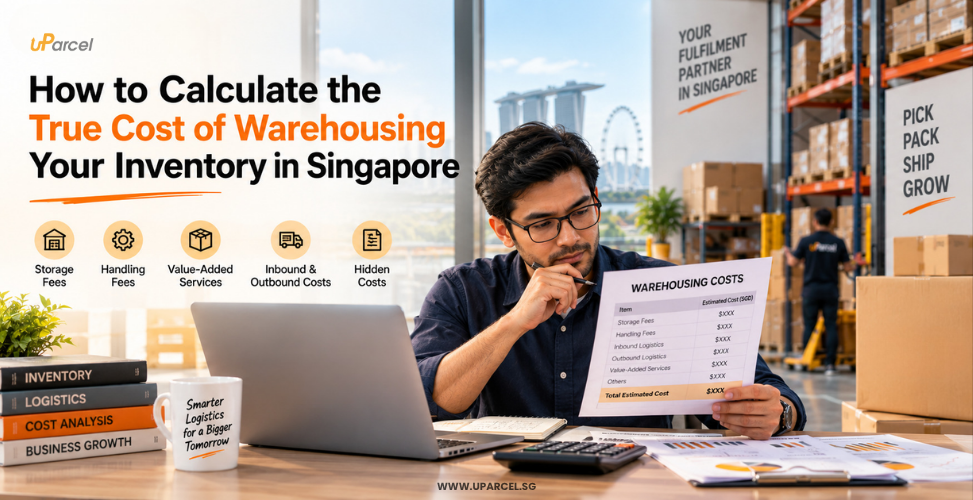
How to Calculate the True Cost of Warehousing Your Inventory in Singapore
Most businesses budget for warehousing by looking at one number: the storage rate per cubic meter. They calculate their inventory volume, multiply by the monthly rate, and call it a cost. That number is usually wrong by a significant margin. The true cost of warehousing in Singapore is not just what you pay to store your goods. It includes inbound receiving fees, per-order pick-and-pack charges, SKU management fees, returns handling, value-added services, and most commonly overlooked, the minimum billing gap that applies when your inventory is below a certain threshold. For ecommerce sellers and business owners evaluating a warehouse partner, understanding every component of this cost is essential. It determines whether you are comparing partners fairly, whether outsourcing actually costs less than doing it yourself, and whether the plan you have made for the next quarter is financially accurate. This guide walks through every layer of warehousing cost in Singapore, shows how to calculate your realistic monthly spend, and explains where uParcel's pricing fits within that picture. What Actually Goes Into the Cost of Warehousing in Singapore? Warehousing costs in Singapore are made up of several distinct fee categories. Most 3PL providers charge across all of these, but not all communicate them with equal clarity upfront. 1. Storage Fee (Charged by CBM or Pallet) The storage fee is the baseline cost of physically holding your inventory. In Singapore, most 3PL warehouses price storage by CBM (cubic metre), the volume your goods occupy in the warehouse. What is CBM? One CBM equals a space of 1 metre × 1 metre × 1 metre. If your inventory occupies a 2m × 1m × 1.5m space, that is 3 CBM. Typical ambient (general dry) storage rates in Singapore range from S$80 to S$120 per CBM per month, depending on: Volume committed (higher volume = lower per-CBM rate) Type of storage required (ambient vs cold chain vs pharma-compliant) Warehouse location (central vs industrial estates) Some providers also offer pallet-based pricing (e.g., S$25–S$60 per pallet per month) for businesses managing bulk stock. 2. Inbound / Receiving Fee Every time goods arrive at the warehouse, whether from a local supplier, an overseas shipment, or a returns return, the warehouse charges a receiving fee to unload, inspect, and log the inventory. Typical inbound rates in Singapore: Per pallet: S$25–S$35 per pallet Per carton/piece: S$0.20–S$0.30 per piece (for loose inbound) This cost is often missed entirely during planning, particularly for businesses with frequent inbound shipments. 3. Pick-and-Pack Fee (Per Order) Every time a customer order is processed, the warehouse charges a pick-and-pack fee to pick the relevant items from racking, pack them, and prepare them for dispatch. This is one of the most significant costs for high-order-volume sellers. Typical pick-and-pack rates in Singapore range from S$1.40 to S$2.50 per order, with rates declining at higher monthly volumes: Low volume sellers (under ~500 orders/month): S$1.80–S$2.50/order Mid volume sellers (500–2,000 orders/month): S$1.60–S$1.80/order High volume sellers (2,000+ orders/month): S$1.40–S$1.60/order For a seller processing 800 orders a month at S$1.70 per order, that is S$1,360 per month in pick-and-pack fees alone, before storage or any other cost. 4. SKU Management Fee A SKU (Stock Keeping Unit) is each distinct product variant you hold, a different colour, size, or product type counts as a separate SKU. Most warehouses charge a monthly SKU management fee for maintaining inventory records across your product catalogue. Typical SKU fees in Singapore: S$1–S$5 per active SKU per month For a seller with 50 active SKUs at S$2/SKU, that is S$100/month. For a seller with 200 SKUs at S$3, it is S$600/month. Volume and catalogue complexity matter. 5. Value-Added Services Beyond core storage and fulfillment, warehouses offer additional services that carry their own fees: Service Typical Singapore Rate Returns processing S$2.50–S$5.00 per returned order Kitting / bundling S$2.50–S$4.00 per kitted order Marketing insert insertion S$0.15–S$0.25 per piece Repackaging / relabelling Quoted per project These costs are relevant for sellers running promotions, subscription boxes, or marketplace-specific fulfillment requirements. 6. Minimum Monthly Billing Most Singapore 3PL warehouses apply a minimum monthly billing, a floor charge you pay regardless of how much storage space you use or how many orders you process. This is the most commonly overlooked cost for new and smaller sellers. A minimum billing of S$200/month means that even if your actual usage only amounts to S$120 in a quiet month, you are paying S$200. For businesses with uneven order flow, this gap adds up. The Hidden Costs Most Businesses Forget to Calculate Beyond the line-item fees, several indirect costs consistently go unaccounted for in warehousing budgets. Minimum Billing Gaps If your monthly usage falls below the minimum billing threshold, you are paying for capacity you did not use. This affects seasonal sellers, new-to-market businesses, and any company going through a slow period. It is worth calculating what your minimum billing exposure looks like across all 12 months, not just your peak months. The Cost of the Wrong Warehouse Location Warehouse location has a direct impact on delivery cost and speed. A warehouse located far from your primary delivery zones in Singapore increases last-mile delivery time and may push same-day delivery outside the possible window. For ecommerce sellers where delivery speed is a competitive factor, this is a real cost, just one that does not appear on a warehouse invoice. uParcel's warehouse at JTC Defu Industrial City is centrally positioned within Singapore's industrial belt, with island-wide same-day delivery coverage from that location. Inventory Damage and Shrinkage Poor storage conditions, improper handling, or inadequate environmental controls can result in product damage, a cost that falls on the business, not the warehouse, unless the contract specifies otherwise. For temperature-sensitive, fragile, or high-value products, the cost of a single damaged batch can dwarf months of storage fees. This is why storage type and compliance matter as much as rate. The True Cost of Self-Storage Many early-stage sellers use self-storage units to keep costs low. The comparison rarely accounts for all the real costs: storage fee + your own time to pick, pack, and dispatch each order + delivery cost (often using consumer couriers at non-commercial rates) + the operational ceiling that self-fulfilment places on growth. For a more detailed breakdown of when this trade-off no longer makes sense, the post on when to move from self-storage to a fulfillment warehouse is worth reading before making that decision. How to Calculate Your Monthly Warehousing Cost: A Step-by-Step Framework Use this five-step framework to estimate your realistic monthly warehousing spend in Singapore before approaching any provider. Step 1: Estimate your storage volume in CBM Measure your inventory (length × width × height in metres) and multiply by the number of units. Divide by the standard carton packing if goods arrive in cases. This gives you your approximate CBM. Step 2: Estimate your monthly order volume How many outbound orders do you process per month? This drives your pick-and-pack cost directly. Step 3: Count your active SKUs How many distinct product variants does your catalogue include? Each active SKU carries a monthly management fee. Step 4: List your value-added requirements Do you need kitting? Returns processing? Marketing insert insertion for marketplace orders? These each carry a per-unit charge. Step 5: Apply minimum billing Check the minimum monthly billing of any provider you are evaluating and compare it against your expected usage. If expected usage is consistently below the minimum, factor the gap into your cost. Example calculation for a mid-size Singapore ecommerce seller: Cost Component Estimate Monthly Cost Storage (4 CBM × S$90/CBM) 4 CBM S$360 Pick & Pack (600 orders × S$1.70) 600 orders S$1,020 SKU management (40 SKUs × S$2) 40 SKUs S$80 Returns processing (30 returns × S$3) 30 returns S$90 Inbound receiving (2 pallets × S$30) 2 pallets S$60 Total estimated monthly cost S$1,610 Running this calculation before you request quotes helps you evaluate provider proposals on a like-for-like basis rather than comparing headline storage rates that exclude the fees that actually drive the majority of your spend. What uParcel's Warehousing Costs Look Like uParcel's warehouse storage pricing follows the CBM-based model described above, with per-order pick-and-pack fees, SKU management, and value-added services layered on top of the storage rate. Pricing scales with volume, so the per-unit cost decreases as your business grows. Rather than publishing a fixed rate card, which would not account for your specific product type, storage requirements, order volume, or SKU count, uParcel provides an instant online quotation tool that generates a tailored estimate based on your actual inputs. Use uParcel's storage quotation tool to calculate your monthly warehousing cost based on: Your estimated storage volume (CBM) Monthly order volume Number of active SKUs Any value-added service requirements The quotation is generated without a commitment and gives you a clear per-component breakdown, making it straightforward to compare against your current costs or other providers you are evaluating. uParcel's warehouse storage service includes: Ambient, cold chain, and GDPMDS pharma-compliant storage under one provider No long-term lease requirement, flexible monthly terms Integration with same-day and last-mile delivery for fast dispatch once goods are picked Fulfillment warehousing is available for sellers who need an end-to-end pick-pack-dispatch operation For sellers who need storage integrated directly with ecommerce fulfillment across Shopee, Lazada, and TikTok Shop, the Ecommerce Fulfillment service connects warehoused inventory directly to a managed order processing workflow. Calculating Warehousing Costs Accurately Changes the Decision When sellers look only at the storage rate, outsourced warehousing often appears expensive compared to self-fulfilment or self-storage. When they calculate the full picture, storage, pick-and-pack, returns, inbound, value-added services, and the true cost of their own time, the comparison usually looks very different. The six cost components covered in this guide, storage, inbound, pick-and-pack, SKU management, value-added services, and minimum billing give you the framework to build an accurate total cost of warehousing, rather than a partial one. Ready to see what warehousing your inventory with uParcel would actually cost? Use the instant storage quotation tool to get a tailored breakdown, no commitment required. Or reach out to uParcel's team if your requirements include cold chain, pharma compliance, or high-volume fulfillment.
Types of Warehousing in Singapore: A Business Guide
Warehousing in Singapore is not one category. It is a range of specialized facilities, each designed for a different type of goods, a different operational model, and a different stage in a supply chain. Choosing the wrong type of warehousing or assuming one option covers all your needs, is one of the most common and costly mistakes businesses make when setting up logistics in Singapore. This guide covers the eight main types of warehousing available to Singapore businesses, what each one does, who it is designed for, and how to identify which type or combination of types, your operation actually needs. 1. General (Ambient) Warehousing General warehousing stores goods at room temperature in a secure, sheltered facility. It is the baseline warehouse type appropriate for any product that does not require temperature control, specialist handling, or bonded status. Goods stored: fashion, homeware, electronics, lifestyle products, FMCG (non-perishable), industrial parts, stationery, sports goods What it includes: shelved or palletised storage, basic inventory tracking, goods-in and goods-out processing, security What it does not include: order picking or packing, platform integration, courier dispatch, returns management (these are fulfillment services, not storage services — see Type 2) Singapore context: Most general warehousing in Singapore is located in JTC industrial estates Defu, Tuas, Jurong, Pioneer, Pandan, Changi where industrial zoning allows warehousing activity. Ambient storage is typically priced by cubic metre (CBM) per month. General warehousing is the right starting point for importers, distributors, and businesses that manage their own outbound logistics separately from storage. 2. Ecommerce Fulfillment Warehousing (3PL) A fulfillment warehouse is a general warehouse with an operational layer on top. It does not just store your inventory; it picks, packs, labels, and dispatches your customer orders, integrating directly with your sales channels. Goods stored: any product sold through ecommerce channels, fashion, electronics, beauty, homeware, food supplements, lifestyle products What it includes: inventory storage, IMS integration with Shopee, Lazada, TikTok Shop, Shopify, and WooCommerce, same-day pick and pack, courier dispatch, returns processing, real-time inventory reporting Who it is for: ecommerce sellers processing orders regularly, typically 50+ orders per month, who want their logistics handled by a dedicated partner rather than managing it in-house Singapore context: Fulfillment warehousing is volume-tiered. As your order volume and inventory footprint grow, the per-order cost of fulfillment decreases. Platform integration is typically included at no extra charge. This warehouse type is most relevant to Singapore's ecommerce seller market and the most commonly confused with general storage. uParcel's Ecommerce Fulfillment service operates on this model, handling everything from inbound receiving to last-mile delivery. 3. Cold Chain / Temperature-Controlled Warehousing Cold chain warehousing maintains goods within a defined temperature range throughout their time in storage. It is not a single type; different temperature zones serve different product categories. Temperature zones are typically available: Zone Temperature Range Common Uses Chilled 0°C to 8°C Fresh food, dairy, and certain pharmaceuticals Pharmaceutical fridge 2°C to 8°C Medicines, vaccines, biologics Food fridge 2°C to 4°C Perishables, ready meals, fresh produce Frozen -18°C and below Frozen food, ice cream, some biologics Ambient-controlled 15°C to 25°C Sensitive lifestyle and beauty products Regulatory context in Singapore: HSA GDPMDS certification is required for the storage and distribution of medical devices and pharmaceutical products, this applies to the delivery leg as well as the storage facility SFA (Singapore Food Agency) licensing requirements apply to food and beverage cold storage Not all cold chain facilities are certified for pharmaceutical use; confirm regulatory compliance before committing inventory Cold chain warehousing commands a significant price premium over ambient storage, reflecting the energy, compliance, and equipment costs involved. 4. Bonded Warehousing and Free Trade Zone (FTZ) Storage A bonded warehouse stores imported goods under Singapore Customs control. Duties and GST are not payable until the goods leave the bonded facility either for local consumption or re-export. This makes bonded warehousing a cash-flow tool for businesses that regularly import and re-export goods. Singapore's Free Trade Zones: Singapore has seven FTZs, primarily serving sea and air cargo: Jurong Port FTZ Pasir Panjang Terminal FTZ Keppel Distripark FTZ Brani Terminal FTZ Sembawang Wharves FTZ Changi Airport FTZ (Air Cargo Complex) Seletar Airport FTZ Who is this for: Trading companies managing international shipments through Singapore Distributors re-exporting to Southeast Asia without paying Singapore duties Businesses holding high-value inventory where duty deferral has a meaningful cash-flow impact Who it is not for: ecommerce sellers selling domestically in Singapore; bonded warehousing requires customs licensing and adds administrative complexity that is not justified for local B2C fulfillment. 5. Hazardous and Controlled Goods Warehousing Some products require specialist storage facilities due to their chemical properties, flammability, or regulatory status. Standard warehouses are not licensed to store these goods. Products typically requiring specialist storage: Flammable liquids (solvents, adhesives, certain aerosols) Corrosives (cleaning agents, laboratory chemicals) Compressed gasses Lithium battery products above certain thresholds Controlled pharmaceuticals Singapore regulatory context: NEA (National Environment Agency) regulates the storage of scheduled waste and hazardous chemicals SCDF (Singapore Civil Defence Force) licensing is required for facilities storing flammable and combustible materials above defined quantities HSA governs controlled pharmaceuticals and medical device storage If your product contains lithium batteries, certain chemicals, or substances regulated under Singapore's Environmental Protection and Management Act, standard 3PL facilities may decline to store it. Specialist hazardous goods warehouses exist but serve a limited market and carry significantly higher storage rates. 6. Self-Storage Units Self-storage facilities offer small-scale, lockable units for individuals and businesses that need flexible space without a long-term commitment. They are designed for storage only; no fulfillment operations are available. Singapore operators include: Extra Space Asia, StorHub, Lock+Store, and Box@Work. Who self-storage is appropriate for: individuals between moves, businesses with seasonal stock, micro-businesses testing a product before committing to fulfillment infrastructure. Who it is not appropriate for: ecommerce sellers processing regular orders. A self-storage unit provides space for picking, packing, courier integration, returns management, or inventory tracking. The operational gap between self-storage and fulfillment warehousing is significant, and the time cost of bridging it yourself typically exceeds the cost of professional fulfillment for sellers at even moderate volumes. For a detailed comparison of self-storage and ecommerce fulfillment warehousing, this post on what a self-storage unit cannot do for your ecommerce business covers the operational and cost differences specifically. 7. Cross-Docking Facilities Cross-docking is a distribution model where inbound goods are transferred directly from receiving docks to outbound vehicles with minimal or no storage time. It is a logistics throughput strategy, not a long-term storage solution. Who uses it: FMCG distributors managing high-velocity stock replenishment to retail chains Supermarket and convenience store logistics networks Last-mile distribution hubs in hub-and-spoke delivery models Singapore context: Singapore's small geographic footprint means true cross-docking is less common than in larger markets. It is most relevant for businesses managing distribution to multiple Singapore retail locations where speed of throughput matters more than inventory holding. Most ecommerce sellers do not need dedicated cross-docking facilities, the same-day dispatch model offered by fulfillment warehouses achieves a functionally similar outcome for B2C orders. 8. Smart and Automated Warehousing Smart warehousing uses technology, Warehouse Management Systems (WMS), barcode/RFID tracking, automated picking systems, conveyor belts, and IoT sensors to increase throughput, reduce error rates, and improve inventory visibility at scale. What distinguishes a smart warehouse: WMS integration with all inbound, outbound, and inventory movements Real-time inventory visibility across all locations Automated or semi-automated picking (conveyor systems, goods-to-person robots) Data analytics on space utilization, throughput rates, and fulfillment performance Who benefits from it: high-volume enterprise logistics operations, manufacturers, large-scale distributors, and enterprise ecommerce operators. The capital investment required for full automation is significant and only justified at large volumes. For SME ecommerce sellers: a 3PL fulfillment warehouse with a robust IMS and platform integration delivers many of the inventory visibility and order accuracy benefits of smart warehousing without the enterprise cost structure. How to Choose the Right Warehousing Type for Your Business The right warehousing type is determined by four questions: 1. What are your product's physical requirements? Temperature-sensitive goods require a cold chain. Hazardous goods require regulated specialist storage. Everything else can use general ambient warehousing. 2. Are you fulfilling individual customer orders? If yes, you need fulfillment warehousing, not storage. The distinction is operational: storage holds your goods; fulfillment ships them to customers. 3. What is your import and re-export structure? If you regularly import goods that you re-export to regional markets, bonded or FTZ warehousing may offer meaningful duty-deferral benefits. If you are selling domestically, it adds complexity without benefit. 4. What is your order volume and growth trajectory? Volume determines cost efficiency. Start-up volumes (under 30 orders/month) may justify self-storage or general warehousing with in-house fulfillment. Growing volumes (50–500 orders/month) typically make 3PL fulfillment more cost-effective once time costs are included. Getting the Warehousing Setup Right Before You Need To The most common warehousing mistake Singapore businesses make is not choosing the wrong type; it is choosing a type that works now but cannot scale, and then making the transition under operational pressure. If your current warehousing setup is a self-storage unit or spare room, and your order volume is growing, migrating to a fulfillment warehouse before you hit your capacity ceiling is significantly less disruptive than doing it in the middle of a peak sales period. For businesses that need storage without fulfillment, uParcel's warehouse storage service offers flexible ambient storage with a live quotation tool. For ecommerce sellers who need the full pick, pack, and dispatch operation, uParcel's Ecommerce Fulfillment service covers the complete outbound logistics cycle.