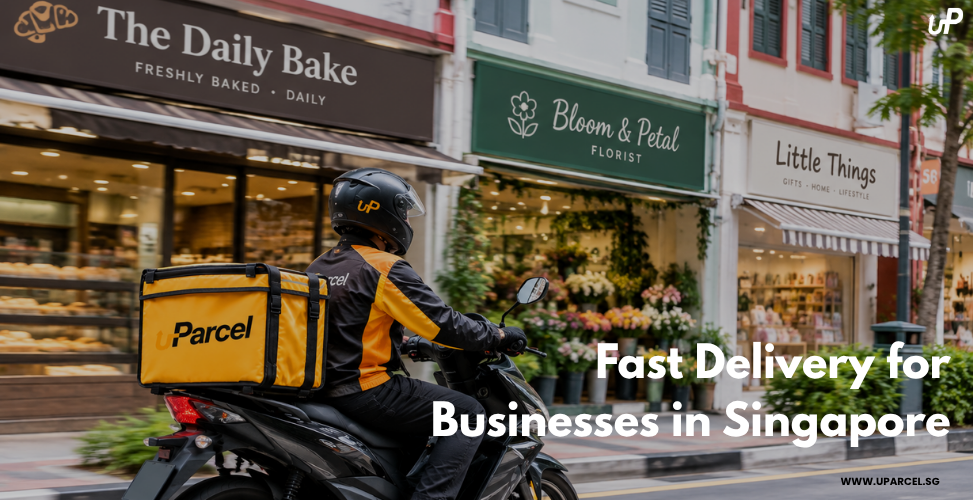
How Express Delivery Gives Singapore SMEs a Competitive Edge

Er Cai Fang
Senior Product Manager
Express delivery is no longer a premium service, it is the baseline Singapore customers expect. Here is how SMEs use 1-hour, 3-hour, and same-day delivery to compete and retain customers.
Customers do not remember that an SME has fewer resources than a large retailer. They remember whether their order arrived when they expected it.
For Singapore's small and medium businesses, this has always been the delivery challenge: large retailers and marketplace-backed brands can absorb the infrastructure cost of fast delivery at scale. SMEs have historically had to absorb slower speeds, less reliable windows, and the operational overhead of managing deliveries manually or pass higher costs on to customers who increasingly expect speed for free.
Express delivery changes that equation. When an SME connects to a delivery network that offers 1-hour, 3-hour, and same-day options at per-drop rates with no fleet to maintain and no driver to manage, it can offer the same delivery speed as a company ten times its size. The gap between what a large retailer can promise and what a well-resourced SME can promise effectively closes.
This article covers how that works in practice: what the different express delivery tiers mean, which business types gain the most, and what changes operationally when an SME outsources express delivery instead of trying to manage it in-house.
What Express Delivery Actually Means for an SME in Singapore
Express delivery is delivery completed within a defined short window, typically the same calendar day, often within hours of the order being placed. For SMEs in Singapore, it sits across three practical service tiers, each suited to different business situations.
1-Hour Rush Delivery
The fastest available tier: pickup and delivery completed within one hour of booking. This is not a standard business courier tier; it is designed for situations where the item's value is time-sensitive in a way that cannot tolerate even a two-hour window.
When SMEs use 1-hour delivery:
-
A florist fulfilling a same-day birthday or anniversary order where the occasion is in the next 90 minutes
-
A F&B business sending a replacement order after an error in the original delivery
-
A clinic or pharmacy dispatching medication to a patient who cannot leave home
-
A business sending a signed document that needs to reach a counterparty before a meeting or submission deadline
At this speed tier, the primary business outcome is not cost saving, it is relationship preservation and crisis resolution. The ability to say "it will be there in an hour" is the capability that retains the customer and prevents the complaint.
3-Hour Express Delivery
Three-hour delivery hits the practical midpoint between urgency and planning. It gives the business time to prepare the order properly while still meeting a same-morning-to-lunchtime or same-afternoon-to-evening commitment.
When SMEs use 3-hour delivery:
-
Cake and bakery businesses fulfill celebration orders for events happening later the same day
-
Retail businesses dispatching a replacement product after a return or complaint
-
Florists managing peak-period orders (Valentine's Day, Mother's Day, Hari Raya) where every order is time-sensitive but not minute-sensitive
-
SMEs sending product samples to a client ahead of a same-day meeting
Same-Day Delivery
Same-day delivery is the baseline expectation for most Singapore ecommerce and retail orders placed before midday. It does not specify a window within the day, only that the item reaches the recipient before the day ends. For most ecommerce sellers on Shopee, Lazada, and TikTok Shop, same-day dispatch is what Preferred Seller status and platform SLA compliance require.
When SMEs rely on same-day delivery:
-
Ecommerce sellers maintaining Shopee Non-Fulfilment Rate (NFR) compliance
-
Retail businesses deliver locally to customers who cannot come in-store
-
B2B SMEs send regular documentation, goods, or samples to business clients

The Business Types That Gain the Most From Express Delivery
Express delivery creates the largest competitive advantage for SMEs whose product is time-sensitive, occasion-linked, or perishable. The faster the item's value decays if delivery is late, the higher the stakes and the more differentiated a business becomes by solving it reliably.
01. Food, bakery, and cake businesses
A birthday cake delivered after the party is not a late delivery; it is a failed occasion. Singapore's F&B and bakery SMEs operate in a category where the delivery window is the product. A florist who can promise same-morning delivery for a 10am event holds the order. A florist who can only promise afternoon delivery loses it.
02. Florists and gift businesses
Flowers are perishable, occasions are specific, and customer expectations are absolute. The ability to offer 1-hour or 3-hour delivery for in-Singapore gifting puts an independent florist on equal footing with large gifting platforms and often ahead of them, because platform logistics add fulfillment layers that slow things down.
03. Medical and healthcare businesses
Clinics, pharmacies, and healthcare providers dispatching medication, samples, or medical supplies to patients who cannot travel need a courier that can meet a clinical time window, not a next-day residential slot. For this category, express delivery is not a convenience; it is a care standard. uParcel's express delivery service covers medication and medical item delivery across Singapore within defined time windows.
04. Ecommerce sellers on Shopee, Lazada, and TikTok Shop
Same-day dispatch is no longer a way to stand out on Singapore's major marketplaces; it is the requirement to maintain Preferred Seller status and avoid Late Shipment Rate penalties. SMEs selling on these platforms who cannot reliably dispatch on the day of order risk their listing visibility and seller ratings. Express delivery capability, outsourced to a reliable courier network, is what makes consistent same-day dispatch achievable without the seller managing a delivery fleet.
05. Document and B2B services businesses
Legal firms, accounting practices, HR consultancies, and B2B service businesses regularly send time-sensitive documents, signed contracts, compliance filings, HR packages that need to arrive within a specific window. For these businesses, a 3-hour express option is a professional-grade commitment they can make to clients with confidence.
How Express Delivery Improves Customer Retention, Not Just Satisfaction
The original reason most SMEs explore express delivery is customer satisfaction; faster delivery means happier customers. This is true, but it understates the retention impact.
Customer satisfaction after a single positive delivery experience is a baseline. What express delivery actually builds, when it is consistent, is customer trust: the confidence that if a customer places an order with an expectation, that expectation will be met.
Trust is the conversion that matters for SMEs. A customer who trusts an SME to deliver on time will return, refer, and tolerate the occasional operational friction that every business encounters. A customer who has been burned by a missed window, especially on a time-sensitive occasion, rarely gives a second chance.
The businesses that invest in a reliable express delivery arrangement are not paying for speed. They are paying for repeatability: the operational guarantee that every order they take, they can fulfill on the terms they promised.
The complaint reduction effect
Delivery complaints, late orders, missed windows, and recipients who were home but no delivery was attempted are one of the highest-volume operational overheads for SMEs that manage fulfillment manually.
A reliable courier with real-time tracking and a defined delivery window reduces complaint volume directly because recipients know when to expect the delivery and drivers are routed to arrive within the window. Fewer failed first attempts mean fewer redelivery, fewer refund requests, and less time spent by the business owner resolving logistics issues instead of running the business.
What Changes When You Outsource Express Delivery
The operational shift from self-managed delivery to outsourced express delivery affects three things for most SMEs.
Time recovered
The owner or team member who was previously managing deliveries, booking rides, loading vehicles, driving runs, or chasing updates recovers that time for revenue-generating activity. For early-stage SMEs where the founder is doing everything, this is a significant operational unlock.
Cost structure shifts from fixed to variable
A self-managed delivery arrangement carries fixed costs: a vehicle, fuel, insurance, and the driver's time regardless of delivery volume. An outsourced arrangement charges per drop, so the cost scales with the business rather than being sunk regardless of order flow. During slow periods, outsourced delivery costs less. During peak periods, the courier network absorbs the volume without the business needing additional capacity.
Customer commitment becomes credible
When a business says "we can deliver within 3 hours," that commitment is only as reliable as the delivery arrangement backing it. A network like uParcel's with same-day delivery across all parts of Singapore and express tiers handled by a dedicated agent network makes that commitment credible, consistently.
For SMEs integrating at volume, uParcel's API integration automates delivery dispatch from the business's own system, removing the manual booking step entirely for ecommerce sellers or businesses processing high daily order counts.
The Competitive Advantage Is Reliability, Not Just Speed
Express delivery gives Singapore SMEs a genuine competitive advantage but not because speed alone wins customers. It wins customers because the combination of speed and reliability creates a service standard that customers trust enough to come back to.
The 1-hour, 3-hour, and same-day tiers that uParcel offers give SMEs the flexibility to match delivery speed to the actual urgency of each order, without maintaining the infrastructure cost of a dedicated fleet. The result is a business that can credibly compete on delivery terms with much larger operators and recover the operational time that in-house delivery was consuming.
For Singapore's SMEs, the delivery layer is not a back-office detail. It is a front-line customer experience that determines whether a first-time customer becomes a returning one.
To explore express delivery options for your business or get a cost estimate for your delivery volume, visit uParcel's express courier service page or same-day courier service page and reach out to the team.
Other Blog Posts
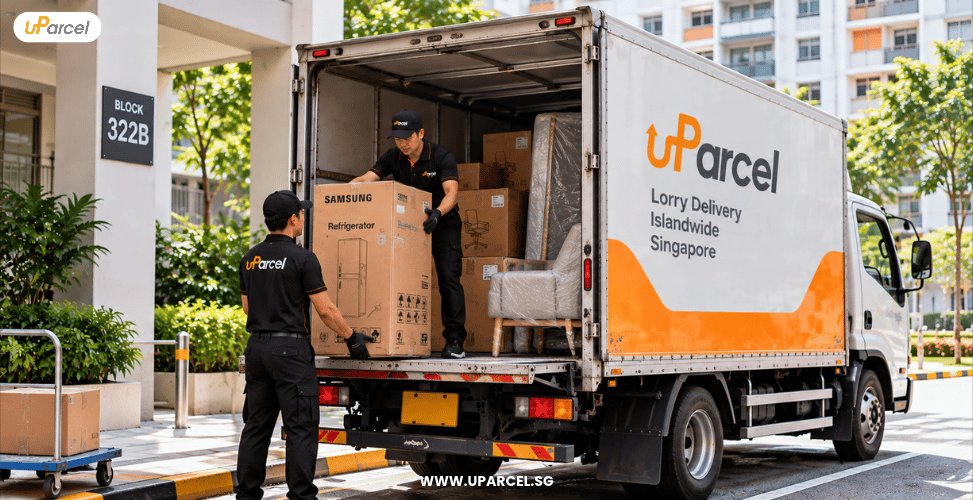
Lorry Delivery Price in Singapore: What Affects the Cost
Getting a lorry delivery quote in Singapore often feels like a moving target. The base rate looks straightforward, but by the time you factor in your actual load, your building’s lift access, and whether you need help carrying things upstairs, the final number can look quite different. This post covers uParcel’s actual lorry and van delivery rates, the factors that push the price up, and the add-ons that most real deliveries end up needing. If you are trying to budget accurately before booking, this is what you need to know. uParcel Lorry and Van Delivery Rates in Singapore uParcel operates a range of vehicles from a half-van up to a 24-foot lorry, all on a flat-rate islandwide basis — no surge pricing regardless of where in Singapore you are sending to. Vehicle Load Space Max Weight Base Rate 1.7m Van (Half) 1.6m × 1.2m × 1m 50 kg From $35 1.7m Van (Full) 1.6m × 1.2m × 1m 350 kg From $52 2.4m Van 2.3m × 1.2m × 1.2m 500 kg From $62 10 ft Lorry 2.9m × 1.4m × 1.7m 700 kg From $102 14 ft Lorry 4.2m × 1.7m × 1.9m 900 kg From $162 24 ft Lorry 7.0m × 2.0m × 2.0m 5,000 kg From $232 Lorries are available in open or covered configuration, and with or without a tailgate — the right combination depends on what you are transporting and how it needs to be loaded. These are the published starting rates. What changes that number is covered below. What Actually Drives the Final Price The base rate gets you the vehicle and the driver. These are the factors that determine whether you pay the minimum or significantly more. Vehicle size vs your actual load The single biggest cost driver is choosing the right vehicle. Underestimating your load means the agent may not be able to proceed, or you will need to rebook a larger vehicle. Measure your items before selecting: A single bicycle, a TV set, or two flat-pack boxes → 1.7m van (half) A full sofa set or 20–25 cartons → 2.4m van Four pallets of goods or large appliances → 10 ft lorry Six pallets or a full retail restocking run → 14 ft lorry Retail moving, 18+ pallets, or full warehouse transfers → 24 ft lorry Weight limits Each vehicle has a maximum weight, and it matters independently of space. A load that fits physically in a 10 ft lorry but weighs more than 700 kg needs the 14 ft lorry instead. If you are shipping dense or heavy goods, tiles, machinery parts, stacked inventory, calculate weight alongside dimensions. Open vs covered lorry An open lorry is cheaper to configure but exposes your items to weather. A covered lorry costs slightly more but is the right choice for electronics, furniture, paper goods, or anything that cannot get wet. If your delivery window includes a risk of rain or your goods are sensitive, covered is the safer option. Tailgate access A tailgate attachment lets the agent lower heavy items from the lorry bed to ground level hydraulically, without manual lifting. If you are moving appliances, machinery, or anything that cannot be hand-carried safely off a lorry, you will need a tailgate-equipped vehicle. Booking one without a tailgate for a job that requires one will delay the delivery on the day. Location surcharges uParcel’s rates are flat-rate islandwide, locations like Jurong Island, Tuas, or Changi are served but carry a long-distance surcharge. If your pickup or dropoff is in a restricted or industrial zone, check for this when booking. Fuel surcharge A temporary fuel surcharge of $1 applies on top of published rates across all vehicle types, with an additional $1 increase to the long-distance surcharge. This is reflected in the final booking cost. The Add-Ons That Most Bookings Actually Need This is where lorry delivery quotes most often surprise people. The vehicle gets your goods to the building, but it does not automatically get them inside, up the stairs, or assembled. uParcel offers a full set of add-ons that can be selected at booking: Add-On What It Covers Cost Extra Manpower An additional agent to help carry, load, or unload +$40 per man per trip Dismantle / Assemble Furniture disassembly before transport and reassembly on delivery +$30 per piece Pallet Jack Agent brings and operates a pallet jack for stacked pallets +$20 per jack No Lift Access (Stairs) Agent carries your load up each floor level with no lift +$10 per level Wrapping Service Agent wraps items in protective materials before loading +$5 per piece Return Trip (Document) Agent brings a signed document back from the dropoff location +$15 A realistic example: A family moving a sofa set and wardrobe to a 4th-floor HDB flat with no cargo lift would add: 1 extra man ($40) + stairs surcharge for 3 floors ($30) + wrapping for the wardrobe ($5). That is an additional $75 on top of the vehicle rate, a number worth planning for rather than discovering on the day. The Half-Van Option: Useful More Often Than You Think Most lorry delivery providers quote by the full vehicle. uParcel’s half-van option is worth knowing about because it directly lowers the cost for loads that do not fill an entire van. The 1.7m van half-load carries up to 50 kg within the same 1.6m × 1.2m × 1m space at $35 versus $52 for the full van. For a single piece of furniture, a bicycle, a rolled carpet, or a handful of bulky boxes, this is the more accurate way to match your cost to your actual load. If you are unsure whether your items fill a full van or half, err on the side of booking a half and contacting uParcel support to confirm before the booking is locked. What to Factor Into Your Budget Before Booking A useful way to estimate your real cost before you reach the checkout: Start with the right vehicle - measure dimensions and calculate total weight before choosing Check your delivery location - long-distance zones carry a surcharge; lifts affect access costs Count your items needing assembly - if anything needs dismantling to move safely, add $30 per piece Assess whether a second agent is needed - for anything heavy or bulky going above ground floor, add manpower Check if it’s an open lorry job or covered - weather-sensitive goods always need covered Add the $1 fuel surcharge - this is applied on top of the published base rate For most single-item or small-load deliveries (a sofa, a gym equipment set, a few pallets of stock), the final cost lands somewhere between the base rate and the base rate plus one or two add-ons. Plan for that range and you will not be caught short. Booking a Van or Lorry in Singapore uParcel’s van and lorry service is booked on-demand, same-day booking is available, and rates are flat across Singapore with no surge pricing. For full vehicle specs, current base rates, and to book directly, visit the uParcel van and lorry delivery. If your load is somewhere between sizes or you are not sure which vehicle fits, the booking interface lets you specify dimensions and weight or you can reach the team for a quick recommendation before you confirm.
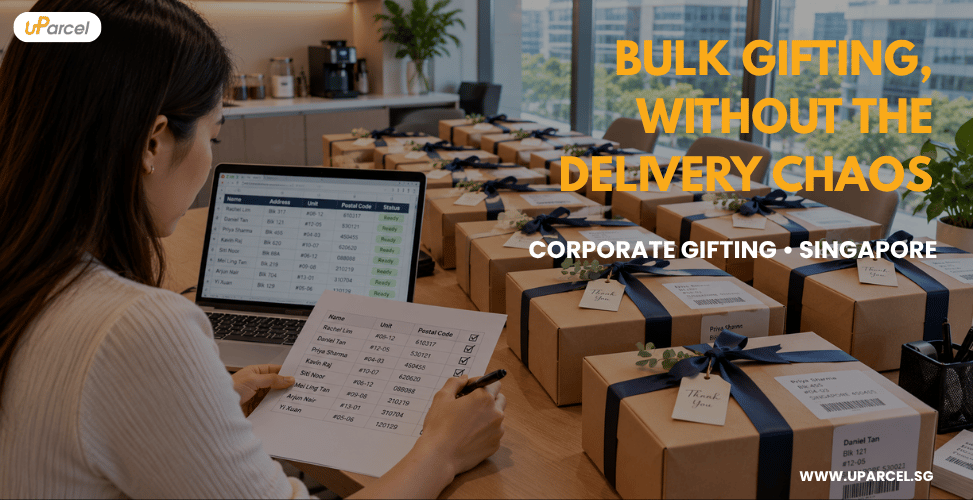
Corporate Gift Delivery in Singapore: Year-End Bulk Guide
Every December, admin and marketing teams across Singapore face the same job. Sixty hampers for clients, two hundred gift boxes for staff working from home, a batch of wine sets for partners across three business parks. The gifts are chosen, but getting each one to the right door before people leave for the holidays is a different problem. Corporate gift delivery in Singapore goes wrong in predictable ways: a missing unit number, an office reception that closed early, a condo guardhouse that refused a parcel, or a gift that arrived after the recipient flew off on leave. Most of these failures start before the courier is even booked. This guide walks through the full process: preparing the address list, packing and labelling, booking many deliveries at once, choosing between same-day and scheduled delivery, handling office, condo and HDB addresses, and keeping proof that every gift arrived. It applies whether you are an HR team sending staff gifts or a gift seller fulfilling a corporate order. Start With a Clean Address List A clean address list prevents most failed deliveries. Build it as a spreadsheet from the start, one row per gift, because that same file can become your bulk booking upload later. Each row should carry: Recipient name and mobile number: the rider calls this number if the recipient cannot be found, so a general office line is less useful than a direct mobile. Six-digit postal code: Singapore's six-digit postal code identifies a single building, not a single unit. Block, street, unit number and building name: for an HDB block or condo tower, the postal code alone only gets the rider to the building. Without "#08-123", the gift goes nowhere. Address type: mark each row as office, condo, HDB or landed. This decides delivery timing later. Gift variant and any note: "Hamper B, contains alcohol" or "Fragile, glassware" helps whoever packs and whoever delivers. Before you finalise the list, run three checks: Postal code against building name. Look up anything unfamiliar on OneMap, the Singapore Land Authority's national map, and fix mismatches. A typo in one digit can send a rider to the wrong estate. Duplicates. The same client often appears twice under different contacts. Decide whether they get one gift or two before you pack. Home addresses for staff. If you collect personal addresses for gifting, tell staff what the address is for and keep the file restricted. The PDPC's advisory guidelines on key concepts in the PDPA treat a residential address as personal data, so consent, purpose and reasonable protection all apply. Collect addresses through a short form rather than email replies. A form with fixed fields for postal code and unit number removes most of the formatting cleanup. Pack and Label Every Gift the Same Way Consistent packing and labelling let a rider identify each gift in seconds, which matters when one vehicle carries dozens of near-identical boxes. Treat the gifts like a production run, not a stack of individual presents. Use an outer carton or mailer over decorative wrapping. Ribbon and gift paper tear in transit. Wrap the gift, then put it inside a plain outer box, or use a branded mailer box that already looks presentable. Print labels from the spreadsheet. Handwritten labels slow the rider down and invite errors. Print name, full address with unit number, mobile number and the booking reference if you have one. Place the label on the top face. Riders photograph the label at drop-off, so a label on the side or bottom makes proof of delivery harder. Cushion fragile items. Wine bottles, ceramic mugs and glass jars need dividers or padding so they do not move when the box is shaken. Keep perishables separate. Cakes, fresh fruit and chilled items should go out on their own same-day run, not sit in a batch that will be delivered over two days. Add a card inside, not on the outside. A personal note belongs inside the box. Anything written on the outside can get smudged or torn. Number the boxes to match the row numbers in your spreadsheet. If a box is returned or a recipient calls, you can find the right row in seconds. Book Many Deliveries at Once With Bulk Upload Booking fifty gifts one by one in an app is slow and error-prone, so most businesses book in bulk. The aim is to turn the spreadsheet you already built into delivery orders in one step. uParcel's bulk upload works this way: 1. Sign in to the uParcel web portal and open the Bulk Delivery module. 2. Download the sample Excel file. This is the template the system reads, so use it rather than your own layout. 3. Copy your address list into the template. Map your columns (name, mobile, address, unit number, notes) to the template's columns. 4. Upload the file. Each row becomes a delivery booking in one go, instead of fifty separate entries. 5. Review the bookings before confirming. Spot-check a few rows against your packed boxes, especially unit numbers. The full walkthrough is in the guide on how to use uParcel's bulk upload function. The benefit is less about speed than accuracy: the address you checked in the spreadsheet is the address the rider sees, with no retyping in between. For gift sellers who receive corporate orders every season, a regular volume of bookings can also be pushed through uParcel's API integration, so orders flow from your store system into delivery bookings without manual uploads. Choose Between Same-Day and Scheduled Delivery The right delivery speed depends on what is in the box and who is receiving it. Faster is not always better for corporate gifts, because an office gift that lands after the recipient has left for the day is effectively a failed delivery. Option Best for Watch out for 1-hour or 3-hour express A single urgent gift, such as a forgotten client hamper or a last-minute replacement Not economical for large batches Same-day delivery Perishables, cakes and fresh hampers; batches that must arrive on a specific day Book early in the day so office deliveries arrive within working hours Next-day delivery Non-perishable gift boxes sent in larger batches where a fixed day is less critical Count working days carefully around public holidays A practical pattern is to split the list. Send office-bound gifts on a mid-week same-day run so they arrive while people are at their desks, and send home-bound gifts by next-day delivery, timed for when recipients are likely to be in. uParcel offers same-day delivery island-wide, plus 1-hour and 3-hour express and next-day options, all bookable from the same account. You can compare the options on the same-day delivery service page. For a batch with heavy hampers or many cartons to one office, a van booking is usually more practical than sending each box separately. Handle Office, Condo and HDB Addresses Differently Each address type in Singapore has its own access rules, and planning for them is the biggest lever for a smooth gift run. This is why the spreadsheet has an "address type" column. Office buildings: Many commercial towers route all parcels through a central reception or loading bay, and some do not let riders go up to individual floors. Confirm with each client whether gifts should go to their own office reception or the building's mailroom. Many offices also wind down in the last week of December, so office gifts should land before the final working days of the year. Condominiums: Guardhouses often need the resident's name and unit number before letting a rider in, and some will hold parcels while others will not accept them at all. Add a note such as "Guardhouse may receive" or "Call resident on arrival" to the booking. If the recipient has told you the guardhouse will hold parcels, say so in the notes. HDB flats: Riders can usually go straight to the unit, so the unit number and a reachable mobile number matter most. If nobody is home, the gift may be left at the door only if your instructions allow it, so decide in advance whether high-value gifts need to be handed over in person. Landed homes: Gates and dogs are the common issues. A mobile number the rider can call on arrival solves most of them. Keep Billing and Records in One Place With a Corporate Account When several departments send gifts, billing and records get scattered across personal cards and expense claims. A corporate account keeps every booking under the company. With a uParcel corporate account: Bookings are billed on a monthly invoice instead of being paid card by card at checkout, which suits finance teams closing the year. Sub-accounts can be added for different departments, so HR's staff gifts and Sales' client hampers are booked separately but billed to the same company. Booking history sits in one place, which helps when you reconcile gift budgets or plan the next gifting round. You request a corporate account from the left-hand panel after logging in, and it is subject to approval, so apply a few weeks before the December rush. The guide on how corporate courier services make corporate delivery simple covers the wider set of business delivery needs a corporate account handles. Track Every Gift and Keep Proof of Delivery Tracking and proof of delivery turn "I think it arrived" into a record you can show a client or a manager. With a hundred gifts in transit, you need both. Live tracking: each booking can be tracked from pick-up to drop-off, so you can answer a "has it been sent?" message without calling the courier. Photo proof of delivery: uParcel riders photograph the parcel at the drop-off point, with the label and unit number visible. For a gift left at a reception desk or guardhouse, the photo shows exactly where it was placed. A simple status column: add "Delivered", "Failed" and "Re-booked" columns to your spreadsheet and update them from the tracking screen at the end of each day. Do not send thank-you or "your gift is on the way" emails before the gifts are actually picked up. If one batch slips by a day, the message becomes awkward. Plan for Failed Deliveries and Re-Delivery Even a well-prepared gift run will have a handful of failed deliveries. Planning for them in advance keeps them from turning into lost gifts. Common causes and fixes: Recipient not reachable: confirm mobile numbers before booking, and send a short heads-up message the day before so recipients expect a call. Office closed or reception refused: check building rules for any address where you have not delivered before, and avoid booking office drops on the last working day before a public holiday. Wrong or incomplete address: this goes back to the address list. Fix the row, then re-book. Condo guardhouse refusal: contact the recipient for an alternative, such as their office or a family member's address. Keep returned gifts in a labelled holding area, matched to their spreadsheet row. Re-book them as one small batch once you have corrected details, rather than one by one as they come back. Work Backwards From the December Peak December is one of the busiest delivery periods in Singapore, and corporate gifting competes with year-end online shopping for courier capacity. Christmas Day on 25 December and New Year's Day on 1 January are both public holidays, and many offices run on reduced staff in between. A simple timeline, counted backwards from your target delivery week: Six to eight weeks before: confirm the gift list and budget, apply for a corporate account if you do not have one, and order gift stock. Four weeks before: collect and clean addresses through a form. Chase anyone who has not replied. Two to three weeks before: pack, label and number all boxes. Fill in the bulk upload template. One to two weeks before: send office-bound gifts first, while offices are fully staffed. Final week before Christmas: send home-bound gifts and any perishables by same-day delivery, and use express delivery only for late additions and re-deliveries. Make the Gift Run as Personal as the Gift Corporate gift delivery in Singapore works best when it is treated as a small logistics project: one clean spreadsheet, consistent labels, deliveries timed to how each address type works, and a proof-of-delivery record for every box. The gift is what recipients remember, but a gift that arrives on time, at the right door, is what makes it land. uParcel's 4.9 Google rating from 9,500+ reviews comes largely from this kind of everyday delivery work. If you are planning a year-end gift run, the uParcel team can help you set up bulk bookings and choose the right mix of same-day, express and next-day delivery for your list.
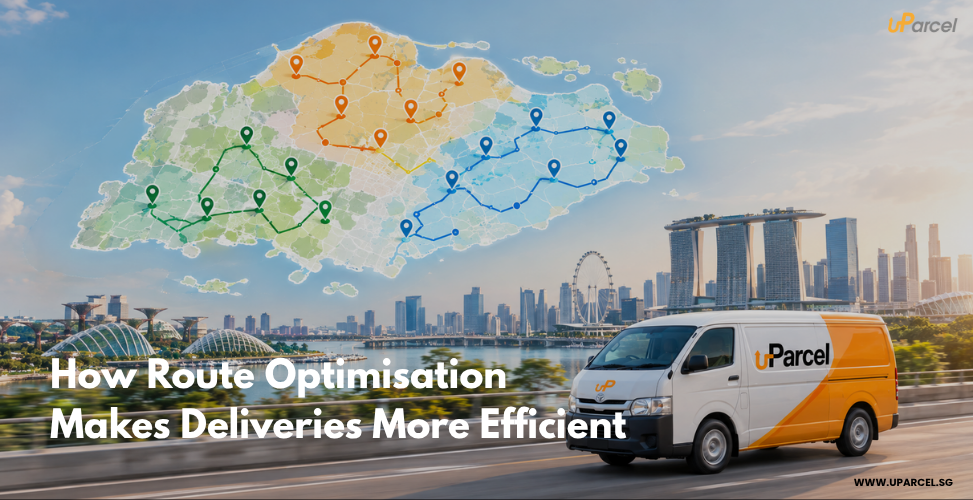
How Route Optimization Cuts Delivery Costs for Businesses with Multiple Daily Drops
If your business is making 20, 50, or 100+ deliveries a day across Singapore, the sequence of those deliveries is either money saved or money wasted. Two businesses with identical order volumes and identical delivery destinations can pay vastly different amounts per drop based entirely on how those deliveries are sequenced, grouped, and dispatched. The difference is route optimization: the practice of organizing delivery stops in a sequence that minimizes total distance, time, and cost while meeting customer delivery expectations. For businesses running their own delivery fleet, route optimization is a deliberate operational decision that requires planning tools and discipline. For businesses using a third-party courier, it is often built into the network but only if the courier's infrastructure is designed for multi-drop efficiency at scale. This article explains how route optimization works, what it costs to get it wrong, and what to look for when choosing a delivery partner for a business with multiple daily drops in Singapore. What Is Route Optimization? Route optimization is the process of determining the most efficient sequence and path for a set of delivery stops minimizing total distance traveled, time spent, and cost incurred, while respecting delivery time windows and vehicle capacity. It is distinct from simple navigation. A navigation app like Google Maps finds the fastest path between two points. Route optimization solves a more complex problem: given 40 delivery stops, a two-hour delivery window for some of them, and a vehicle that can carry a maximum load, what is the sequence that minimizes total cost? The variables that route optimization has to balance simultaneously include: Geographic clustering: grouping nearby stops to reduce backtracking Time windows: ensuring time-sensitive deliveries reach recipients within the promised window Vehicle capacity: matching load size to vehicle type for each run Traffic patterns: routing around known congestion periods on Singapore's road network Drop density: areas with more stops per square kilometer cost less per delivery than dispersed single drops When these variables are handled well, cost per drop falls. When they are not — when drivers are crisscrossing the island, backtracking to areas they already passed, or running half-full vehicles, every inefficiency multiplies across the entire day's deliveries. The Real Cost of an Unoptimised Delivery Route Businesses that have not thought systematically about route optimisation often underestimate how much inefficiency is embedded in their current operations. The costs appear in several places: Unnecessary Distance and Fuel An unoptimised route covering the same stops as an optimised one can add 20–35% more distance in a single run. Over a fleet of vehicles operating five days a week, that additional distance translates directly into fuel spend, vehicle wear, and driver hours, none of which appear on a per-delivery invoice but all of which appear on a monthly cost sheet. Failed Deliveries and Redelivery Costs A failed delivery, where a recipient is unavailable, the address is inaccessible, or the time window is missed, is one of the most expensive events in last-mile logistics. The original delivery attempt costs the same as a successful one. The redelivery costs the same again. And in Singapore's ecommerce marketplace environment, a failed delivery frequently triggers a negative seller rating or a dispute. Failed deliveries are often a sequencing problem. When delivery windows are not respected because routes are planned without accounting for them, recipients who expected a morning delivery get a driver showing up at 6pm and nobody is home. Driver Time as a Hidden Cost For businesses running their own delivery staff, driver time is a fixed cost that does not disappear when routes run long. A driver spending two hours completing a run that should take 90 minutes is not a route that cost 33% more fuel, it is a driver who is unavailable for the next run during those 30 minutes. Across a team of drivers, unoptimised routes consistently compress the number of deliveries possible in a working day. The Key Variables That Determine Cost Per Drop in Singapore Understanding what drives cost per drop gives businesses the framework to evaluate both their own operations and the partners they work with. Drop density The most significant driver of cost per drop is how many stops a vehicle can service within a defined geographic area. A driver covering 10 drops in Tampines in one run has a far lower cost per drop than a driver covering 10 drops spread across Tampines, Jurong, and Woodlands. In Singapore's compact urban geography, tight geographic clustering is one of the highest-leverage optimisations available. Vehicle-to-drop matching Using a van for three small parcel drops, or a motorcycle for a large, heavy delivery, both represent a mismatch between vehicle cost and delivery requirement. Optimised operations match vehicle type, motorcycle, car, van, lorry to the load size and delivery characteristics of each run. uParcel's network includes motorcycles, cars, vans, and lorries, allowing each delivery to be matched to the appropriate vehicle type rather than defaulting to a single mode regardless of parcel size. Time-window compliance Deliveries that carry a specified time window (e.g., same-day before 6pm, or a specific two-hour slot) must be sequenced so that the driver reaches those stops within the window. When time-constrained stops are sequenced poorly, placed too late in a route, or too far from the previous stop, drivers either miss the window or rush to meet it inefficiently. Batching and dispatch timing For businesses processing orders continuously throughout the day, the timing of dispatch runs matters. Batching all morning orders into a single optimised run is more efficient than dispatching three separate runs as orders trickle in. The trade-off is delivery speed, earlier batching means longer wait times for the first orders in the batch. The right balance depends on what your customers have been promised. Own Fleet vs Outsourced Courier: The Route Optimisation Trade-Off Businesses with multiple daily drops face a foundational choice: run their own fleet and manage routing internally, or use a third-party courier whose network handles the routing problem. Running your own fleet gives maximum control over delivery scheduling and sequencing but places the full burden of route optimisation on your own operations team. This requires either dedicated routing software (with the associated cost and learning curve) or significant manual planning time daily. It also means your delivery cost structure is fixed: vehicles, drivers, insurance, and maintenance are sunk costs whether the routes are optimised or not. Using a third-party courier transfers the routing problem to a network that is already optimised, but only if the courier's infrastructure is genuinely built for multi-drop efficiency at scale. A courier that dispatches individual drivers for single drops is not providing a routing advantage; it is just shifting your fixed costs to variable ones. For businesses with consistent multi-drop volumes in Singapore, the decision hinges on whether the volume justifies the overhead of maintaining and optimising a dedicated fleet. For most SMEs and mid-size businesses, the variable cost of a purpose-built courier network is more efficient than the fixed cost of an internal fleet that requires ongoing route optimisation investment to match the same efficiency. How uParcel's Network Is Built for Multi-Drop Efficiency uParcel's delivery network is designed for businesses with consistent, volume-based delivery needs across Singapore not just one-off single drops. Key features relevant to multi-drop businesses: Island-wide coverage with no area surcharges uParcel covers all parts of Singapore on the same delivery network, Jurong, Woodlands, Changi, and everywhere in between. Businesses do not pay a premium for drops in specific zones or face coverage gaps that require a second provider. Multiple vehicle types matched to load From motorcycles for small parcels to vans and lorries for bulky or high-volume runs, uParcel matches vehicle type to delivery requirement, eliminating the vehicle-mismatch inefficiency that inflates cost per drop for businesses using a one-size-fits-all fleet. Same-day delivery across all drops For businesses whose customers expect same-day delivery, uParcel's same-day network covers Singapore-wide drops dispatched within the service window. This removes the trade-off between delivery speed and route efficiency that businesses managing their own fleet often face. Transparent per-drop pricing Rather than absorbing the hidden cost variability of an internal fleet, businesses using uParcel pay per delivery on a transparent rate structure. For businesses with consistent multi-drop volumes, this makes total delivery cost predictable and comparable across months. View uParcel's delivery rates to estimate cost per drop based on your delivery profile. What to Look for in a Delivery Partner for Multi-Drop Businesses For businesses evaluating a courier partner or reconsidering their current one, route optimisation capability is one of several criteria that determine whether the partnership will be cost-efficient at scale. 01. Coverage without gaps A courier that cannot reliably serve all of Singapore forces you to maintain backup arrangements for uncovered zones. Every exception in coverage adds operational complexity and cost. 02. Scalability on volume The partner needs to be able to absorb volume spikes, peak sale periods, campaign launches, seasonal demand without degrading delivery performance or requiring significant advance notice. A courier network that works well at 50 drops per day but struggles at 200 is not a long-term fit for a growing business. 03. API integration for automated dispatch For businesses processing high volumes, manual order submission to a courier is itself an inefficiency. API integration allows orders to be dispatched automatically as they are placed removing a daily administrative step and reducing the risk of missed or delayed bookings. uParcel's same-day courier service includes API integration for businesses that need automated, high-volume dispatch. 04. Tracking and proof of delivery Multi-drop operations generate a high volume of recipient queries. A courier that provides real-time tracking and digital proof of delivery reduces the time your team spends responding to "where is my order" contacts, a hidden administrative cost that scales with delivery volume. The Route Is Part of the Cost Route optimisation is not a logistics detail, it is a direct cost lever for any business making multiple deliveries every day. Unoptimised routes add distance, driver time, vehicle cost, and failed delivery risk to every run. Optimised routes compress all of those costs without compromising delivery speed or coverage. For businesses managing their own fleet, the investment in route planning whether through software or disciplined manual scheduling pays back in reduced operating cost per drop. For businesses using a courier, the equivalent question is whether the network they are using is genuinely built to deliver multi-drop efficiency or whether it is simply processing individual orders one at a time. The right answer depends on your volume, your delivery commitments to customers, and the total cost of each option at your current and projected scale. For businesses with regular multi-drop delivery needs in Singapore, view uParcel's delivery rates or reach out to the team through the same-day courier service page to discuss a delivery arrangement that fits your volume and schedule.