How a UAE Brand Went Live on Singapore Marketplaces in 2 Weeks

Er Cai Fang
Senior Product Manager
Nominee director unreachable? See how a Dubai brand launched on Shopee Singapore in 2 weeks via an Ecommerce Enabler despite a local entity.
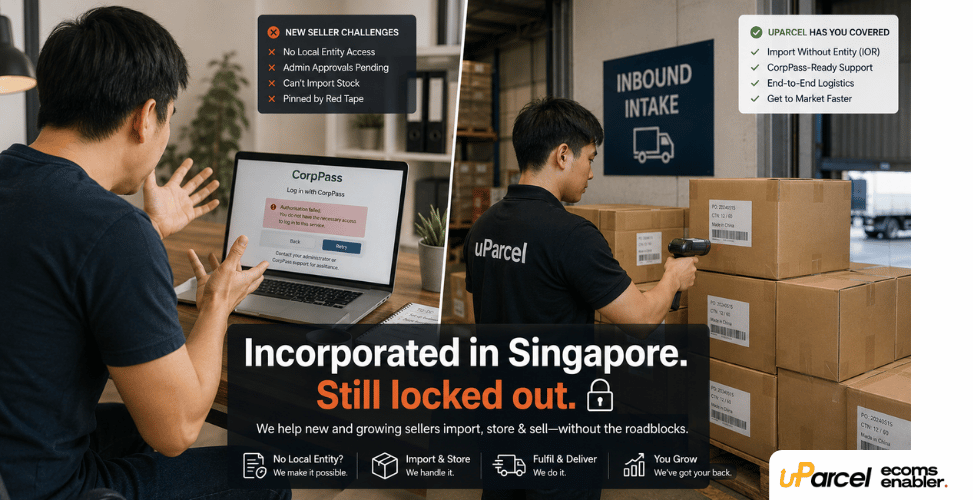
Most guides for foreign companies planning to sell in Singapore, whether through retail stores or online marketplaces, focus on company incorporation as the biggest hurdle. This case study tells a different story. The foreign brand had already incorporated a Singapore entity and appointed a nominee director. Yet it still couldn't clear customs, access TradeNet via CorpPass, open marketplace accounts, or fulfil a single customer order.
The real challenge wasn't setting up the local Singapore company. It was everything that came after: truly utilising CorpPass access, managing TradeNet declarations, and having a reliable local operator on the ground. That's why the brand ultimately partnered with uParcel as its Importer of Record in Singapore, despite already having an incorporated Singapore entity.
The Setup: A Registered Entity That Still Couldn't Operate
The brand's initial approach was conventional: incorporate a Singapore private limited company and engage a nominee director to satisfy the local-director requirement under the Companies Act. On paper, the entity was fully compliant and ready to trade.
In practice, two systems stood in the way:
-
CorpPass. CorpPass is the Singapore government's single sign-on system for businesses to transact with government agencies and, by extension, to verify identity for marketplace seller accounts on Shopee, Lazada, and TikTok Shop. A nominee director's appointment does not automatically translate into usable CorpPass access for the business owner and in this case, geographic access restrictions on the admin's end blocked account activation entirely. Having a director on paper is not the same as having someone who can operate the government's own administrative tool.
-
TradeNet. Clearing imported goods through Singapore Customs requires a declaration through TradeNet, Singapore's national trade single window. Without a contactable local representative and a working local phone number tied to the entity, the brand hit a deadlock at the customs clearance stage, with goods arriving in Singapore with no one authorised and reachable to clear them.
The entity existed. The ability to transact as that entity, with the platforms and authorities that matter, did not.
Why a Local Entity Alone Doesn't Solve Market Access
There's a cost dimension too. A nominee director arrangement isn't a one-time fee it typically comes with ongoing accounting and compliance obligations tied to Anti-Money Laundering (AML) checks, since corporate service providers are required to conduct due diligence on the businesses they represent. For a company not yet generating local revenue, this means paying recurring compliance costs for a structure that, on its own, still couldn't get a shipment through customs or a store live on Shopee.
This is a common pattern for foreign companies starting in Singapore: incorporation solves the legal-entity question, but it doesn't solve the operational one who can actually sign for the goods, answer the phone when Customs calls, and log into CorpPass to open a seller account.
The uParcel Intervention: Importer on Record, Fulfilment Warehouse, Marketplace Manager
Rather than trying to fix the CorpPass and nominee-director bottleneck from Dubai, the brand engaged uParcel to operate the parts of the chain that require a genuine local presence:
-
Importer on Record. uParcel cleared the shipment through customs and received the goods into Singapore under its own compliance standing removing the TradeNet and local-representative deadlock entirely.
-
Fulfilment Warehousing. Once cleared, inventory is moved directly into uParcel's fulfilment warehouse for storage, pick-and-pack, and dispatch, no separate handoff to a third-party warehouse.
-
Marketplace Manager. The brand's ecommerce experience was almost entirely on Amazon, a platform with limited traction among Singapore shoppers, where Shopee, Lazada, and TikTok Shop dominate consumer behaviour. uParcel's marketplace team set up and operated the brand's store fronts on Shopee Singapore, Lazada Singapore, and TikTok Shop, applying local listing, pricing, and promotions conventions the brand had no prior exposure to.
This is the practical definition of an ecommerce enabler: one partner covering inbound customs, warehousing, and marketplace operations, rather than the brand assembling three separate vendors for three separate problems.
Launch Results: First Sale Inside Two Weeks
Within two weeks of engagement, the brand's Shopee Singapore store recorded its first organic sale. Early performance metrics:

The dispatch figure is worth sitting with: 0.18 days against a 1.1-day Shopee dispatch SLA benchmark is roughly six times faster than what the platform expects from sellers, achieved from a warehouse the brand had never operated in a market it had never sold in before. That gap is a direct function of goods already being cleared, stocked, and fulfilment-ready under one provider rather than moving through separate customs agents, warehouse operators, and delivery vendors.
Why This Is an Ongoing Partnership, Not Just a Launch Fix
Getting a store live is the visible milestone; it isn't where the engagement stopped. uParcel runs weekly store performance reviews with the brand checking listing performance, response rates, and stock levels and acts on the findings rather than filing them. Part of that ongoing work includes producing video content for the store, aimed at building top-of-funnel traffic rather than relying purely on marketplace search.
This is the distinction between a one-off setup service and always-on growth management: a setup vendor hands over login credentials and exits; an ongoing operating partner keeps adjusting the store, the content, and the fulfilment operation as the business grows.
Three Reasons the Brand Chose uParcel as a Long-Term Partner
1. Single Provider, No Subcontracting Risk
Before settling on uParcel, the brand evaluated other Singapore fulfilment options and found a recurring structure: warehousing run by one subcontractor, delivery run by another, coordinated loosely by the fulfilment company's own team. When something goes wrong a missed pick, a late dispatch that structure makes it hard to establish which link in the chain is responsible. uParcel runs warehousing and last-mile delivery in-house, under one provider, which keeps accountability for pick, pack, and delivery performance in a single place.
2. Multi-Channel, Platform-Agnostic
The brand's ambitions extended beyond Shopee: Lazada Singapore, TikTok Shop, its own website, and B2B distribution channels including pop-up booths and physical retail placements. A fulfilment house tied to a single marketplace's logistics program structurally can't support that spread its systems and SLAs are built around one platform's rules. uParcel's model is channel-agnostic: the same warehouse and delivery infrastructure serves marketplace orders, direct-to-website orders, and B2B distribution without re-platforming.
3. Marketplace Expertise Across Platforms, Plus uShop Market
Running Shopee, Lazada, and TikTok Shop simultaneously requires fluency in three different sets of listing rules, promotion mechanics, and seller-performance metrics not a generic "ecommerce" skillset. Alongside that, the brand gained access to uShop Market, uParcel's own delivery platform, which offers Singapore buyers six delivery choices at checkout: same-day, specific-hour, instant, next-day/door-to-door, economical multi-day, and self-pickup. That range lets a seller match delivery cost and speed to the order, something a single-carrier or platform-locked logistics program typically can't flex on.
Frequently Asked Questions
01. What happens if my nominee director in Singapore is unresponsive?
A nominee director satisfies the legal local-director requirement but has no obligation to administer CorpPass, respond to Customs, or operate marketplace accounts on the business's behalf. If they're unresponsive or geographically restricted from doing so, the business still needs a reachable local partner to handle customs clearance, marketplace setup, and day-to-day operations.
02. Can I clear customs in Singapore without CorpPass access?
No. CorpPass access (directly or through an authorised local representative) is required to transact with Singapore Customs via TradeNet. Without it, or without an Importer on Record acting on the business's behalf, an inbound shipment cannot be cleared.
03. What is an Importer on Record and when do I need one?
An Importer on Record (also referred to as Importer of Record) is the entity legally responsible for clearing goods through customs and meeting the associated compliance obligations with Singapore Customs and related authorities. Foreign companies without a locally operable entity one that can access CorpPass and respond to Customs directly typically need an Importer of Record to bring goods into Singapore.
04. What is Shopee Singapore's dispatch SLA benchmark?
Shopee's standard dispatch benchmark is 1.1 days from order confirmation. Sellers who consistently miss this threshold risk lower search visibility and account penalties.
05. Why do some Singapore fulfilment companies subcontract warehousing or delivery?
Many fulfilment providers do not operate their own local warehouse and delivery fleet, instead subcontracting one or both legs to third parties. This becomes a problem when a seller needs to trace an issue, for example, reconciling what an online order system shows against what actually happened during pick-and-pack at the warehouse or during last-mile delivery because responsibility is split across separate vendors.
06. Can one fulfilment partner handle Shopee, Lazada, TikTok Shop, and my own website?
Yes. uParcel's Fulfilment Warehouse connects to a seller's Shopee, Lazada, TikTok Shop, and website stores through its Inventory Management System (IMS), a roughly one-minute setup to sign in and link a store, after which orders across all connected channels flow into the same fulfilment operation.
07. What delivery options does uShop Market offer in Singapore?
uShop Market, uParcel's own delivery platform, gives Singapore buyers six checkout-stage delivery options: same-day delivery, specific-hour delivery, instant delivery, next-day/door-to-door delivery, an economical multi-day option, and self-pickup.
Conclusion
Incorporating a Singapore entity is often treated as the finish line for foreign companies entering the market, this case shows it can just as easily be the starting point of a second, less visible problem: who actually operates CorpPass, clears TradeNet, and answers the phone when Customs calls.
For this Dubai-based brand, the answer wasn't more paperwork on the entity side; it was a Seller on Record and Importer on Record who could clear goods, warehouse them, and run marketplace operations under one accountable roof, turning a stalled launch into a first sale within two weeks, and a fulfilment vendor into a standing operations partner.
If you're a foreign company weighing up whether a local entity alone is enough to launch in Singapore, uParcel's team can walk you through what an Importer of Record and Ecommerce Enabler setup would look like for your business. Get in touch with uParcel to find out what works best for you.
Other Blog Posts
From Zero to Search-Driven Sales: How uParcel Launched Slipstop on Shopee Singapore
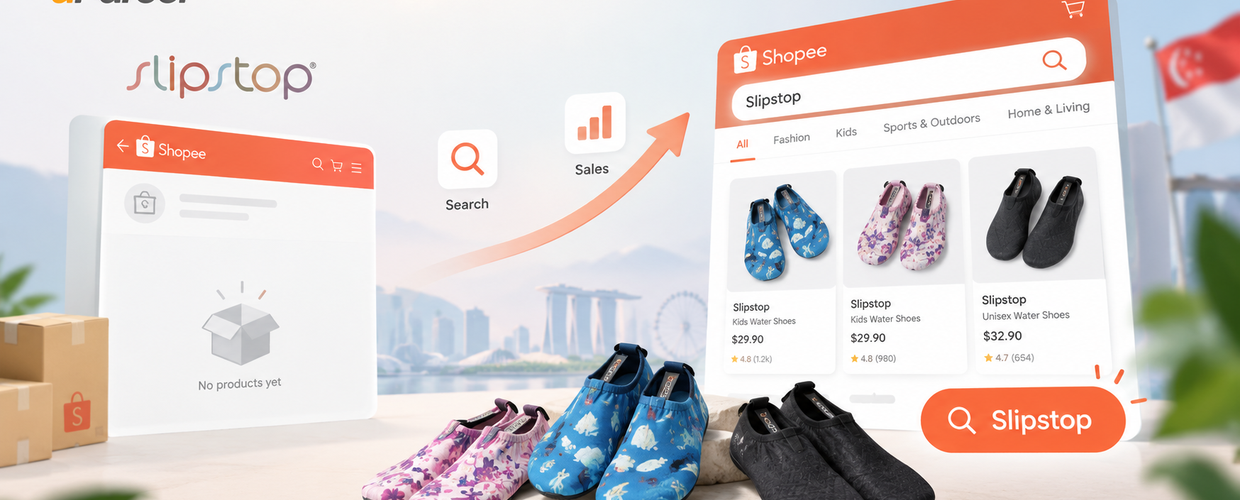
Many overseas brands may think that launching on Shopee requires assembling a small team of specialists before they've made a single sale. Sarpi Group, based in Dubai, is the company behind Slipstop, a grip socks and water shoes brand, looking to enter the Singapore market with no existing local presence, no Shopee account, no reviews, and no way for Singapore shoppers to find them yet. uParcel took this on as a fully outsourced ecommerce partner, handling everything from the Seller of Record relationship through to daily account management, from a standing start. What an Overseas Brand Would Normally Need to Hire For a brand based outside Singapore trying to launch on Shopee, "getting online" usually means assembling a team of specialists, each solving one piece of the puzzle: A Seller of Record, since most overseas brands have no local entity able to legally operate a compliant Shopee seller account An SEO or keyword specialist, to research what Singapore shoppers actually search for and optimise listings against it A paid ads manager, to run and monitor Shop+ Ads or keyword ad campaigns A promotions or CRM coordinator, to plan and set up vouchers and discounts aimed at different buyer segments A fulfilment or 3PL provider, to store stock, pack orders, and hit Shopee's delivery cut-offs An account manager, to monitor account health, respond to customers, and keep the store clear of penalties Each of these is usually a separate hire, a separate contract, or a separate agency retainer, and for a brand with no existing Singapore presence, finding and vetting all of them before a single sale happens is its own project. What Fully Outsourced Ecommerce Actually Means Slipstop didn't need to assemble any of this. Every one of the functions above sat inside a single engagement with uParcel, run by one team from day one. That's the difference between fully outsourced ecommerce and simply hiring several vendors. A few things follow from having one team own the whole operation, rather than one team per function: One company, fully accountable. There's no ambiguity over who's responsible when something goes wrong, whether that's a missed customer message, a late dispatch, or a listing that stops ranking. The same team handling fulfilment is the same team handling the storefront, so nothing falls into a gap between contracts. No handoff gaps or conflicting priorities. When SEO, ads, vouchers, and fulfilment sit with separate vendors, each one tends to optimise for their own slice of the job, an ads agency pushing more spend, a 3PL focused only on packing orders on time, without necessarily coordinating with the others. With one team, keyword strategy, promotions, and delivery performance are all working toward the same outcome, not managed in isolation from each other. One point of context, not five. Slipstop only had to explain its product, positioning, and target customer once. With separate vendors, that same context has to be repeated to every hire, and it inevitably gets diluted or interpreted differently by each one. Faster decisions, since nothing needs to be relayed across parties. If a voucher underperforms or a listing needs a keyword adjustment, the same team that set it up can see it and act on it immediately, rather than the brand flagging it to one vendor, waiting, then looping in another to make the actual change. Here's how that played out across Slipstop's launch, from account setup through to delivery performance. 1. Seller of Record As an overseas company with no Singapore entity able to legally operate a compliant marketplace seller account, Slipstop needed an SOR before it could sell on Shopee at all. uParcel took on this role directly, setting up and operating the Shopee account on Slipstop's behalf, so the brand didn't need to solve its Singapore entity question before it could start selling. Because the same team running the SOR relationship also handled everything downstream, listings, ads, vouchers, fulfilment, this wasn't a case of one vendor opening the account and handing it off to someone else to actually run. The account setup and the account's day-to-day operation stayed with the same people throughout. 2. Product Listings and Keyword Research A new account with no reviews and no sales history has no way to surface in Shopee's search results on its own. uParcel used SEO tools to research Shopee Singapore's own marketplace data, identifying which keywords Singapore shoppers were actually searching for in Slipstop's product category, then built those terms into product titles and descriptions. The listings were also brought in line with Shopee's own Listing Optimiser standards, accessible under Seller Centre's Business Insight and Selling Coach tools, which set concrete benchmarks for a well-optimised listing: product names of at least 30 characters using relevant keywords, descriptions of at least 300 characters in point form, and a minimum of three images, ideally closer to eight plus a cover photo, since Shopee's own guidance notes video content in particular can meaningfully lift views and sales. The result is visible directly in Slipstop's traffic data. In June, the first full month live, only 8.89% of sales came from Shopee's Search traffic source, most sales were still coming from shop-page browsing and promotional placement, the kind of traffic a brand new account leans on before it has any organic search presence. By July that had climbed to 33.28%. By the end of August, Search accounted for 61.37% of sales, the single largest traffic source by a wide margin. That shift matters because it reflects buyers actively searching for and finding Slipstop's products, rather than stumbling across them. It's also not a result keyword work alone could have produced. Listings that rank well but sit under an account with poor response rates or delivery penalties don't convert as reliably, and a search-driven sale means nothing if the order then ships late. The same team that researched and set the keywords was also the team keeping the account's delivery performance and customer response clean, so the traffic gain and the ability to convert it stayed aligned rather than being two separate teams' problems. 3. Discounts and Vouchers To give new visitors a reason to convert on a store with no track record yet, uParcel set up a tiered voucher structure: discounts for first-time buyers, vouchers for followers, and general promotions aimed at browsing buyers who hadn't yet purchased. Because the same team managing vouchers also had visibility into what keywords were driving traffic and what the ad budget was doing, promotions could be timed and targeted against where buyers were actually arriving from, rather than run as a generic, disconnected discount campaign. 4. Ad Campaigns Alongside organic listing work, uParcel ran weekly keyword boosting and a short keyword ads campaign to support visibility while the account was still building organic search presence. Given Slipstop's niche product category, a brand-new account, and a modest budget, this was treated as a supporting lever rather than the primary growth driver, which is reflected in the traffic data: Search's growing share of sales through the campaign period came predominantly from organic ranking gains, not paid spend. This is also where having one team matters in a way that's easy to overlook. An ads-only agency is typically measured, and paid, on ad performance in isolation, which can create pressure to keep pushing spend regardless of whether it's the most efficient lever available. Because uParcel's team was accountable for the account's overall growth rather than one specific channel, ad spend stayed proportionate to what the account actually needed at each stage, rather than being scaled up to justify a standalone retainer. 5. Next-Day Delivery Status NDD is not something every Shopee seller has access to. Shopee has described it as a service made available to selected and whitelisted retailers, not a default feature every account is granted, which is why many long-running stores still don't carry the badge even after years of trading. Earning it typically depends on consistently strong dispatch performance, since a single pattern of late handovers is enough to lose eligibility once granted. For a brand-new account, that makes NDD a particularly high bar. There's no performance history to draw on, and a new account has to establish reliable dispatch behaviour from its very first orders, with no room for the early missteps a longer-running store might absorb without consequence. Slipstop achieved NDD status before its account reached the three-month mark. This came down to uParcel's fulfilment operation packing orders same-day and consistently hitting Shopee's NDD cut-off windows without a single miss, getting every eligible order into the customer's hands the day after order confirmation. Because fulfilment sat inside the same engagement as the storefront and marketing work, there was no coordination lag between "an order came in" and "an order got packed", the kind of delay that can creep in when a brand's marketing and fulfilment are run by separate vendors on separate schedules. 6. Account Health Since launch, Slipstop's account has not been penalised for late or missed deliveries, poor customer response, or any other account health violation. This matters more than it might sound like on paper. Shopee's seller performance metrics, covering response rate, dispatch performance, and order defect rates, directly affect how visible a store's listings are and whether features like NDD remain active. A single lapse, a slow response streak, a run of late dispatches, can undo months of ranking and traffic gains. Keeping account health clean isn't a separate task from everything else in this case study, it's the output of every other function being run well and by people paying attention to the account as a whole, not just their individual slice of it. Results at a Glance Visitors grew nearly 2.4x from June to the first 27 days of August, a period covering less than three months from a completely cold start with no prior presence in the market. July's dip in orders, despite higher traffic, reflects the real, uneven path of building an account from zero, not a straight line up, and the recovery in August, alongside continued traffic growth and a majority-search sales mix, points to an account that was gaining durable, organic footing rather than relying on one-off spikes. The clearest single indicator of that footing is the shift in where sales come from. An account moving from under 9% to over 61% of sales originating from Search in under three months is a sign that Slipstop's listings were not just visible, but increasingly the reason buyers were finding and choosing the brand on their own. One Team, Every Function An overseas brand launching on Shopee Singapore typically has to solve a stack of separate problems before a single sale happens: who can legally operate the seller account, who researches what Singapore shoppers search for, who runs the ads, who sets up promotions, who fulfils orders fast enough to earn delivery status, and who keeps the account itself in good standing. For Slipstop, none of that was solved by five different vendors working in parallel. It was one team, working from the same context, moving at the same pace, and accountable for the outcome as a whole rather than for their individual piece of it. That's what let a brand-new account with no Singapore history achieve Next-Day Delivery status inside three months, a clean account health record, and a search-driven traffic mix that most new stores take considerably longer to build, if they build it at all. If you're an overseas brand weighing up what it would take to launch on Shopee Singapore, uParcel's team can walk you through what a fully outsourced ecommerce setup looks like for your specific product and market. Get in touch to find out what that would mean for your business.
Handling with Care: How uParcel Fulfils for Point of Care
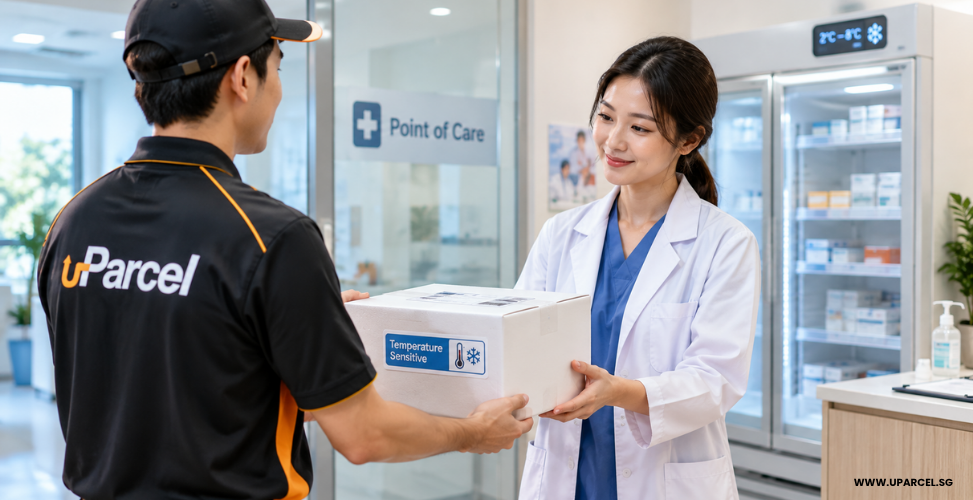
Many fulfilment providers can store a product and ship it on time. But far fewer are legally permitted to touch a medical device at all. GDPMDS is not a nice-to-have credential. It is the gate between having stock and being allowed to touch it. Point of Care sells medical devices, including pregnancy test kits, to consumers in Singapore through online marketplaces. Before a single unit could reach a customer, the business faced a wall most sellers never have to think about: without GDPMDS certification, there was no legal way to import, store, or distribute the product at all. This isn't a licensing formality that can be sorted out after launch. It's a prerequisite. A business can have a registered product, a Singapore entity, and stock ready to ship, and still be unable to bring it into the country, because the company itself isn't certified to handle it, and neither is any warehouse without the same certification. Point of Care needed a fulfilment partner who could carry the weight of these requirements without slowing delivery down, which is where uParcel came in. Every stage of Point of Care's fulfilment runs through a GDPMDS-certified facility, a pick and pack process built around each product's specific packaging and labelling needs, and dispatch timed to Shopee's delivery cut-off. Here's how uParcel supported Point of Care at every step, from import to pick and pack to last mile delivery. The Regulatory Picture: What Medical Device Sellers Are Actually Up Against Before getting to fulfilment, it helps to understand what a business selling medical devices in Singapore has to clear. Medical devices are regulated by the Health Sciences Authority (HSA) under the Health Products Act. HSA sorts devices into four risk classes, A through D, based on factors including how long the device stays in contact with the body and how invasive it is. Risk Class Risk Level Examples Class A Low Wheelchairs, tongue depressors, surgical masks Class B Low to Moderate Hypodermic needles, suction equipment, hearing aids Class C Moderate to High Ventilators, bone fixation plates, X-ray machines Class D High Heart valves, implantable defibrillators, pacemakers Pregnancy test kits and similar diagnostic products fall within this framework and carry the same import and handling requirements as other regulated devices. Two separate approvals sit on top of this, and businesses often conflate them. The product needs registering. Medical devices must be registered with HSA before they can be sold, with Class A devices exempted from this requirement. Registered devices are listed on the Singapore Medical Device Register (SMDR). The company needs licensing. Manufacturers, importers, and wholesalers must all hold a dealer's licence, and these are valid for 12 months from approval, meaning renewal is a recurring obligation rather than a one-off. Registering a product does not license the company to import it, and licensing the company does not approve the product. A business needs both before a device reaches a customer. 1. Import into a GDPMDS-Certified Warehouse This is where most medical device businesses discover the hard part. What GDPMDS actually is GDPMDS stands for Good Distribution Practice for Medical Devices. It is a quality management system covering the handling, storage, delivery, and tracking of medical devices on its way to the customer. Why it blocks businesses before they start Without GDPMDS certification, a company cannot legally obtain a Medical Device Dealer's Licence, and therefore cannot bring products to market. HSA only grants the licence after the applicant has obtained GDPMDS certification or an accepted equivalent. It is a prerequisite, not a box to tick later. A business can have a registered product, a Singapore entity, stock ready to ship, and still be unable to import a single unit. What certification actually involves This is not paperwork a company files and forgets. The certificate has to come from a Conformity Assessment Body accredited by the Singapore Accreditation Council (SAC), not from any auditor a business chooses. The audit itself runs in two stages: a review of the quality management system documentation, followed by on-site verification covering storage conditions, environmental controls, training records, traceability, and product disposal. Then it keeps going. Initial certification is valid for three years and requires annual surveillance audits to maintain. Maintaining it means keeping suitably qualified personnel in place who can consistently hold the standard, which for a small distributor means hiring for compliance rather than growth. Building this from scratch means writing a full QMS, training staff to the standard, running an internal audit, fixing whatever that surfaces, then passing an external two-stage audit, all before the first shipment lands. What this meant for Point of Care uParcel's warehouse is GDPMDS-certified, so Point of Care did not need to build and certify a facility of its own just to clear this step. From the moment stock landed, it could be transported and stored under uParcel's certification. The traceability and storage controls the standard demands were already in place and already audited, and the annual surveillance audits, training records, and documentation upkeep sit with uParcel rather than with Point of Care. Verification at the door What happens on arrival is where the process gets specific to how uParcel runs. When stock reaches the warehouse, uParcel's team carries out a manual count of every import, checking both quantity and condition against the order information already uploaded to the IMS. Short shipments, damaged cartons, and count discrepancies surface at the door rather than weeks later during a customer complaint or a stock reconciliation. For medical devices this matters more than it would for general goods, because GDPMDS exists to control risks like contamination and damage across the distribution chain. A device that arrived damaged and went unnoticed is not just a stock write-off, it is a traceability failure. Point of Care gets a verified record of exactly what arrived and in what state before any of it is made available for sale. 2. Where uParcel Goes Further Than a Standard 3PL Clearing the GDPMDS bar gets a fulfilment partner into the room. It doesn't automatically mean they can handle what a medical device, especially a delicate, privacy-sensitive one like a pregnancy test kit, actually needs on a day-to-day basis. This is where the gap between uParcel and a general 3PL shows up most clearly. Packaging and handling requirements are set by the client, not fixed by the warehouse Many fulfilment providers work off one or two default packaging options, and clients have to fit their product into whichever one comes closest. That's workable for general merchandise. It's a problem for something like a pregnancy test strip, which is genuinely brittle and needs handling a generic default wasn't built for. uParcel's Inventory Management System (IMS) lets clients set packaging and handling requirements per product, directly in the system, reinforced packaging for fragile items, or any other specific instruction Point of Care needs. Clients can also supply their own packaging, which uParcel will use during pick and pack instead of a standard option, a level of customisation most fulfilment providers can't accommodate, since it falls outside a fixed set of default packaging types. Privacy labelling This is the adjustment a standard fulfilment setup isn't necessarily built to accommodate, and it's central to why Point of Care needed a partner beyond just GDPMDS certification. Health-related purchases carry a level of sensitivity that most consumer goods do not. A parcel sits in a mailroom, a lobby, or a shared corridor before someone collects it, and anyone handling it can read what is printed on the outside. For a medical device, the product name alone can disclose something a customer considers private. On request, uParcel cuts the product name before the shipping label is prepared. What goes on the parcel is the order and delivery information a courier needs to complete the delivery, nothing that identifies what's inside. The parcel moves through the network looking like any other parcel. Why this holds at volume, not just in theory The common thread across both the packaging and privacy requirements is that neither depends on a person remembering to apply them. During the pick and pack process, items with special packaging requirements are flagged, and workers are able to see the instructions that come with the item automatically, through every order. As it's embedded into our IMS, there is no need to fully rely on human memory, decreasing the risk of human error. This is the actual mechanism behind "consistent handling," not just a claim. Being able to meet whatever specific labelling or packaging rule a client sets, and hold it consistently at volume, is where uParcel goes beyond a standard fulfilment setup. 3. Inventory and Expiry Management Medical devices and their consumables often carry expiry dates, and tracking them at product level is not enough, since one SKU can hold several batches at once with different expiry dates. uParcel's IMS handles this from the point a product is first created. A "Require Expiry" checkbox can be switched on for expiry-sensitive items, after which every batch entering the warehouse is tracked individually rather than absorbed into one combined stock count. Clicking into the product shows each batch with its own Batch ID, expiry date, and quantity on hand. When an order comes in, the IMS pulls from whichever batch expires soonest, sequencing outbound stock on a First Expiry First Out (FEFO) basis without anyone checking dates by hand. Because this logic is tied directly to the warehouse's inbound and outbound processes, older stock does not quietly accumulate until it is close to expiry, and Point of Care's team never has to work out which batch should move first. Batch-level tracking also supports the traceability side of GDPMDS. If a specific batch needs to be identified, held, or traced, the record is already there rather than needing to be reconstructed from shipping records. 4. Last-Mile Fulfilment Orders need to reach customers on time to keep Point of Care's Next-Day Delivery (NDD) status on Shopee intact, which depends on parcels being packed and handed to SPX (Shopee Express) before the 11am and 2pm cut-off. Miss the window and the parcel is not collected that day, which means it does not reach the customer the next. uParcel treats that cut-off as a hard deadline rather than a target, preparing orders ahead of it so the handover happens on schedule. NDD status shows up directly on the product listing, which lifts buyer confidence and search visibility. For medical devices, speed carries extra weight. A customer buying a monitoring device or a consumable is often replacing something they actively use, not browsing for something they are happy to wait on. Delivery reliability reads as product reliability, whether or not that is fair. The Certification That Comes Before Everything Else Importing and distributing medical devices comes with a level of regulatory scrutiny, handling care, and customer sensitivity that most fulfilment providers are not built to accommodate. That gate doesn't disappear once a business finds a partner, it just moves to whoever holds the certification. For Point of Care, working with uParcel meant a GDPMDS-certified facility from day one, inbound verification against live system records, packaging and handling requirements set by the client rather than limited to a warehouse's defaults, privacy protection built into every label, batch-level expiry tracking that supports both operational accuracy and regulatory traceability, and delivery that protects its Next-Day Delivery status on Shopee. What ties it together is that uParcel owns every one of these steps rather than subcontracting them out. There is no gap between providers where accountability becomes unclear, and no need for Point of Care to coordinate between a warehouse operator, a labelling vendor, and a compliance consultant to understand what happens to a single order. If your business handles specialised, sensitive, or highly regulated products, uParcel's end-to-end fulfilment solution is built for exactly this. Get in touch to see how we can support your business. Frequently Asked Questions 01. If my fulfilment partner is GDPMDS-certified, do I still need my own certification? It depends on what your own company does. GDPMDS certification is tied to the activities a legal entity performs at its facility, and the dealer's licence is issued to a specific legal entity. If a business holds and distributes stock itself, it needs its own certification and licence. Using a certified fulfilment partner means the storage and distribution activities happen under a facility that is already certified for them. 02. Can a standard 3PL store my medical devices? No. GDPMDS applies to any company that imports, stores, or distributes medical devices in Singapore. A general warehouse without certification is not permitted to handle them, regardless of how well run it is. 03. What is the difference between GDPMDS and ISO 13485? ISO 13485 governs the entire product lifecycle including design and manufacturing, while GDPMDS covers quality, safety, and integrity through storage and distribution. HSA may accept ISO 13485 or MDSAP as an equivalent for licensing purposes. 04. How long does GDPMDS certification take to obtain? Timelines vary by how much quality management infrastructure a company already has. The sequence involves implementing a compliant QMS, training staff, running an internal audit, and then passing a two-stage external audit by an SAC-accredited body. Once granted, certification runs three years with annual surveillance audits. 05. Does my product need to be registered separately from my company being licensed? Yes, and these are commonly confused. Devices must be registered with HSA before sale unless they are Class A, and manufacturers, importers, and wholesalers must separately hold a dealer's licence. Neither substitutes for the other. 06. What happens if HSA audits my fulfilment partner? Surveillance audits of the certified facility are handled by the certified party. This is part of why the arrangement is useful: the audit burden, documentation upkeep, and corrective actions sit with the operator of the certified facility rather than with every client storing stock there. 07. How are expiry-dated consumables tracked? Through batch-level records in the IMS. Each batch is logged with its own ID, expiry date, and quantity, and outbound orders are sequenced so the earliest-expiring batch moves first.
Blue Bird Taiwanese Egg Rolls: From Import to Doorstep
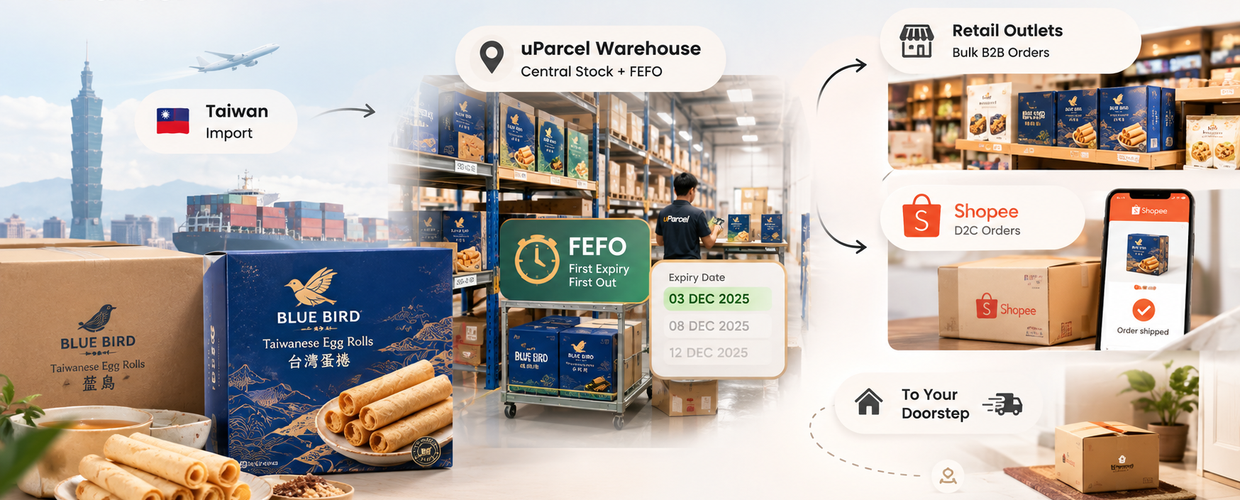
Importing and selling food in Singapore is not a simple process. Businesses face a mix of licensing, storage, and compliance requirements at nearly every stage, and here's where many run into trouble. 1. Business registration and licensing Before importing anything, the company must be registered with ACRA (Singapore's company registrar). Once registered, the type of food determines what's needed with the Singapore Food Agency (SFA), the main regulator: Meat and fish products need a full import licence Fresh fruits and vegetables need a full import licence Shell eggs need a full import licence Processed food and food appliances only need registration, which is a lighter process The classification matters a lot, since some products can fall under more than one category depending on how they're made. 2. Cargo Clearance Permit (CCP) for every shipment Even with a valid licence or registration, each individual shipment needs its own Cargo Clearance Permit approved by SFA before it clears customs. This is separate from the business level licence and is required per consignment, not once for the business. 3. Overseas source accreditation For higher risk categories, SFA often requires the exporting country and specific overseas establishment to be pre accredited. If the source isn't already on SFA's approved list, accreditation can take time, making this a common bottleneck for new suppliers. 4. Labelling compliance Prepacked food sold in Singapore must show: The product name, described accurately Full ingredient list, including anything that could cause allergic reactions Country of origin The importer's name and address Net quantity If the manufacturer's original label doesn't meet these requirements, the importer needs to apply a sticker label with the missing details before sale. 5. Storage and expiry management Food has to be kept in a properly SFA licensed facility, not a general warehouse. On top of that, stock needs to be managed on a First Expiry First Out (FEFO) basis, so older stock moves before newer stock. Without a system to track this, businesses risk stock expiring on the shelf or being sold past its shelf life. 6. Ongoing compliance and enforcement SFA runs inspections and can sample products for lab testing. Importing without the correct licence, or storing food in an unlicensed facility, carries real penalties, and enforcement action is not rare. Where businesses commonly get stuck The biggest friction points tend to be figuring out the correct product classification, arranging overseas source accreditation early enough, and keeping labelling and storage compliant once volume picks up. For most food businesses, managing all of this alone means either building out compliance and warehousing capability from scratch, or finding a partner who already has it in place. The Blue Bird Case Study Blue Bird Taiwanese Egg Rolls is a brand that sells Taiwanese egg roll snacks, mostly importing and selling to consumers on online marketplaces like Shopee. Faced with these challenges, Blue Bird decided to outsource its fulfilment to uParcel. uParcel gives Blue Bird end to end support across the entire fulfilment journey. From the moment its import lands, uParcel handles labelling services to meet mandatory compliance requirements before the product goes up for sale. Stock then moves into SFA registered food storage, where an Inventory Management System automatically rotates inventory by expiry date to keep it FEFO compliant. From there, same day pick and pack keeps orders moving fast enough to hit Shopee's Next Day Delivery cut off, with uParcel's own delivery fleet handling the final leg to customers when required. With this in place, Blue Bird no longer has to worry about compliance gaps, manual stock tracking, or fulfilment delays. It can instead focus on growing the brand, while uParcel manages the operations behind it. Here's how uParcel supported Blue Bird at every step of the fulfilment journey, from import to pick and pack to last mile delivery. 1. Import into SFA Food Storage Warehouses To store and sell its imported snacks in Singapore, Blue Bird needed a warehouse partner that already had this compliance sorted, since storing food locally without the right SFA registration runs the risk of penalties or having products seized, stakes too high for most brands to take on themselves. uParcel holds an SFA Registration for a Food Storage Warehouse, covering general and processed food, and operates across four storage environments to match different product needs: Blue Bird's egg rolls are stored in uParcel's dry and ambient tier, the right environment for a packaged, shelf-stable snack that doesn't require refrigeration or freezing to maintain quality. What this means for Blue Bird: uParcel already holds the SFA registration required to legally store and handle packaged food products in Singapore Blue Bird's product sits in the storage environment actually suited to it, rather than a one-size-fits-all facility Blue Bird can store and sell its products locally without setting up or maintaining its own licensed facility This gave Blue Bird the assurance that its stock is being stored in a facility that meets Singapore's regulatory requirements, in an environment matched to the product itself. Blue Bird could start storing and fulfilling locally without needing to secure its own licensed facility or navigate the registration process itself, while also protecting consumer safety on every order that goes out. 2. Pick and Pack Picking When an order comes in, uParcel's warehouse team receives a picking list and pulls the correct items for that order. Items are then packed according to Blue Bird's packaging requirements, which can be set and adjusted through uParcel's in-house Inventory Management System (IMS). Packing Products or orders that need special packaging are flagged during the pick and pack phase, so the warehouse team can pack them according to those specific requirements. For example, Blue Bird runs a promotion where customers who purchase a certain flavour of egg rolls receive a free gift bag. When an order for that flavour comes into the IMS, the gift bag is automatically added to the picking list, so the warehouse team packs it alongside the product without needing a manual reminder or separate instruction each time. Because this logic is built directly into the IMS, special packaging requirements are consistently met with minimal risk of human error, even as order volume grows. 3. Last-Mile Fulfilment Orders need to reach customers on time, especially to keep Blue Bird's Next-Day Delivery (NDD) status on Shopee intact, which depends on parcels being handed over to Shopee's own courier, SPX (Shopee Express), before a strict daily cut-off. Missing that window even occasionally can put NDD eligibility at risk, along with the visibility and buyer trust that come with it. How uParcel keeps orders moving uParcel packs Shopee orders with two batch windows a day, at 11am and 6pm, timed so that SPX can collect and deliver parcels within their NDD framework. If a parcel misses the cut-off, it isn't collected in time, which means the order won't reach the customer the next day, so timing during pick and pack is treated as a hard deadline rather than a general target. Orders placed on Shopee that require NDD are packed to hit the SPX collection windows, keeping Blue Bird's NDD status intact Orders that don't require NDD, whether placed on Shopee or through Blue Bird's own website, are delivered by uParcel's own fleet of riders on a less time sensitive 3 to 5 day timeline Splitting fulfilment this way lets uParcel meet Shopee's strict NDD requirements without slowing down or over-resourcing less urgent orders Why this matters for sales NDD status is more than a delivery perk. It shows up directly on the product listing, which boosts buyer confidence and gives the listing higher search visibility on the platform. For a snack brand competing with other F&B sellers on Shopee, that badge can directly influence whether a customer chooses to buy, making it as much a sales tool as a logistics outcome. Why First Expiry First Out (FEFO) Matters: Most warehouses default to First In First Out (FIFO), sending out whichever stock arrived first. For expiry-sensitive snacks like Blue Bird's egg rolls, that doesn't always match which batch is closest to expiring, especially when new shipments arrive before older ones have fully cleared. Stock can end up expiring on the shelf even while newer stock is still moving. First Expiry First Out (FEFO) fixes this by sequencing stock according to expiry date rather than arrival date, which is what actually protects shelf life for food. How uParcel's IMS Manages FEFO FEFO only works if expiry dates are tracked at the batch level, not just the product level, since a single SKU can have multiple batches in stock at once, each with a different expiry date. uParcel's IMS handles this from the moment a product is first added to the system. When a new product is created in the IMS, there's a "Require Expiry" checkbox available for expiry-sensitive items like Blue Bird's egg rolls. Ticking this means every batch of that product coming into the warehouse is tracked individually by expiry date, rather than treated as one undifferentiated stock count. Once this is switched on, clicking into that product shows every batch currently in stock, each with its own Batch ID, expiry date, and quantity on hand. For example, a product might have one batch expiring on 22 January 2027 with 9 units left, and a separate batch expiring on 12 February 2027 with 16 units, both visible at a glance, rather than blended into a single stock figure. When an order comes in, the IMS automatically pulls from whichever batch has the earliest expiry date first, so Blue Bird's team never has to manually check which batch is closest to expiring before it moves. This gives Blue Bird full batch-level visibility without needing a separate spreadsheet or manual tracking system. Every batch's expiry status is visible directly against live stock counts, so ageing inventory is never hidden inside a single combined total. What Happens When Products Are Nearing Expiry Even with FEFO in place, some stock will eventually approach its expiry date, and how that stock is handled matters just as much as how it was rotated. Left unmanaged, near expiry stock can either get sold too close to its shelf life or sit unsold and go to waste, both of which are outcomes Blue Bird would rather avoid. To prevent this, uParcel notifies Blue Bird at least a month before a batch's expiry date, giving the client time to decide how that stock should be handled. The email outlines the options available: Return to client: Stock will be shipped back to a location of the client's choice, whether that's their own warehouse or their manufacturer. Dispose of: Stock will be disposed of responsibly, in line with Singapore's food waste regulations. Donate: Where possible, stock can be donated to food charities or shelters. This generally applies to products that are not yet unsafe to consume, such as those nearing a "best before" date rather than a hard expiry date. Once Blue Bird responds with its intended action, uParcel's team carries out the intended action and updates the IMS on its behalf, with the changes reflected in real time so the brand always has an accurate view of its stock. This gives Blue Bird visibility over ageing stock well before it becomes a problem, along with control over how it's handled, without needing to manually update records themselves. One Partner, No Gaps Importing and selling food in Singapore comes with a long list of requirements, and for a growing brand like Blue Bird, managing all of it alone would mean building out compliance knowledge, licensed storage, inventory systems, and delivery capability from scratch, all while trying to grow the business itself. By working with uParcel, Blue Bird gets an end to end partner that owns every step of that process: Import and compliance: uParcel handles labelling requirements the moment stock lands, so Blue Bird's products meet Singapore's regulations before they're ever sold. Storage: Stock is kept in uParcel's SFA registered food storage warehouse, giving Blue Bird a fully compliant facility it didn't have to build or manage itself. Pick and pack: Orders are picked and packed according to Blue Bird's exact requirements, adapting automatically to promotions like their free gift bags, all built directly into uParcel's IMS to minimise human error. Last-mile fulfilment: Time sensitive Shopee orders are packed to hit SPX's NDD collection windows, while less urgent orders are handled by uParcel's own delivery fleet, keeping Blue Bird's NDD status on Shopee intact. Inventory management: uParcel's IMS runs FEFO automatically, so older stock is always sold first, reducing wastage without anyone needing to track expiry dates by hand. Expiry management: When stock does approach expiry, uParcel flags it a month in advance and handles the outcome, then updates the IMS on Blue Bird's behalf, so nothing falls through the cracks. What ties all of this together is that uParcel isn't just handling one part of Blue Bird's supply chain, it owns the entire process from import to last-mile delivery. That means there's no gap between providers where responsibility becomes unclear, and no need for Blue Bird to coordinate between multiple vendors to get a full picture of their stock and orders. If something needs to be fixed, adjusted, or explained, Blue Bird has one partner who's directly accountable for every step, not several parties pointing to each other. If your business imports and stores expiry-sensitive food products, whether for retail, wholesale, or direct-to-consumer sale on marketplaces, uParcel can help. Get in touch with our team to talk through your needs, get an instant quotation to see what it would cost, or explore our warehousing and fulfilment services to see everything we offer.