>
Ecommerce Enabler>
How to Expand Your Ecommerce Business to Singapore in 2026: A Practical Guide for Global Sellers
How to Expand Your Ecommerce Business to Singapore in 2026: A Practical Guide for Global Sellers

Er Cai Fang
Senior Product Manager
Looking to enter the Singapore ecommerce market in 2026? Learn how to launch, localize, and scale your online business with this complete guide for global sellers.
Singapore is one of Southeast Asia’s most digitally connected economies and a gateway for international brands looking to establish a foothold in the region. Its tech-savvy population, stable economy, and efficient infrastructure make it an attractive ecommerce destination.
If you're planning to expand your online business to Singapore in 2026, here's a detailed yet practical roadmap to guide your launch, compliance, operations, and long-term growth.
1. Get to Know the Singapore Ecommerce Landscape

Before entering any new market, it’s crucial to understand the behavior of your target audience. In Singapore, ecommerce is mobile-first, convenience-driven, and highly competitive. With over 60% of internet users shopping online weekly, local consumers are active and well-informed.
Popular ecommerce platforms like Shopee SG, Lazada SG, Amazon.sg, uShop Market and TikTok Shop dominate the digital shelf space. To succeed, it’s important to:
-
Research consumer trends and shopping behavior
-
Analyze top competitors and price points
-
Identify under-served niches where your product can stand out
Pro Tip: Use market research to spot gaps perhaps certain categories or quality tiers aren't well-covered by existing sellers. Position your brand accordingly.
2. Navigate Legal and Regulatory Requirements
Singapore has a transparent and well-structured regulatory framework. That said, it’s important to comply with the necessary requirements before selling.

Here’s what you’ll need:
-
Register your business with ACRA (Accounting and Corporate Regulatory Authority)
-
Register for GST if your annual revenue exceeds SGD 1 million
-
Comply with PDPA and IMDA regulations for data protection and product standards
-
Check for special permits if selling food, cosmetics, medical items, or electronics
If you're feeling overwhelmed, you're not alone. Regulatory compliance can be complex especially when handling customs, taxes, and product approvals.
✅ How uParcel Helps: Our Marketplace Manager Service acts as your Importer of Record, managing customs clearance, tax filing, product documentation, and all compliance needs so you can focus on selling, not paperwork.
3. Localize Your Brand for Singaporean Shoppers
Localization goes far beyond translation. It’s about adapting your product, messaging, pricing, and user experience to resonate with local expectations.
For example:
-
Adjust sizes, colors, or features based on regional preferences
-
Price your items in Singapore Dollars (SGD)
-
Offer promotions during local festivals like Chinese New Year, Hari Raya, or National Day
-
Customize your visuals and tone of voice to fit the multicultural, urban Singaporean audience
Pro Tip: Keep customer service channels open during local working hours, and provide bilingual support (English & Mandarin) if possible.
4. Offer Familiar, Secure Payment Methods
In Singapore, digital payments are the norm and the wider your payment options, the better your conversion rate.
Here are common payment modes:
-
PayNow (linked to bank accounts)
-
GrabPay and ShopeePay
-
Credit/debit cards
-
Buy Now, Pay Later services like Atome and Grab PayLater
Ensure your checkout process is mobile-optimized, secure, and fast. Use a PCI-compliant payment gateway and keep friction low to reduce cart abandonment.
5. Partner with Local Fulfillment & Delivery Experts
Shipping cross-border for every order may cause delays, high shipping costs, and a poor customer experience. Singaporean shoppers expect fast delivery, often same-day or next-day.

Instead, store your products locally through a fulfillment partner like uParcel and enjoy:
-
Local warehousing with ambient, air-conditioning, or cold storage options
-
Real-time inventory tracking
-
Seamless last-mile delivery and returns handling
-
Multiple delivery options (locker, doorstep, scheduled)
What to look for in a logistics partner:
-
Flexibility to scale as your business grows
-
Transparent tracking systems
-
Affordable rates without long-term contracts
✅ Why Choose uParcel: We offer smart warehousing, order fulfillment, and same-day delivery across Singapore, helping your brand deliver the speed and reliability local consumers expect.
6. Monitor Performance and Stay Agile

After launch, continuous optimization is key. Use data to:
-
Monitor best-selling SKUs and underperforming products
-
Analyze customer feedback and reviews for improvement
-
A/B test pricing or marketing campaigns
-
Adjust inventory based on demand fluctuations
Don’t underestimate the power of social proof. Highlight positive reviews and feature real customer stories on your product pages and ads to build trust.
Final Thoughts: Is Your Business Ready to Grow in Singapor?
Singapore may be small, but its ecommerce potential is significant. Brands that take the time to understand local regulations, deliver a tailored shopping experience, and work with the right fulfillment partners can thrive in this competitive market.
🚀 Launch Your Online Business in Singapore through uParcel

At uParcel, we simplify cross-border expansion. Whether you're starting from scratch or scaling an existing business, our Marketplace Manager service gives you:
-
A dedicated team to manage local compliance
-
Fast and flexible warehousing solutions
-
Order fulfillment and delivery (same-day included!)
-
Full dashboard visibility over inventory, orders, and deliveries
CHECK OUT UPARCEL'S MARKETPLACE MANAGER PLANS
No local entity? No problem. Let us be your fulfillment and regulatory partner in Singapore.
Contact us today to learn how uParcel can help launch and scale your online business in Singapore in 2026 and beyond.
Other Blog Posts
Outsourcing vs Hiring an Ecommerce Executive in Singapore: Cost Comparison
Most Singapore sellers reach the same point once their Shopee or Lazada store starts to grow. The owner can no longer answer every chat, update every listing and set up every campaign alone, so the question becomes whether to hire an ecommerce executive or hand the marketplace work to an outside team. The salary is the number everyone looks at first, but it is only part of the bill. Employer CPF, the Skills Development Levy, tools, leave cover and the cost of replacing someone who resigns all sit on top of it. This guide breaks down the full monthly cost of an in-house ecommerce executive using official Singapore figures, looks at what one person can realistically cover across three marketplaces, and compares that with outsourcing marketplace operations. It also covers the situations where hiring is the better choice, so you can decide on your own numbers. What an Ecommerce Executive Earns in Singapore The closest official benchmark for an in-house ecommerce or marketplace executive is the "Online sales channel executive" occupation in the Ministry of Manpower's Occupational Wage tables. The figures below cover full-time resident employees across all industries in private sector establishments with at least 25 staff. Percentile Monthly basic wage Monthly gross wage 25th percentile S$2,969 S$3,008 Median S$3,894 S$4,065 75th percentile S$4,989 S$5,143 A few points matter when you use these numbers for budgeting: Gross wage in MOM's tables includes basic pay, overtime, commissions, allowances and other regular cash payments. It excludes employer CPF, bonuses and other lump sums. Experience shifts the range. A junior hire who needs training sits nearer the 25th percentile, while someone who can already run campaigns and ads across three platforms is more likely to ask for 75th percentile pay or above. Small firms are not in the survey. The data comes from establishments with 25 or more employees, so a small seller may pay less or more depending on the candidate and the role. Bonuses, such as a year-end or 13th-month payment, are not included in the gross figure. If you plan to pay one, add it to your annual budget separately. The Employer Costs That Sit on Top of Salary Employer CPF and the Skills Development Levy are compulsory costs that add directly to every month's payroll. They apply to every Singapore Citizen or Permanent Resident you hire. Employer CPF contribution: for employees aged 55 and below earning more than S$750 a month, the employer contributes 17% of wages, according to the CPF Board's contribution rates. This is separate from the employee's own share, which is deducted from their pay. Rates step down for older employees. Skills Development Levy (SDL): 0.25% of monthly total wages for each employee, with a minimum of S$2 (for wages under S$800) and a maximum of S$11.25 (for wages above S$4,500). Bonuses attract CPF too. If you pay a year-end bonus, employer CPF is also payable on it, so the bonus costs more than its face value. Full Monthly Cost of an In-House Ecommerce Executive Adding the compulsory employer costs to MOM's gross wage figures gives the base monthly cost of one hire. This is the minimum before any tools, training or management time. Cost line 25th percentile Median 75th percentile Monthly gross wage S$3,008 S$4,065 S$5,143 Employer CPF (17%) S$511 S$691 S$874 SDL (0.25%, capped at S$11.25) S$8 S$10 S$11 Base monthly cost S$3,527 S$4,766 S$6,028 These figures are rounded to the nearest dollar and assume an employee aged 55 or below. The real cost of the role is higher, because several other lines rarely show up in the first budget. Tools and software: An executive running three stores usually needs paid tools for some of the work: design software for banners and listing images, a chat or inventory management tool that pulls Shopee, Lazada and TikTok Shop into one view, and a laptop and phone. Prices vary by provider and plan, so get quotes for the tools you would actually use. Training and ramp-up: Each marketplace has its own Seller Centre, campaign calendar, ad system and penalty rules. A new hire, even an experienced one, needs time to learn your products and your stores before they perform at full speed, and those first months are paid at the full rate. Management time: Someone has to brief the executive, review campaign plans, approve ad spend and check results. That time usually comes from the owner, which is the time the hire was meant to free up. Recruitment and turnover: Job ads, interviews and the weeks a role sits empty all cost money. If the executive resigns, you pay those costs again, and you also lose their knowledge of your listings, logins and campaign history unless it was documented. What One Executive Can Realistically Cover One ecommerce executive works set hours, while marketplace stores take orders and chats every day. This gap matters more than the salary for many sellers, because Shopee, Lazada and TikTok Shop all track how fast you ship and reply. A single store on one marketplace involves daily work across several areas: Orders: confirming orders, arranging shipment and watching for late or cancelled orders. Customer chat: replying to pre-sale questions, delivery queries and complaints. Listings: updating prices, stock, descriptions and images, and fixing listings flagged by the platform. Promotions: setting up vouchers and flash deals, and nominating products for platform campaigns such as 11.11 and payday sales. Ads: running and adjusting Shopee Ads, Lazada Sponsored Solutions and TikTok Shop ads. Returns and disputes: reviewing return requests and responding before platform deadlines. Multiply that by three Seller Centres, each with its own interface and rules, and one person is usually forced to prioritise. In practice, the store with the most orders gets attention and the others drift: slower chat replies, outdated listings and missed campaign nominations. Leave cover is the other limit. Under the Employment Act, an employee gets at least 7 days of paid annual leave in the first year of service, rising to 14 days from the eighth year, plus up to 14 days of paid outpatient sick leave after six months of service. Every one of those days is a day the stores run without their only operator unless the owner steps in. Outsourcing Marketplace Operations: What the Fee Covers Outsourcing marketplace operations means a team, rather than one employee, runs the daily work of your stores under a fixed monthly fee. When you compare it with hiring, look at exactly what the fee includes, how many marketplaces it covers, and what service levels the provider commits to. uParcel's Complete Marketplace Outsource Solution (CMOS) is one example of how this is structured. Its CMOS-02 Day-to-Day Management package costs S$3,000 per month and covers up to 3 marketplaces, with a minimum period of 3 months (the usual period is 6 months). The package includes four areas of work: 1. Order management and fulfilment monitoring: The team targets orders confirmed and shipped in under 1.1 days and a late shipment rate under 5%, the metrics marketplaces use to judge seller performance. 2. Listing accuracy: Regular updates to product information and supplementary images, aimed at cutting avoidable returns (change-of-mind returns are excluded). 3. Store credibility and promotions: Proposing and setting up biweekly flash deals for 2 selected products, managing product ads, and nominating and enrolling the store into eligible campaigns and programmes. 4. Customer service from Monday to Sunday, 11am to 9pm: The package targets at least 85% of first responses within 12 hours, an average response time under 1 hour, and chat satisfaction of at least 70%. The seven-day customer service window is the part a single hire cannot match. A five-day employee leaves weekend chats waiting until Monday, which is exactly when weekend shoppers are deciding whether to buy. Two points keep the comparison fair: Fulfilment is billed separately. Fulfilment warehousing, pick and pack and delivery are separate services and are not part of the CMOS-02 fee, just as an in-house executive's salary does not cover your packing and courier costs. Setup is a one-time package. If your stores are not set up yet, store setup and listing creation are a separate one-time package (CMOS-01 List & Launch, from S$1,688 for the first marketplace). The ecommerce enabler cost breakdown covers how these charges usually fit together. Side-by-Side Cost Comparison Put the two options next to each other and the difference is less about the monthly number and more about what each number buys. The table uses MOM's median wage for the in-house column. Factor In-house ecommerce executive Outsourced marketplace operations (CMOS-02) Base monthly cost About S$4,766 (median gross wage + employer CPF + SDL) S$3,000 for up to 3 marketplaces Costs not in the base figure Bonus and CPF on bonus, tools, training, recruitment, management time Store setup if needed (CMOS-01); fulfilment and delivery billed separately People on the account One person A team Customer service hours The employee's working hours Monday to Sunday, 11am to 9pm Leave and sick days Stores run unattended or the owner covers Covered by the team Marketplaces covered Whatever one person can manage Up to 3 marketplaces Performance targets Set and enforced by you Written into the package (shipping, late shipment rate, chat response) Commitment Notice period under the employment contract Minimum 3 months, usually 6 months If it does not work out Recruit and train again Change provider at the end of the term Knowledge of your brand Builds inside your company Sits with the provider; agree on handover of logins and data When Hiring an Ecommerce Executive Makes More Sense Outsourcing is not the right answer for every seller. Hiring in-house is usually the better choice in these situations: Your own website is the main channel. If most sales come from a Shopify or WooCommerce store and marketplaces are a side channel, you may need a generalist who also handles email marketing, the website and social media. The role is really brand or product work. Product development, influencer relationships and content shoots depend on close contact with the founder and suppliers, which an in-house hire handles more easily. You already have an ecommerce team. Once you have several people across marketing, operations and customer service, adding one more executive is cheaper per head and the leave cover problem disappears. You want to build the capability inside the company. Some owners plan to grow a full internal team over time and see the first hire as its foundation. Your products need deep technical knowledge. Highly technical or regulated products may need someone who can answer detailed questions that a general support team would escalate. Many sellers end up with a mix. They keep one in-house person focused on brand, content and supplier coordination, and outsource the daily store operations: orders, listings, chats, promotions and ads. The guide to ecommerce outsourcing services in Singapore walks through which tasks sellers usually hand over first. How to Decide on Your Own Numbers Start with your current workload rather than the salary table. List every marketplace task done in a normal week, who does it now, and what slips when that person is away. Then run three checks: Cost check: Compare S$3,000 a month against your realistic in-house figure, including employer CPF, SDL, tools and the owner's management time, not just the advertised salary. Coverage check: Count how many hours a week your stores need someone answering chats and processing orders, including weekends and campaign days, and compare that with one employee's working week. Risk check: Ask what happens to your stores if your only executive resigns during the run-up to 11.11, and how long it would take to recruit and train a replacement. If your stores need more coverage than one person can give, outsourcing vs hiring an ecommerce executive in Singapore usually comes down to paying for one person's hours or for a team's coverage at a lower monthly fee. If you want to see how outsourced store management and fulfilment would work for your Shopee, Lazada or TikTok Shop stores, uParcel's ecommerce enabler team can walk you through it.
Product Listing Services in Singapore: What's Included
Most marketplace sellers in Singapore know their listings could be better. Titles were written in a hurry, half the attribute fields are blank, and the photos came straight from the supplier's catalogue. Buyers scroll past, and the store never builds the sales history that search ranking depends on. Product listing services in Singapore promise to fix that, but "listing" can mean anything from copying supplier data into Seller Centre to a full rebuild of how each product is found and chosen. This guide breaks down what a professional listing service should deliver on Shopee, Lazada and TikTok Shop, what to check before you pay for one, and how to tell whether the work was done well. What a Product Listing Service Actually Covers A product listing service creates, optimises and maintains the product pages buyers see on a marketplace. Done properly, it covers three stages, and the price you are quoted depends on which of them are included. Build: creating each listing from scratch, with the right category, attributes, title, description, images, variations and shipping details. Optimise: rewriting titles and descriptions around the terms buyers actually search, and improving images and attributes so more shoppers click and buy. Maintain: keeping prices, stock, product information and images accurate as products, packaging and marketplace rules change. Many low-cost offers cover only part of the first stage. The sections below explain each component, so you can compare quotes like for like. Category and Attribute Mapping Category and attribute mapping decides where a product appears and which filters it shows up under. It is the least visible part of a listing and one of the most important, because marketplace search and filters read these fields directly. Choose the most specific category: A tumbler placed under "Kitchen & Dining > Drinkware > Tumblers" competes with tumblers. The same product under a broad "Others" category competes with nothing and gets found by no one. Fill every relevant attribute: Material, capacity, colour, size, country of origin and warranty are common examples. Buyers use these as filters, so an empty "Capacity" field means the product drops out when a shopper filters for 500ml. List once, in one category: Shopee treats the same product listed in two categories as a duplicate, so a good service picks the single best fit. A provider who maps categories carefully will ask you questions about materials, sizes and specifications before writing anything. If no one asks, the attributes are probably being guessed. SEO Titles and Descriptions Written for Marketplace Search Marketplace listing optimisation starts with the title, because it is the main text the marketplace search engine matches to a buyer's query. A good title is specific and readable, not a pile of keywords. A workable title pattern for Shopee and Lazada is Brand + Product + Key Specification + Size or Variant. Compare these two: Weak: "Hot Sale!! Best Tumbler Bottle Cup Mug Flask Gift Cheap" Strong: "ThermoCo Stainless Steel Insulated Tumbler 500ml, Leak-Proof Lid, Keeps Cold 12 Hours" The weak version is also risky. Shopee's Seller Education Hub guidance on spam listings counts keyword spam, irrelevant keywords, duplicate listings and inaccurate brand attributes as spam, which can lead to deboosting, deleted listings or penalty points. A listing service that stuffs titles with unrelated terms is putting your account at risk, not helping it. Descriptions should do a different job from the title. They answer the questions that stop a buyer from checking out: What exactly is in the box (one tumbler, one lid, one straw) Dimensions and capacity, in centimetres and millilitres Materials and care instructions (dishwasher safe or hand wash only) Who it suits and who it does not (fits most car cup holders; not suitable for carbonated drinks) Warranty and after-sales terms A clear "not suitable for" line often prevents a return before it happens. Product Images That Answer Buyer Questions Product images carry more weight than any text on the page, because they are what a shopper sees in the search results before deciding to click. A professional image set has a job for every slot. Main image: the product alone on a clean, light background, filling most of the frame. This is the thumbnail that wins or loses the click. Scale image: the product in a hand or next to a familiar object, so buyers can judge the size. Feature images: close-ups of the lid, the stitching, the texture or the ports, with short labels. In-use image: the product in a realistic Singapore setting, such as a tumbler on an office desk or a bath mat in an HDB bathroom. Spec chart and variants: dimensions and contents as a simple graphic, plus one clear photo for every colour or size. Before you sign, ask whether the service shoots new photos, edits your existing ones, or only uploads what you provide. These are very different levels of work. Also check who owns the final images, because you will want to reuse them on other channels. Variations, Bundles and Dimensions Variations, bundles and package dimensions are where listings most often break in practice. Errors here cause wrong orders, stock problems and shipping fee surprises, so a good service treats them as operational setup, not decoration. Variations: colours and sizes should sit under one listing as variations, each with its own SKU, price, stock count and image. Listing every colour as a separate product splits your reviews and sales history, and can count as duplicate listings. Bundles: a "2 tumblers + 2 straws" set needs its own SKU and a clear name, so the warehouse picks the right items and stock for single units updates correctly. Weight and dimensions: enter the packed weight and the size of the shipping box, not the bare product. Marketplaces use these figures to calculate shipping fees, so an underestimated box can leave you paying the difference. SKU naming: consistent SKU codes across Shopee, Lazada and TikTok Shop make multichannel listing management possible, since stock sync tools match on SKU. If a provider never asks you to measure or send samples, the weights on your listings are estimates. Brand Applications and Authenticity A brand application links your listings to a registered brand on the marketplace, rather than a generic or "no brand" label. It matters most for sellers who own a brand or hold official distribution rights. Marketplaces check the brand attribute because counterfeit and misattributed listings are a real problem. Shopee, for example, treats inaccurate brands in product attributes as attribute spam and gives sellers a short window to fix them before the listing is banned. A brand application usually needs supporting documents such as trademark registration or an authorisation letter from the brand owner. A listing service can prepare and submit the application, but approval rests with the marketplace. Be cautious of any provider who guarantees approval, and confirm whether brand application is included or charged separately. How Listing Work Differs Across Shopee, Lazada and TikTok Shop The building blocks are the same on every marketplace, but each platform rewards slightly different things. A service that copies one listing to all three channels without adjusting it leaves sales on the table. Area Shopee SG Lazada SG TikTok Shop SG How buyers find products Mainly keyword search and category browsing Keyword search, categories and LazMall brand pages Largely through videos, LIVE sessions and creator content, plus Shop search What the title needs Clear keywords in a natural order Brand-led, structured titles Short, clear titles that make sense when a viewer taps through from a video Image emphasis Strong thumbnail to win the search click Clean, consistent brand presentation Images and short video that match what viewers just saw in content Brand attribute Checked for accuracy; inaccurate brands are flagged as spam Brand chosen at listing; brand owners can apply to have their brand recognised Brand names should only be used by the owner or with the owner's authorisation Exact limits for title length, image count and image size change from time to time and vary by category. A competent provider checks them in each Seller Centre when building listings, rather than working from an old template. What uParcel's List & Launch Package Includes uParcel's List & Launch package (CMOS-01) is a one-time setup for sellers launching on Shopee, Lazada or TikTok Shop in Singapore. It covers the listing work described above for up to 20 products, as part of getting a store ready to sell. Here is how the work runs, step by step: Lite market audit: The team benchmarks the sellers already selling similar products on pricing, delivery speed and product authenticity. This shows which search terms, price points and delivery promises your listings need to compete with. Category, attributes and dimensions: Each product is mapped to the right category, attributes are filled in, and variations, bundles and package dimensions are set up. SEO titles and tailored descriptions: Titles are written around the search terms found in the audit, and descriptions are written for each product rather than copied from supplier sheets. Product images: Images are prepared for each listing, with a clean main image and supporting shots. Brand application: Where you own or are authorised for a brand, the team submits the brand application, if the marketplace allows it. Storefront design: The shop page is designed to show buyers that the store is genuine, which matters for new stores with no reviews yet. The listed rates are S$1,688 for the first marketplace, S$388 for each additional marketplace, and S$100 for each additional product beyond the first 20. A seller launching 20 products on both Shopee and Lazada would pay S$2,076 for the setup. Because uParcel also runs its own fulfilment warehouse, the SKUs, bundles and dimensions set up in the listings match how stock is received, picked and packed. That link between listing data and warehouse data is what prevents wrong-item orders and shipping fee mismatches later. You can see how this played out in practice in how uParcel launched SlipStop on Shopee Singapore with search-driven listings. What to Check Before You Pay for a Listing Service Ecommerce product listing outsourcing is only as good as the scope you agree on. Before paying, get clear answers to these points in writing. How many products and marketplaces are covered, and what each extra one costs. Per-product and per-marketplace pricing make quotes easier to compare. Whether research is included. Ask how they choose keywords. "We use our experience" is not an answer; a competitor and keyword review is. Who produces the images, whether new photography is included, and who owns the files afterwards. Whether variations, bundles and dimensions are set up, or only the main product page. Whether brand applications are handled, and what documents you need to provide. Who holds the Seller Centre login. Listings should sit in your own account, or in an account set up with clear access terms, never one the provider can withhold. What happens after launch. A one-off setup leaves the listings to you. Ask whether ongoing updates are available, and at what cost. If a quote does not mention most of these points, it is probably a data-entry service priced as optimisation. How to Judge Listing Quality After Launch Listing quality shows up in the store's numbers within the first few weeks. Seller Centre on each marketplace gives you the data you need to check the work. Search visibility: search for your main keywords as a buyer would. Your products should appear for the terms used in their titles. Click-through rate: a low rate from search impressions usually points to a weak main image, title or price. Conversion rate: visits without orders suggest the description or images are not answering buyer questions. Return and cancellation reasons: "item not as described" or "wrong size" means the listing set the wrong expectation. Listing violations: any spam or attribute warnings in Seller Centre are a direct sign of poor listing practice. Treat the first month as a test. Strong listings show steady improvement in clicks and conversion; weak ones stay flat no matter how much you spend on ads, because ads send traffic to a page that does not convert. For a wider view of what to monitor once listings are live, the store management checklist for Shopee Singapore covers the routine checks. Good Listings Keep Earning After Launch Day Product listing services in Singapore are worth paying for when they cover the full job: category and attribute mapping, search-led titles and descriptions, purposeful images, correct variations and dimensions, and brand applications where they apply. The cheapest quote usually skips the parts that matter most for search and for accurate orders. Listings also need care after launch, as prices change, packaging is updated and buyers ask new questions. If you would like the listing work and store launch handled together, the team behind uParcel's ecommerce enabler service can walk you through the List & Launch package and what your products need.
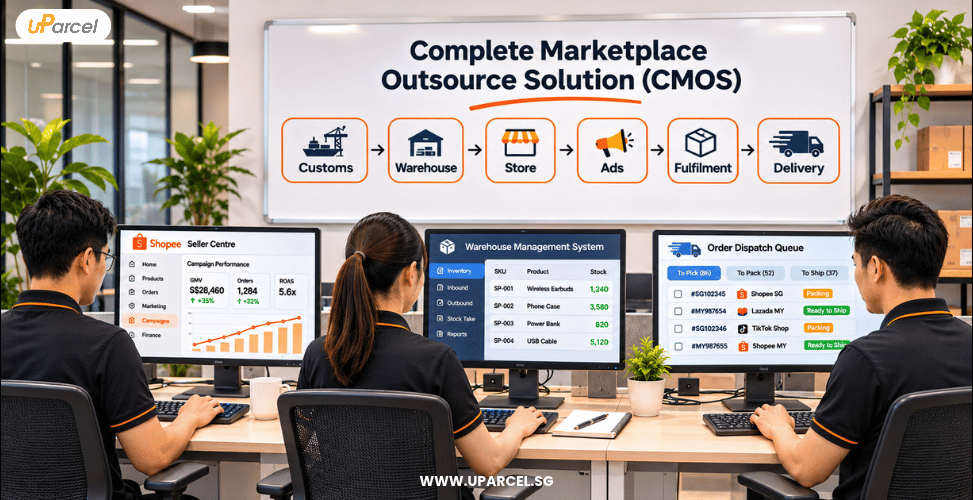
What Is CMOS? The Complete Marketplace Outsource Solution Explained
Selling on Shopee, Lazada and TikTok Shop looks straightforward from the outside. In practice, running a marketplace operation involves daily listing management, paid campaign optimisation, inventory tracking, order fulfilment, customer service, and logistics and each of those functions has to work together for the operation to perform. Most brands try to manage this across separate vendors: a marketing agency for the store, a 3PL for fulfilment, an in-house team for customer service. The result is fragmented accountability, when an order goes wrong, no single party owns the problem. CMOS, Complete Marketplace Outsource Solution is the model designed to eliminate that fragmentation. One partner takes on the full marketplace operation on the brand’s behalf, from the moment stock arrives to the moment the customer receives their order. This post explains what CMOS covers, who it is designed for, and how it applies to brands operating in Singapore, Malaysia or both. What CMOS Stands For CMOS stands for Complete Marketplace Outsource Solution. It describes a managed service model in which a single operations partner handles every layer of a brand’s marketplace presence, storefront management, traffic and ads, warehousing, order fulfilment, customer service and last-mile delivery rather than one or two of those functions in isolation. The defining characteristic of CMOS is accountability across the full chain. Under this model, the partner is not advising the brand on what to do; they are doing it, and they are responsible for the outcome at each stage. What CMOS Covers: The Full Scope CMOS covers six operational layers. Each one supports the others which is why outsourcing them to separate vendors creates coordination gaps that a single-partner model avoids. Store Setup and Marketplace Management The brand’s storefronts on Shopee, Lazada and TikTok Shop are set up, listed and managed on an ongoing basis. Product listings created with optimised titles, descriptions, specifications and images Store branding, banners and category structure configured for each platform Daily store health monitoring, seller ratings, fulfilment rates, response times Promotion planning and campaign nomination across platform-wide sale events Traffic Optimisation and Ads Management Paid campaigns within each marketplace are structured, run and reviewed against each product’s actual margin, not a blanket target across the whole store. Campaign architecture: products grouped into hero, supporting and test tiers Keyword strategy and bid management under manual and auto-bidding modes Break-even ROAS calculated per product before spend goes live Budget pacing through peak hours and campaign-day monitoring during mega sales Post-campaign review covering true ROAS after cancellations and returns Social Commerce and Live Social and live commerce channels are managed as part of the same traffic strategy as the marketplace ads — not as a separate workstream. TikTok Shop LIVE sessions planned and executed in peak traffic slots Short-form video content aligned with product launches and sale events Social content coordinated with listing updates and promotional mechanics Warehousing and Inventory Management Stock is stored in a managed fulfilment warehouse and tracked in real time. Inbound stock received, verified and shelved against the product catalogue Inventory levels monitored and low-stock alerts triggered before listings are affected Storage conditions matched to product type Order Fulfilment and Last-Mile Delivery Every order placed across connected marketplaces is fulfilled from the same warehouse. Pick, pack and dispatch for every order, with same-day processing during peak volumes Same-day delivery available across Singapore; fulfilment coverage in Malaysia Returns processed and restocked without the brand managing the logistics Customer Service and Returns Marketplace inbox management, review handling and return coordination are covered by the same team running the store — so responses reflect actual stock and fulfilment status. Buyer enquiries and escalations managed within platform response-time requirements Review monitoring and response coordination Return instructions issued and stock reconciled on receipt How uParcel Helps Overseas Sellers Enter Singapore For brands based outside Singapore, the first challenge is not the marketplace, it is the legal and logistical groundwork needed before a single product can be listed and sold. Without a local Singapore entity, an overseas brand cannot legally receive goods into the country or appear as the importer of record for customs purposes. Setting up a Singapore-registered company to solve this costs approximately S$4,000 per year in corporate secretarial and maintenance fees, a significant commitment for a brand that is still testing whether the Singapore market is viable. uParcel’s inbound and customs clearance service removes that barrier. It acts as the local entity on the brand’s behalf, allowing overseas brands to start selling in Singapore without incorporating locally. Specifically, uParcel: Acts as the local receiving entity: goods can be shipped to Singapore and received by uParcel even if the brand has not set up a Singapore business entity Submits customs declarations on TradeNet: all required declarations are filed with Singapore Customs on the brand’s behalf, covering the full inbound clearance process Holds a tax account for duties: import duties are paid through uParcel’s account, with the cost passed to the client; the brand does not need its own Singapore tax or GST registration to start Maintains audit-ready records: all import, export and sales records are kept for five years, meeting Singapore’s regulatory requirements without the brand managing compliance directly This service is designed for brands that are entering Singapore for the first time and want to test the market without the financial and administrative commitment of full incorporation. Clients include brands from Hong Kong, Taiwan, Australia and Malaysia who use uParcel as their Singapore operational base. The inbound and customs service is modular brands can start with inbound clearance and warehouse storage, then add store management and ads as the operation grows. Who CMOS Is Designed For CMOS suits brands at a specific operational stage, one where the gap between what internal teams can manage and what the marketplace operation actually requires has become too wide to close with another tool or another hire. Local Singapore or Malaysia brands scaling past internal capacity - the store is running, sales are growing, but managing listings, ads, stock and customer service internally is consuming more resource than it returns Overseas brands entering Singapore for the first time - no local entity, no warehouse, no fulfilment partner; the brand needs the entire operation set up from scratch without incorporating locally Brands selling in both Singapore and Malaysia - operating two separate marketplace operations through different vendors in each country; consolidating under one partner simplifies reporting and accountability Product companies that want to focus on product - brands with strong sourcing or manufacturing capability that want to hand the entire commercial operation to a partner and focus on what they do well CMOS is not suited to brands in the very early stages of marketplace testing with minimal order volume, where the overhead of a fully managed operation would outweigh the benefit. How CMOS Differs from Partial Outsourcing Most marketplace outsourcing arrangements cover one or two functions. CMOS is distinguished by covering all of them under a single accountable partner. Area Agency only 3PL only Self-managed CMOS Store and listing management ✓ ✗ ✓ ✓ Ads and traffic ✓ ✗ ✓ ✓ Warehousing and stock ✗ ✓ ✓ ✓ Order fulfilment ✗ ✓ ✓ ✓ Inbound and customs (overseas) ✗ ✗ ✗ ✓ Customer service ✗ ✗ ✓ ✓ Single point of accountability ✗ ✗ ✗ ✓ The table shows why fragmentation creates risk. When an agency runs the store and a 3PL runs fulfilment, campaign budgets can be set without visibility into stock levels, resulting in ads driving traffic to products that are already out of stock. Under CMOS, the team managing the campaigns is the same team receiving the stock, so those decisions are made with real information. CMOS Across Singapore and Malaysia uParcel operates CMOS in both Singapore and Malaysia, with scope adapted to each market. In Singapore: Full CMOS including inbound customs clearance and acting as local receiving entity for overseas brands Marketplace operations across Shopee SG, Lazada SG and TikTok Shop SG Fulfilment and same-day delivery across Singapore from uParcel’s Singapore warehouse Suitable for overseas brands from Malaysia, Hong Kong, Taiwan and Australia entering the Singapore market In Malaysia: Warehousing and fulfilment based in Selangor, covering Shopee MY, Lazada MY and TikTok Shop MY Full store management, ads, social commerce and customer service for Malaysia marketplaces Suitable for local Malaysian brands scaling their marketplace operations and for overseas brands wanting a managed presence in Malaysia For brands in both markets: running a single managed partner across Singapore and Malaysia simplifies operational reporting and removes the coordination layer between two separate vendor relationships. Product assortment, pricing and campaign strategies can be aligned across both markets rather than managed independently. What Handing Over the Full Operation Looks Like The transition to CMOS typically follows a structured onboarding sequence rather than a simultaneous handover of all functions. Scope and product audit: the partner reviews current listings, stock, platform health scores and ad history to establish a baseline Modular start: most brands begin with the services they need most urgently (often inbound + store management, or warehouse + fulfilment), then add layers as the operation stabilises Platform access setup: sub-account permissions on Seller Centre are configured so the partner operates within the brand’s own accounts, not a shared one Inventory inbounding: existing stock is transferred to the partner’s warehouse, received against the product catalogue, and listed for fulfilment First live order: campaigns go live once listings are complete, stock is in the warehouse, and fulfilment capacity is confirmed for the expected order volume From this point, the brand’s ongoing involvement is reviewing performance reports, approving major campaign changes and making product decisions. The day-to-day operational work sits with the partner. When One Partner for the Whole Operation Makes Sense CMOS is not the right model for every brand at every stage. It makes most sense when the operational complexity of running a marketplace business has grown past what internal coordination can handle efficiently, when managing multiple vendors is itself a significant job. For brands at that point, or for overseas brands entering Singapore or Malaysia for the first time with no local infrastructure, the ecommerce enabler service covers the complete CMOS scope. The uParcel team can walk through which modules apply to the current stage of the business and what the onboarding process looks like in practice. FREQUENTLY ASKED QUESTIONS 01. Does CMOS include fulfilment or only store management? CMOS covers the full operational chain store management, ads, warehousing, order fulfilment, customer service and last-mile delivery. It is not limited to the digital storefront; the physical fulfilment and delivery are part of the same engagement. 02. Can overseas brands use CMOS to enter Singapore without setting up a local company? Yes. uParcel acts as the local receiving entity for overseas brands, handles customs declarations on TradeNet, and manages inbound clearance, so brands can start selling in Singapore without incorporating locally. This removes the need to commit to Singapore entity maintenance costs before knowing whether the market is viable. 03. Is CMOS different from hiring a marketplace agency? A marketplace agency typically manages the store and ads but does not cover warehousing, fulfilment or inbound logistics. CMOS covers all of these under one partner. The key difference is accountability under CMOS, a single partner is responsible for the full chain from stock receipt to customer delivery. 04. What platforms does CMOS cover? In Singapore: Shopee SG, Lazada SG and TikTok Shop SG. In Malaysia: Shopee MY, Lazada MY and TikTok Shop MY. For brands selling on both, the same partner manages both market operations. { "@context": "https://schema.org", "@type": "FAQPage", "mainEntity": [ { "@type": "Question", "name": "Does CMOS include fulfilment or only store management?", "acceptedAnswer": { "@type": "Answer", "text": "CMOS covers the full operational chain store management, ads, warehousing, order fulfilment, customer service and last-mile delivery. It is not limited to the digital storefront; the physical fulfilment and delivery are part of the same engagement." } }, { "@type": "Question", "name": "Can overseas brands use CMOS to enter Singapore without setting up a local company?", "acceptedAnswer": { "@type": "Answer", "text": "Yes. uParcel acts as the local receiving entity for overseas brands, handles customs declarations on TradeNet, and manages inbound clearance, so brands can start selling in Singapore without incorporating locally. This removes the need to commit to Singapore entity maintenance costs before knowing whether the market is viable." } }, { "@type": "Question", "name": "Is CMOS different from hiring a marketplace agency?", "acceptedAnswer": { "@type": "Answer", "text": "A marketplace agency typically manages the store and ads but does not cover warehousing, fulfilment or inbound logistics. CMOS covers all of these under one partner. The key difference is accountability under CMOS, a single partner is responsible for the full chain from stock receipt to customer delivery." } }, { "@type": "Question", "name": "What platforms does CMOS cover?", "acceptedAnswer": { "@type": "Answer", "text": "In Singapore: Shopee SG, Lazada SG and TikTok Shop SG. In Malaysia: Shopee MY, Lazada MY and TikTok Shop MY. For brands selling on both, the same partner manages both market operations." } } ] }